
evergreen guide
High-MOI Drivers: Where Forgiveness Ends and Better Contact Begins
A practical guide to separating a more stable driver choice from the swing and strike-pattern work that still determines your ball flight.
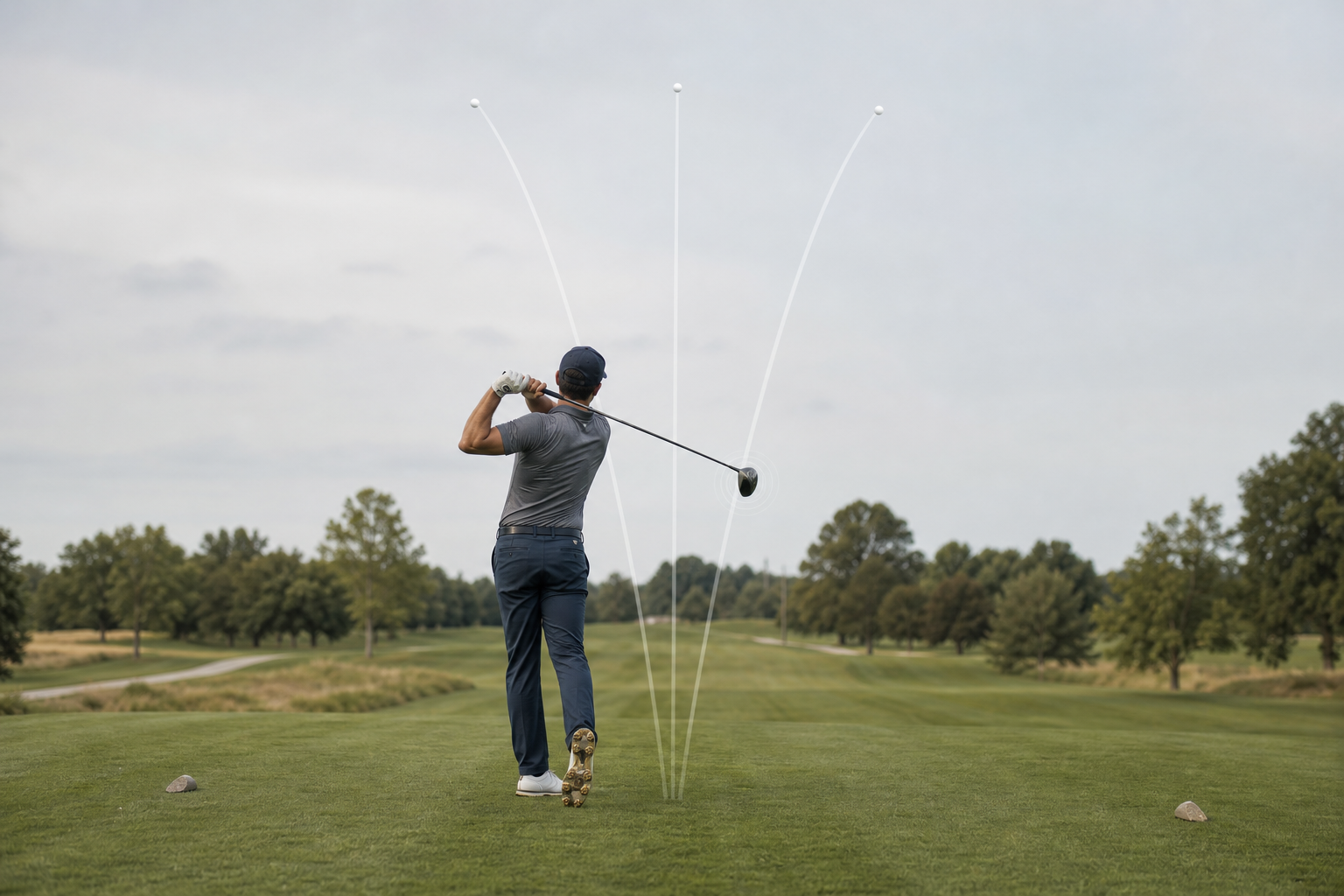
Built for: Golfers whose off-center strikes lose too much speed or curve unpredictably and who need to distinguish forgiveness from swing correction.
When a heel strike leaks right or a toe strike dives left, a high-MOI driver can be an appealing answer. It may be a sensible equipment category to compare, but the useful question is not whether forgiveness is “good”; it is whether your recurring misses are modest enough that a more stable-feeling head and a measured fitting can improve the result without hiding the reason contact keeps moving around the face.
The quick verdict
Consider a high-MOI driver when your strike pattern is broadly playable but scattered around the face, then judge it through measured fitting results rather than a promise of a swing cure.
Best for Golfers who repeatedly find heel, toe, high, or low contact but can identify a reasonably consistent starting line and want to compare how different driver setups handle that pattern.
Skip it if Skip the category-first purchase when your main problem is severe face-to-face contact variation, changing start direction, or a swing issue you expect a clubhead to correct.
The tee-box tension: one bad strike, two possible explanations
You catch one drive on the toe, watch it curve farther than expected, and immediately wonder whether the driver is too punishing. That is a fair equipment question, but it is not automatically an equipment answer. The strike location may be drifting because of setup or delivery, while the curve may also reflect where the clubface and swing path were pointing at impact. A forgiving-driver search is most productive when it starts with the observable pattern: where the ball meets the face, where it starts, and how often that pattern repeats.
Guild recommendation: Before comparing heads, collect nine to twelve ordinary swings and identify broad heel-side, center, or toe-side contact rather than judging the club from a single memorable miss.
What a high-MOI comparison is really asking
For this purchase category, “high MOI” is useful shopper shorthand for a driver designed around stability on off-center impact. That makes it relevant when you routinely miss a small area around the center of the face and want to compare the resulting ball-flight consistency. It does not mean every off-center strike becomes a center strike, and it does not establish that a particular model will suit your delivery. Driver design and conformance are governed by the USGA Equipment Rules, so a buyer should also confirm that any club intended for competition is conforming under the applicable rules.
Guild recommendation: Treat high MOI as one comparison criterion, alongside loft, shaft, length, address comfort, and measured strike and flight results.
Where forgiveness can help
A golfer whose typical strike lives slightly toward the heel may have a different equipment conversation from a golfer whose contact alternates wildly between heel and toe. In the first case, comparing stability-oriented heads may be worthwhile because there is a repeated miss to evaluate. In the second, the range of contact is the more important finding: even a forgiving choice has to contend with dramatically different impact conditions from swing to swing. The practical win is not a label on the sole; it is a tighter and more usable dispersion pattern in measured shots.
Guild recommendation: Bring your dominant miss, typical start direction, and a recent sample of normal drives to a fitting instead of asking only for the “most forgiving” model.
What it cannot fix
A driver cannot decide the target for you, make a changing face delivery consistent, or replace instruction when your goal is to alter how you move the club. If one drive starts far left, the next starts far right, and contact moves all over the face, selecting a high-MOI category alone gives you too little information to isolate the cause. Likewise, a player who needs a different setup, a more reliable tee height, or a better understanding of their ball flight should address those variables rather than repeatedly changing clubheads.
Guild recommendation: Use the practice drill to establish a simple contact record, then seek coaching for movement change and fitting for equipment optimization; the two jobs are complementary.
Fit the pattern, not the marketing term
The PGA of America describes club fitting as evaluating equipment for the individual golfer using measured results. That is especially valuable here because a high-MOI driver is not a single standardized playing result. A fitting can compare candidate setups against your own delivered strike and ball-flight pattern, helping you decide whether the change improves the outcome you care about. Ask to compare more than one head and setup, and define the result in advance: tighter starting lines, more repeatable contact, or a dispersion pattern you can manage on your home course.
Guild recommendation: Choose the option that produces the most useful measured pattern for your normal swing, not the option that produces one exceptional drive.
Try this · 20 minutes.
The Three-Impact Tee Drill
Use a driver, a level practice tee, nine balls, and two spare tees placed on the ground just outside the heel and toe edges of the driver at address; leave enough clearance that the club can swing freely and do not place the tees where they could obstruct the strike.
- Hit three balls with a normal swing while aiming at a conservative target, then note only the general face location of each strike: heel-side, center, or toe-side.
- Move the ball position only a fraction forward or back for the next set of three, keeping your stance, target, and effort level unchanged.
- For the final three balls, return to the ball position that produced the most center-side contact and repeat the same calm swing.
- Record the dominant contact zone and the usual starting direction, rather than trying to manufacture a particular shape or make an in-swing correction.
What progress looks like: The useful result is five or more of nine strikes occurring in the same broad face zone, giving you a clearer pattern to bring to a fitter or instructor.
Put the guide to work
These searches are a starting point—not a substitute for the fit and comparison criteria above.
Compare high-MOI driver categories.
Compare the address shape, adjustability, and shaft options only after you know whether your impact pattern is repeatable enough to evaluate them.
Add simple face-contact feedback.
Impact tape can help distinguish a contact-location pattern from a ball-flight impression before a purchase decision.
Prepare for a fitting session.
Consistent practice tees support a repeatable setup while you gather the strike-pattern information a fitting can measure.
If you buy through these links, Guild of Golf may earn a commission at no extra cost to you.
The practical takeaway
- High-MOI is a useful driver category to compare when your off-center contact follows a recognizable pattern.
- Forgiveness may help manage a repeated miss, but it does not replace work on inconsistent setup or delivery.
- A simple strike-pattern record makes a fitting conversation more productive than a search based on one bad drive.
- Measured individual results are the appropriate basis for deciding whether a driver setup fits you.
Frequently asked questions
Should I buy a high-MOI driver if I slice the ball?
Only if your strike pattern and measured results indicate it improves your usable dispersion. A slice describes ball flight, not a complete explanation of why it occurs, so do not assume a stability-oriented head alone will change it.
Can impact tape tell me which driver to buy?
Impact tape can show a broad contact pattern, which is useful context. It does not replace a fitting that evaluates equipment for you with measured results.
Is a high-MOI driver automatically legal for competition?
Driver design and conformance are governed by the USGA Equipment Rules. Confirm the conforming status of the specific club under the rules that apply to your competition.
What should I ask for in a driver fitting?
Ask to compare candidate setups using your normal swing and to review the measured result that matters most to you, such as contact consistency, starting line, or usable dispersion.
Sources used for this draft
- USGA Equipment Rules — Driver design and conformance are governed by the equipment rules.
- PGA of America: Club Fitting — A fitting evaluates equipment for the individual golfer using measured results.
Guild of Golf may earn a commission from qualifying purchases made through affiliated shopping links, at no additional cost to the reader.