
evergreen guide
Choose a Home Launch Monitor That Makes Practice More Useful
A practical framework for deciding whether a personal launch monitor supports purposeful home practice rather than adding more numbers to every shot.
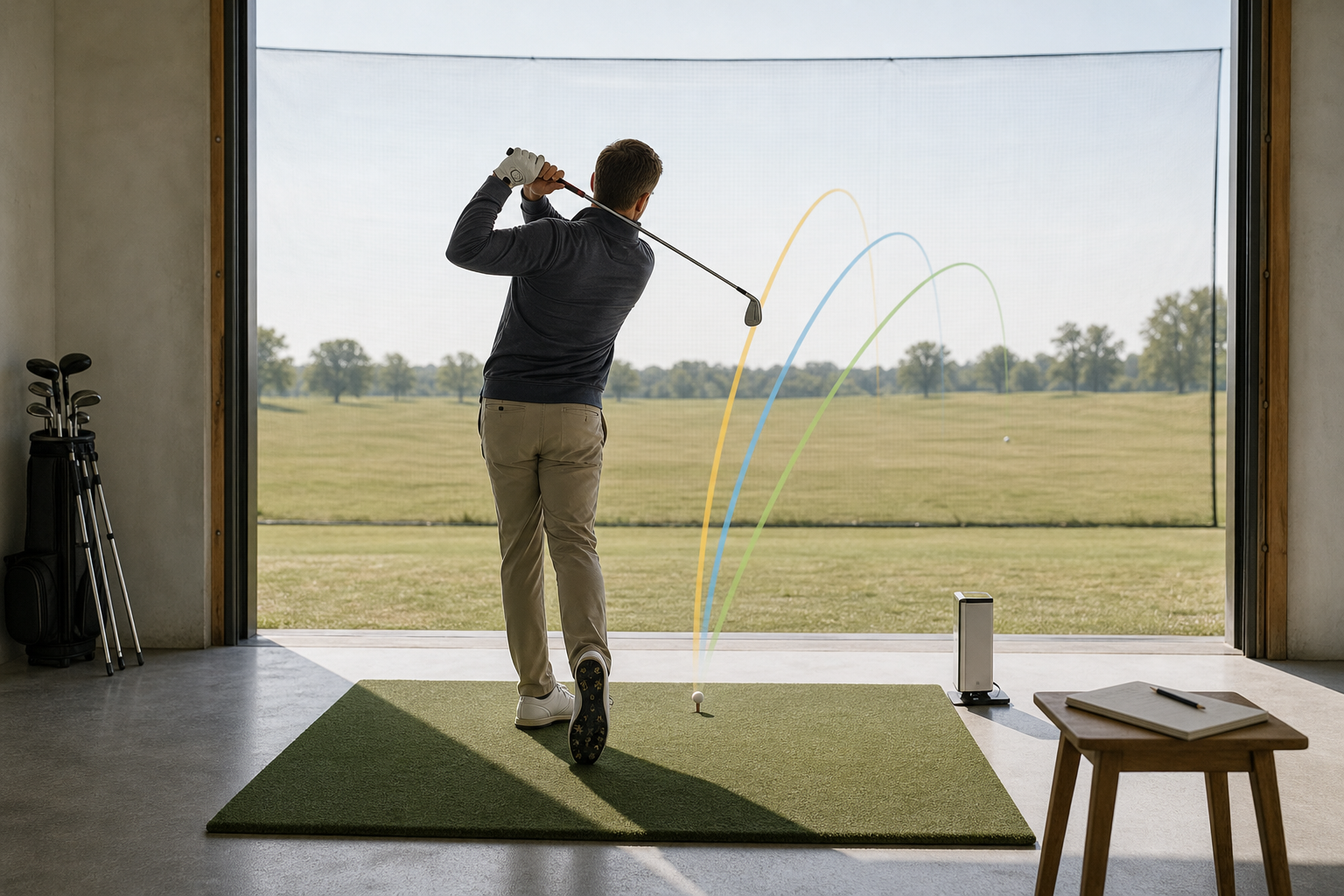
Built for: Golfers deciding whether a personal launch monitor provides the measurements and setup their practice actually needs.
The frustrating home-practice trap is hitting ball after ball, watching a screen or a number change, and still not knowing what improved. Start with the shot question you want to answer, then judge a launch monitor by whether its reported measurements, feedback routine, and physical setup make that question easier to test.
The quick verdict
A personal launch monitor is worth considering when it gives you a repeatable way to measure one defined practice outcome in the space you can use safely. The better choice is not necessarily the one that promises the most information; it is the one whose feedback you can understand, record, and use to make a next-shot decision.
Best for Golfers with a stable home setup who want measurable structure for a specific task, such as producing a more consistent starting pattern or carrying a chosen target distance.
Skip it if Skip or postpone the purchase if you do not have a safe hitting arrangement, cannot establish a repeatable setup, or do not yet know what result you want to measure during practice.
Begin with the shot decision, not the device
A launch monitor becomes useful when it settles a question that your eyes alone cannot settle reliably. Imagine a golfer working on a 100-yard target in a garage bay. The productive question is not, “What did every number do?” It is, “Did my last nine shots produce a repeatable result for the target distance I chose?” A golfer preparing for a round might instead use a monitor to organize a short session around a selected club and target. In each case, the measurement must connect to a decision for the next shot or the next practice session. Purposeful practice needs a defined purpose and measurable structure, as the PGA of America emphasizes in its guidance. Before comparing products, write down one primary task, the result you want to observe, and what you would do differently if that result changed.
Guild recommendation: Make a one-line buying brief: “I want to use this in [location] to track [one result] while practicing [specific shot task].” If you cannot complete that sentence, clarify the practice goal before shopping.
Judge the measurement by its usefulness to your routine
Do not reward a measurement simply because it sounds precise or technical. Ask whether you will understand what a change in that reported result means for the task at hand. For a golfer trying to make a target-distance session more structured, a repeatable distance-related result may be useful because it can be logged in groups. For a golfer working on where shots begin relative to a target, a direction-related result may be more useful. The key constraint is attention: if a device presents more information than you can connect to a practical choice, it can turn practice into score-watching. Keep the first month simple. Track one primary outcome, and add a second only when you can explain how both guide your next drill or target selection.
Guild recommendation: During a demonstration, trial, or product review, identify the exact result you would record after each shot. If you would not write it down or act on it, do not make it a deciding feature.
Treat the hitting area as part of the purchase
The most appealing device cannot compensate for a practice environment that is unsafe, cramped, or inconsistent. Your decision should account for the full arrangement: where you stand, where the ball sits, where the device sits, where the ball travels, and how you protect people and property. A home golfer who must move furniture, change ball position, or guess at device placement each session may spend more time rebuilding the setup than practicing. That matters because the same measurement is more useful when the setup is repeatable. Consider the normal use case rather than an idealized one. A golfer with a permanent net bay has different needs from a golfer who practices briefly in a shared space or plans to use the device outdoors.
Guild recommendation: Map the entire hitting arrangement before buying. Choose only an option whose placement and safety requirements fit the space you can use consistently, not the space you hope to create someday.
Ask for evidence that supports the claims you rely on
Product language can make any feature sound decisive. Focus instead on the claims that matter to your stated practice task, and look for clear support from the seller or manufacturer before treating those claims as a reason to buy. The Federal Trade Commission says objective advertising claims should have a reasonable basis. Applied here, that means separating a broad promise from the practical question you need answered: what does the product report, under what home-practice conditions, and how will that reported result shape your next shot? Be especially careful when a purchase decision rests on a claim about measurement, compatibility, or intended setup. If the evidence is unclear, do not fill the gap with assumptions.
Guild recommendation: Keep a short comparison sheet with three columns: the claim, the source supporting it, and the practice decision it would enable. Leave a claim out of your buying decision when you cannot complete all three columns.
Build a feedback loop before adding complexity
The useful purchase is the one that fits a repeatable loop: choose a target, hit a small group, record the selected result, review the pattern, and make one modest next decision. That loop protects you from a familiar trap: reacting to every shot with a new adjustment. A golfer practicing after work may have only 20 minutes. In that window, nine intentional shots with a written result can be more informative than a long session with no target and no record. It also makes future practice comparable. You can return to the same target and question without pretending that one isolated session proves a lasting change.
Guild recommendation: Use the same simple nine-shot format for several sessions before expanding the data you track. Buy for the feedback loop you will actually repeat.
Choose for your constraints, then reassess the value
Home launch-monitor value is practical, not abstract. It depends on whether you have time to set it up, enough space to use it safely, a clear reason to consult its feedback, and a record that makes later sessions more useful. A golfer whose main obstacle is an inconsistent practice schedule may benefit more from a fast, low-friction routine than from a complex information set. A golfer who enjoys detailed logging may reasonably value deeper feedback, provided each added result serves a defined question. Neither approach is automatically better. The better fit is the one that turns available practice time into observable learning rather than another equipment decision to manage.
Guild recommendation: After four structured sessions, reassess with one question: “Did this setup help me make clearer practice decisions?” Continue only if the answer is supported by your notes, not by novelty.
Try this · 15 minutes.
The One-Question, Nine-Shot Check
Use a safe, permitted hitting area with your usual ball, club, target line, and launch-monitor position. Choose one observable question before beginning, such as whether your shots are producing a similar reported carry result or a similar reported start direction. Do not change the question during the set.
- Hit three shots with your normal routine and write down only the one measurement that answers your chosen question.
- Pause and review the three results without trying to explain your swing. Mark the result range or pattern you see.
- Choose one modest, non-technical intention for the next three shots, such as aiming at the same target or completing the same pre-shot routine. Hit three more shots and record the same measurement.
- Repeat the same intention for a final three shots. Compare the three groups by their consistency and by whether the result moved toward the outcome you selected.
- End by writing one next-session decision, such as keeping the same setup, checking alignment more carefully, or choosing a different target distance.
What progress looks like: The session succeeds when you can state, in one sentence, whether the final group was more repeatable for your chosen measurement than the first group.
Put the guide to work
These searches are a starting point—not a substitute for the fit and comparison criteria above.
Compare setup-oriented options
Use this search after you have measured your available space and listed the setup conditions you can repeat every session.
Compare feedback and record keeping
Use this search after you have chosen the one or two results you want to track across practice sessions.
Compare portable practice use
Use this search if you expect to move between a home bay and an outdoor practice area, and need a routine that remains practical in both places.
If you buy through these links, Guild of Golf may earn a commission at no extra cost to you.
The practical takeaway
- Define the practice question before comparing launch monitors, because useful feedback must lead to a next-shot or next-session decision.
- Prioritize measurements you can record and interpret over a larger set of numbers you will not use.
- Evaluate the complete home arrangement, including safe ball travel and repeatable device placement, rather than the device in isolation.
- Use small shot groups and a written record to give monitor feedback measurable structure.
- Rely on supported product claims that matter to your setup and practice goal.
Frequently asked questions
What should I decide before buying a home launch monitor?
Decide where you will practice, whether the full arrangement is safe and repeatable, the shot task you want to practice, and the one result you want the monitor to help you observe. Those answers turn a feature list into a practical comparison.
How many measurements should I track in home practice?
Start with one measurement that directly answers your chosen shot question. Add another only when you can explain how it changes your target, routine, or next practice decision.
Can a launch monitor replace purposeful practice?
No. The monitor can provide feedback, but the practice still needs a defined purpose, a measurable structure, and a plan for what you will do with the result.
How can I avoid chasing numbers during a session?
Choose the measurement and success condition before the first ball, use small groups such as three shots, and review the group pattern rather than reacting to every individual result.
What product claims deserve the closest scrutiny?
Scrutinize claims that are central to your decision, including what the product reports, how it fits your intended practice environment, and whether it supports the feedback routine you plan to use. Seek clear supporting information rather than relying on broad promotional language.
Sources used for this draft
- PGA of America: Practice With Purpose — The recommendation that practice should have a defined purpose and measurable structure.
- FTC Advertising and Marketing Basics — The recommendation to seek support for objective product claims used in a buying decision.
Guild of Golf may earn a commission from qualifying purchases made through shopping links, at no additional cost to you.