
comparison
Putting Mirror vs. Putting Mat: Choose the Feedback Your Stroke Needs
A putting mirror and a putting mat solve different home-practice problems: one makes setup visible, while the other makes the ball’s start and travel easier to observe.
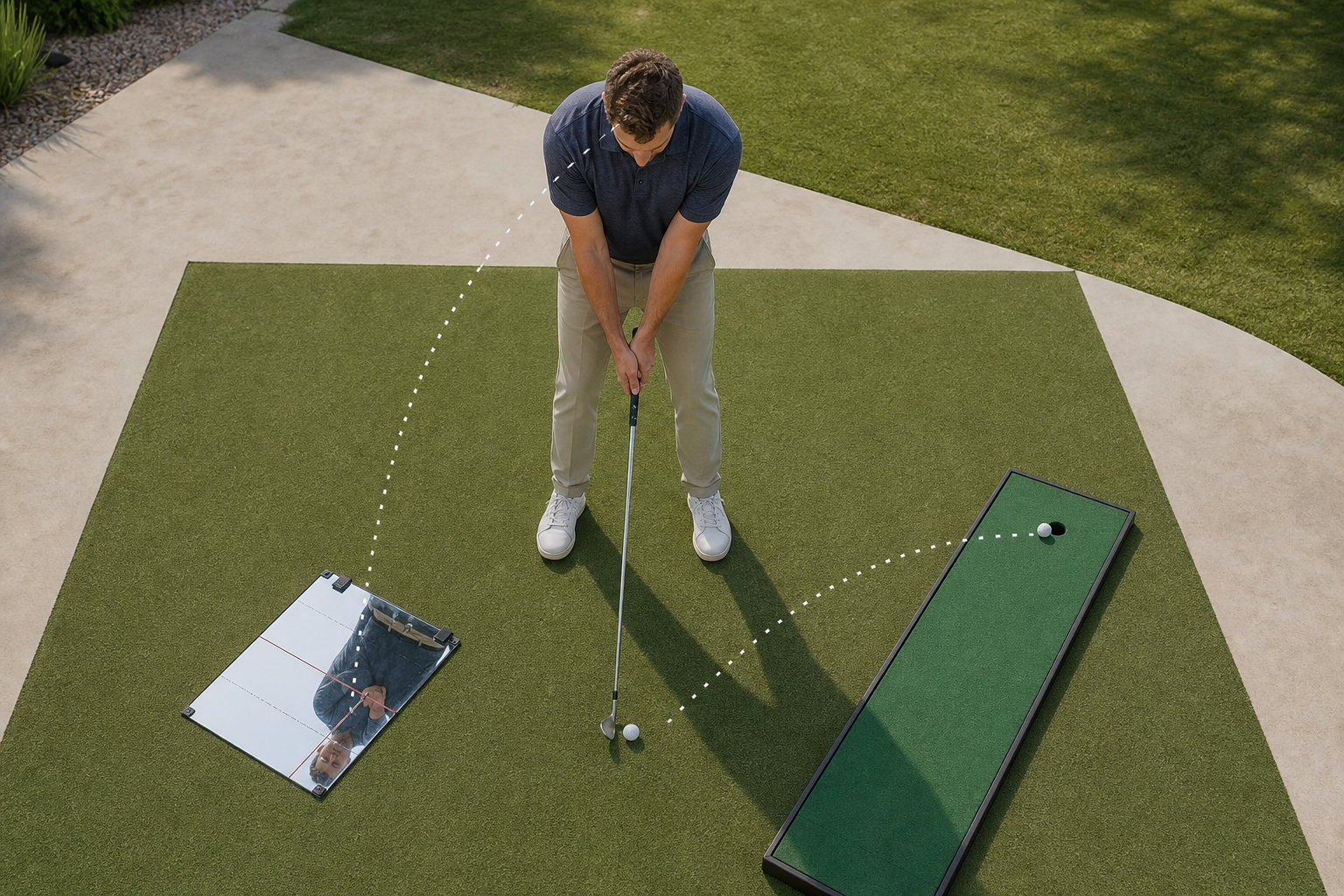
Built for: Golfers choosing one practice aid and deciding whether they need setup feedback or ball-roll feedback.
When a six-footer misses at home, it is tempting to buy the aid that looks most complete. Start with the question the miss leaves unanswered: do you need to see how you are addressing the ball, or do you need a clearer result from the ball itself?
The quick verdict
Choose a putting mirror when you want repeatable visual checks at address; choose a putting mat when you need a dedicated place to rehearse starts, pace, and short-putt routines. If you can buy only one, pick the aid that answers the uncertainty you actually have during practice.
Best for A mirror is best for golfers who want to notice a changing setup before the stroke. A mat is best for golfers who struggle to create a consistent, purposeful home putting session without a defined target and surface.
Skip it if Skip a mirror if you already set up consistently and rarely use visual checkpoints. Skip a mat if space is tight or if you are likely to roll balls without a target, a distance, or a way to judge the result.
The missed putt tells you which tool to buy
Picture a golfer who misses four short putts in the living room. If each miss begins in a different direction and the golfer cannot tell whether the ball position, eye position, or clubface presentation looked the same at address, a mirror offers the more direct question: did the pre-stroke picture repeat? If the golfer is comfortable with the address but has no clear target, no consistent distance, and no routine for observing the ball’s travel, a mat creates the more useful task: roll the ball to a specific place and record what happened. Purposeful practice starts with a defined purpose and structure, not simply with more putts.
Guild recommendation: Buy the mirror for uncertainty before the stroke; buy the mat for uncertainty revealed by the ball after the stroke.
A mirror is a setup-feedback station
A putting mirror is most valuable when used briefly and specifically. It gives the golfer a visible reference at address, which can make a chosen checkpoint easier to repeat from putt to putt. That is useful for the player who tends to make several pre-putt changes, then has no idea which version produced the result. The tradeoff is that a mirror does not automatically make practice purposeful. Without a target, a stated checkpoint, and a small number of repetitions, it can turn into prolonged staring at setup rather than putting.
Guild recommendation: Choose a mirror if your home sessions are derailed by uncertainty about what you looked like before the stroke, and limit each session to one observable address checkpoint.
A mat is a ball-roll and routine station
A putting mat gives a golfer a dedicated surface on which to set a target, repeat a distance, and observe whether the ball starts near the intended line and finishes near the intended destination. That makes it a practical choice for the golfer who otherwise drops balls on carpet without a consistent task. Its limitation is equally important: a mat can show a result without explaining the cause. A putt that misses the target may prompt a useful observation, but the mat alone does not identify whether the golfer should change setup, stroke motion, or simply the next practice objective.
Guild recommendation: Choose a mat if you need a repeatable home routine built around a target and an observable ball-roll result, not a promise that the surface will diagnose a miss.
Do not confuse an indoor result with a course answer
Home practice can sharpen attention and repetition, but it should not be treated as a substitute for reading a putting green. Rule 13 provides the rules context for putting greens and lines of play. In practical terms, keep the jobs separate: use the mirror or mat to rehearse a simple, repeatable process at home, then use time on the course to respond to the line and conditions in front of you. A golfer who practices this distinction is less likely to expect one indoor station to solve every putting decision.
Guild recommendation: Use home practice to make your process clearer, then reserve green reading and on-course decisions for the putting green.
The one-aid decision is usually a space-and-behavior decision
A mirror can be the better purchase in a small apartment because it supports a compact setup check. A mat can be the better purchase in a spare room because the permanent target encourages a short daily routine. Be honest about behavior, not aspiration. If you will use a mat only when you have time for a long session, but will make six intentional setup rehearsals beside a mirror most evenings, the mirror is the practical choice. If visual setup checks tend to absorb your attention while you avoid rolling putts to a target, the mat imposes the better constraint.
Guild recommendation: Choose the aid that fits both your available floor space and the short practice behavior you will genuinely repeat.
Try this · 12 minutes
The Two-Question Home Putting Check
Set up a ball and a small target or cup substitute on a clear, level indoor surface. If using a mirror, place it beneath the ball according to its own instructions. If using a mat, use its target or place a small target at a short, repeatable distance. Have three coins or markers available.
- Spend two minutes making five rehearsal addresses without hitting a ball. With a mirror, note one repeatable visual checkpoint you can see at address; without a mirror, use a coin to mark a consistent ball position and return to it each time.
- Roll nine putts in three groups of three from the same spot. Before each group, state one purpose: return to the same setup mark, start the ball toward the target, or finish with a controlled pace.
- After each group, place a marker beside the starting position and write down only two observations: how many balls began near the intended line and how many finished at or near the target.
- For the final three putts, keep the same one-purpose cue that produced the clearest result rather than adding a new adjustment.
What progress looks like: The session is successful when you can name one setup checkpoint or one ball-roll outcome that stayed more repeatable across the final three putts.
Put the guide to work
These searches are a starting point—not a substitute for the fit and comparison criteria above.
Compare mirrors for address feedback
Look for a layout that lets you return to the same ball position and visual checkpoint without crowding your normal address.
Compare mats for repeatable roll practice
Prioritize a usable target and a length that fits the space where you will actually practice, so each putt has a defined outcome.
Compare compact home setups
Use this search only if you have limited room and need to compare whether a small feedback station is more realistic than a longer roll-out surface.
If you buy through these links, Guild of Golf may earn a commission at no extra cost to you.
The practical takeaway
- A putting mirror is primarily a way to make a chosen address checkpoint visible.
- A putting mat is primarily a way to give ball roll a repeatable surface, distance, and target.
- Neither aid diagnoses every reason for a missed putt, so define one observable purpose before starting.
- A useful home session ends with a repeatable observation, not a pile of uncounted putts.
- Practice structure matters more than owning both aids.
Frequently asked questions
Should I buy a putting mirror or mat first?
Buy a mirror first when your main uncertainty is setup at address. Buy a mat first when you need a reliable place to roll putts toward a target and build a short routine.
Can a putting mat tell me why I missed?
No. It can make the ball-roll outcome easier to observe, but it does not by itself identify the cause of a miss. Use the result to choose a narrower practice question rather than making several changes at once.
Can I practice putting purposefully without both tools?
Yes. A ball, a clear starting position, a small target, and one stated purpose can create a useful session. The mirror or mat is worthwhile when it makes the feedback you need easier to see and repeat.
How long should a home putting session last?
A short session with a defined purpose can be useful. The 12-minute plan above is enough time to observe a setup checkpoint or ball-roll pattern without turning the session into unfocused repetition.
Sources used for this draft
- PGA of America: Practice With Purpose — The recommendation to give practice a defined purpose and structure.
- USGA Rule 13: Putting Greens — The rules context for putting greens and lines of play.
Guild of Golf may earn a commission from qualifying purchases made through affiliate links, at no additional cost to the buyer.