
comparison
Putting Mirror vs. Putting Mat: Choose the Feedback You Need at Home
A putting mirror and a putting mat solve different practice problems, so the better one is the aid that answers the question holding back your next session.
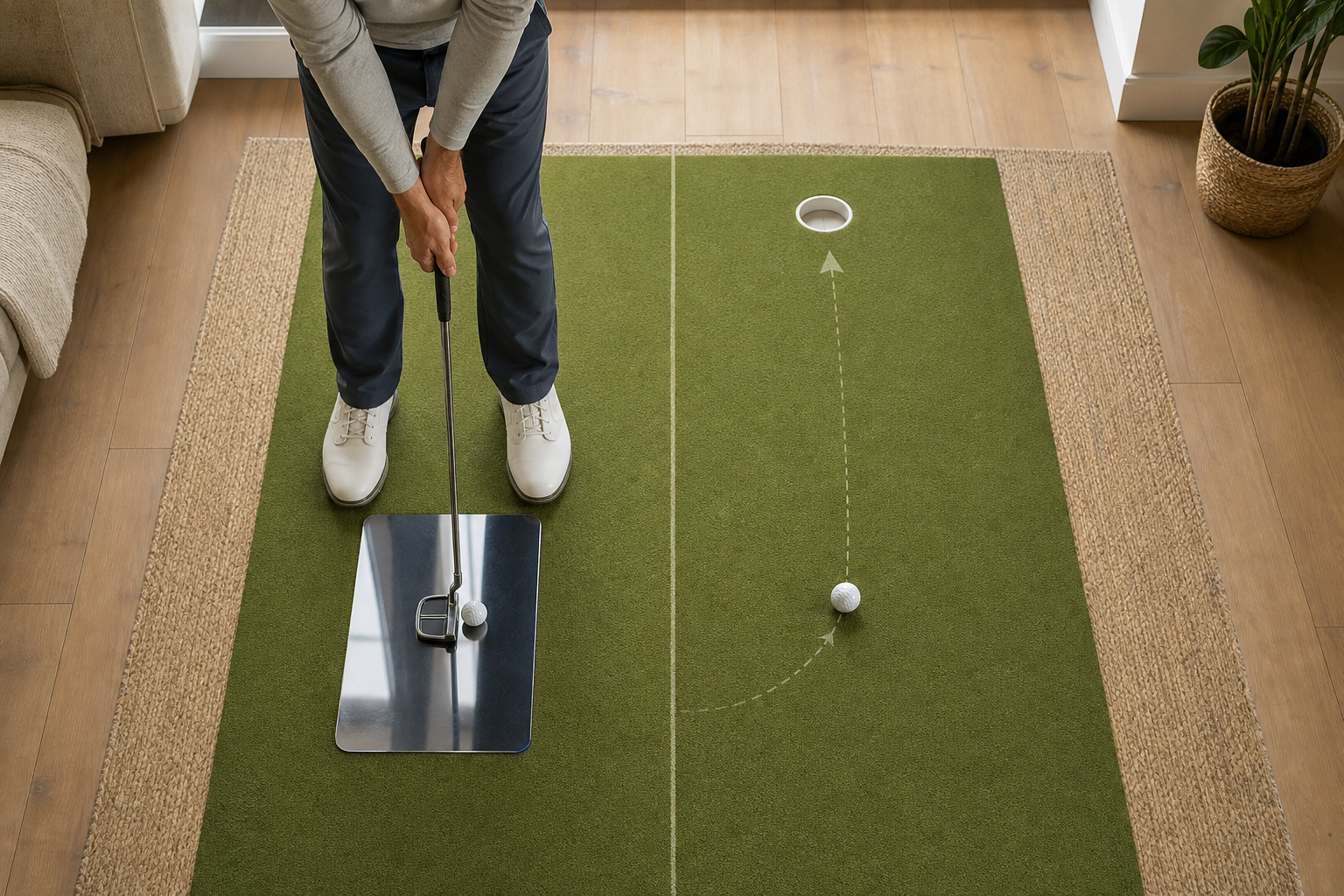
Built for: Golfers choosing one home practice aid and deciding whether they need setup feedback or ball-roll feedback.
When a short putt misses at home, it is tempting to buy the aid that looks most complete. A mirror is the cleaner choice when you need a repeatable starting picture; a mat is the better choice when you need a visible task for each ball to complete.
The quick verdict
Choose a putting mirror when your priority is repeating a deliberate address and start routine. Choose a putting mat when you will practice more consistently by rolling balls toward a defined target and recording the result.
Best for A mirror best suits golfers who want setup feedback before they hit the putt, while a mat best suits golfers who want ball-roll feedback after they hit it.
Skip it if Skip the mirror if you mainly need a target-based rolling task, and skip the mat if its target distracts you from establishing the same pre-putt picture each time.
Begin with the miss you are trying to make less likely.
Picture the familiar hallway session: three putts slide past a cup or target, and the golfer immediately changes grip pressure, backswing length, and aim. That is activity, not a useful answer. The first decision is whether you need information before the ball is struck or after it starts rolling. The PGA of America recommends practice with a defined purpose and structure, which makes that question more valuable than a long feature list (https://www.pga.com/story/practice-with-purpose-to-improve-your-game).
Guild recommendation: Buy the aid that makes one repeatable question visible during your normal home practice window.
A putting mirror is a pre-stroke reference.
Use a mirror when the productive part of practice is pausing over the ball and comparing your current address picture with the picture you want to repeat. Its value is not in staring at it for ten minutes. Its value is a short routine: step in, establish the same picture, look to the target, and roll a ball. For the golfer who often feels different over every four-footer, that kind of reference can make a session more deliberate.
Guild recommendation: Choose a mirror if you want to evaluate your setup routine before each putt and are willing to pair it with a simple target or gate for a result.
A putting mat is a post-stroke task.
A mat puts the emphasis on the ball’s job: start through a gate, travel toward a target, and finish in a chosen area. That can be especially useful for the golfer who loses interest in static setup checks but will stay engaged by a ten-ball score. A mat does not automatically explain why a ball missed. It gives you a consistent task, and your record of the result tells you whether that task was completed.
Guild recommendation: Choose a mat if a visible target and repeatable rolling challenge will help you practice often enough to collect useful outcomes.
Do not confuse a target with a diagnosis.
A ball that misses a target gives feedback about that attempt, but it does not by itself identify one cause. Keep the response modest: hold the same distance and target for a small set of balls, count the outcome, then decide what to practice next time. This protects you from rebuilding a motion after a single miss. It also follows the purpose-and-structure approach described by the PGA of America (https://www.pga.com/story/practice-with-purpose-to-improve-your-game).
Guild recommendation: Use a ten-ball record and change only one practice question in the next session.
Let home practice support your on-course attention.
The Rules of Golf give putting greens and lines of play their own context under Rule 13 (https://www.usga.org/rules/rules-and-clarifications/rules-of-golf/rule-13.html). A home aid is not a substitute for reading an actual green, but it can help you arrive on the course with a simpler process. The useful carryover is not trying to reproduce your living-room surface outdoors. It is being able to settle into a familiar setup or commit to a clearly chosen start line when the putt matters.
Guild recommendation: After any home session, carry one cue to the course, such as repeating your address routine or choosing a precise starting point, rather than carrying a list of mechanics.
Try this · 15 minutes.
The One-Question, Ten-Ball Putting Session
Choose a clear, level indoor area and one short putting distance that you can repeat. Use either a mirror with a small target beyond it or a mat with its intended target. Place two small objects just wider than a ball a short distance in front of the starting spot to create a simple start-line gate, and keep the walking path clear.
- Write one question for the session: “Can I create the same starting picture?” with a mirror, or “Can I start the ball through the gate toward the target?” with a mat.
- Hit five balls one at a time. Before each mirror rep, pause briefly in the address position and notice whether the picture matches the one you intend to repeat. Before each mat rep, identify the gate and target before starting the stroke.
- Mark only two observations after each ball: whether it passed through the gate and whether it reached the target area. Do not change several things between balls.
- Take a short break, then hit five more balls with the same question, distance, and target. Finish by recording the total that passed through the gate and reached the target area.
What progress looks like: The session is successful when you can state one measurable result, such as how many of 10 balls cleared the gate and finished in the target area, rather than relying on a vague sense that the stroke felt better.
Put the guide to work
These searches are a starting point—not a substitute for the fit and comparison criteria above.
Compare reflective setup aids.
Compare the usable hitting area, the clarity of the setup reference, and whether you can create a simple target and gate beyond the aid.
Compare target-based home surfaces.
Compare the available putting distance, whether the target gives you a repeatable finish area, and whether the surface fits the room where you will actually practice.
Compare a simple start-line gate.
A gate gives either choice an observable first part of the ball’s journey, which helps turn repetitions into a countable practice task.
If you buy through these links, Guild of Golf may earn a commission at no extra cost to you.
The practical takeaway
- A putting mirror is most useful when your practice question is about repeating a deliberate setup picture.
- A putting mat is most useful when your practice question is about producing and recording a ball-roll outcome.
- Neither aid diagnoses a miss on its own; a fixed distance, a simple gate, and a ten-ball record create more useful feedback.
- Choose the aid you will set up in your actual practice space and use with one clear purpose.
Frequently asked questions
Should I buy a putting mirror or mat first?
Buy a mirror first if you want a repeatable pre-stroke reference. Buy a mat first if a target-based rolling task is more likely to keep you practicing and recording outcomes.
Can I use a putting mirror without a mat?
Yes. Give the mirror session a defined ball-roll task by placing a small target beyond it and using a simple gate near the ball. The mirror supplies the setup reference, while the target gives the putt a measurable outcome.
Can a putting mat tell me why I missed?
No. It can show whether the ball completed the task you set, such as passing through a gate and reaching a target area. Treat that result as information for the next practice question, not as a diagnosis.
How should I keep home putting practice purposeful?
Use one distance, one target, and one question for a short set of balls. This reflects the PGA of America guidance that practice is more useful when it has defined purpose and structure (https://www.pga.com/story/practice-with-purpose-to-improve-your-game).
Sources used for this draft
- USGA Rule 13: Putting Greens — Provides rules context for putting greens and lines of play.
- PGA of America: Practice With Purpose — Supports using defined purpose and structure in practice.
Guild of Golf may earn a commission from qualifying purchases made through its shopping links, at no additional cost to the reader.