
comparison
Putting Mirror vs. Putting Mat: Choose the Feedback Your Home Practice Needs
A putting mirror and a putting mat solve different home-practice problems: one makes your chosen setup easier to repeat, while the other makes the ball’s start and pace easier to observe.
Built for: Golfers choosing one practice aid and deciding whether they need setup feedback or ball-roll feedback.
When a six-foot putt misses at home, it is tempting to buy the aid that looks most complete. The better decision is narrower: choose a mirror when you need to make one address routine more repeatable, or choose a mat when you need a clear target and a repeatable place to watch how the ball starts and finishes.
The quick verdict
Buy a putting mirror if your main goal is to rehearse a consistent setup before each putt; buy a putting mat if your main goal is to give your stroke a dedicated target-and-roll practice space. If you can buy only one, let the feedback you will actually record decide rather than trying to solve every putting question at once.
Best for A mirror is best for golfers who regularly feel uncertain at address and want a simple pre-putt checkpoint. A mat is best for golfers who will practice short putts often and want an obvious route from ball to target.
Skip it if Skip a mirror if you are unlikely to pause and check a preset setup routine. Skip a mat if limited floor space means it will stay rolled up, or if you expect any home surface to duplicate the changing conditions of an on-course green.
Begin with the miss that frustrates you most
Picture two familiar home sessions. In the first, you stand over the ball and keep shuffling your feet or re-aiming the putter because the address position never feels settled. In the second, your setup feels acceptable, but you have no clear way to tell whether a ball began on your intended route or stopped with the pace you planned. Those are different practice problems, so they deserve different tools. Purposeful practice starts by defining the job of the session rather than collecting more tasks, a principle emphasized by the PGA of America in its guidance on practicing with purpose: https://www.pga.com/story/practice-with-purpose-to-improve-your-game.
Guild recommendation: Choose the aid that gives you feedback on the problem you can state in one sentence before you begin.
What a putting mirror is for
A mirror is an address-rehearsal tool. Its value is not that it supplies a universal putting position; its value is that it allows you to select a simple visual checkpoint and return to it from putt to putt. For example, a golfer who rushes into a three-footer can use the reflective surface to pause, settle into the same intended picture, and then make the stroke. That creates a defined routine rather than an endless sequence of adjustments. The tradeoff is that a mirror asks for attention before the ball moves. If you only want to roll putts after work, its feedback can be more deliberate than you will use.
Guild recommendation: Pick a mirror when repeatable address discipline is the missing piece in your current home routine.
What a putting mat is for
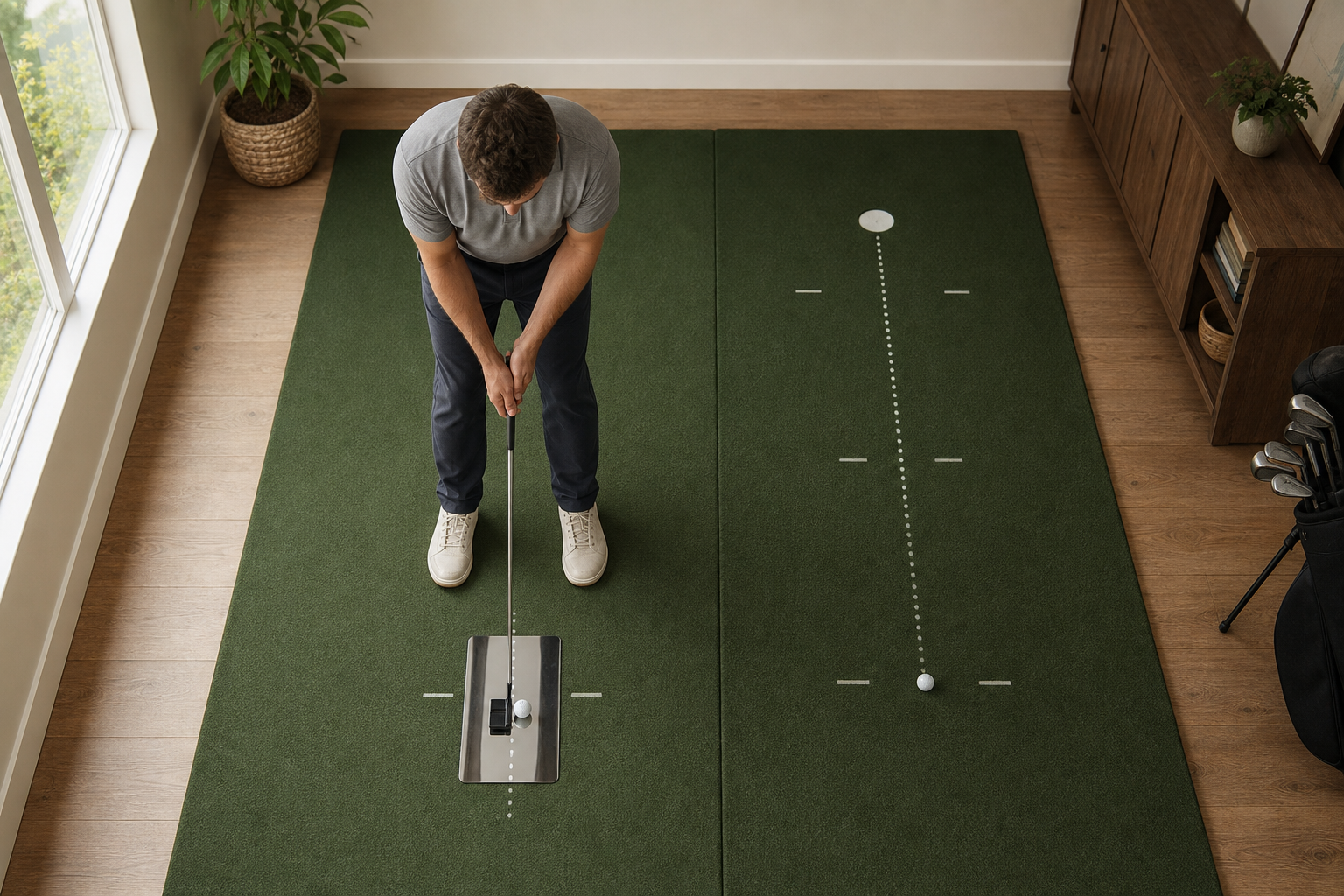
A mat creates a dedicated lane for rolling putts toward a target or finishing area. Its practical advantage is convenience: ball, route, and destination are already organized in one place. That is useful for a golfer who will gain more from making ten intentional short-putt attempts than from spending the same time rebuilding a setup position. The tradeoff is that a mat does not tell you what visual setup cue to adopt. It can show the outcome you chose to watch, but you still need to arrive at the ball with a simple plan. It also should not be treated as a replacement for the changing lie, pace, and line context encountered on a putting green. Rule 13 provides the rules context for putting greens and lines of play: https://www.usga.org/rules/rules-and-clarifications/rules-of-golf/rule-13.html.
Guild recommendation: Pick a mat when a permanent or easy-to-unroll practice lane will make frequent, target-based repetitions more likely.
Do not ask one purchase to do both jobs
The common buying error is expecting a mirror to create better ball-roll observation or expecting a mat to settle an uncertain address routine. Either product can be part of a broader practice station, but choosing one means accepting a useful constraint. A mirror turns your session into, “Can I arrive at the ball in my intended picture?” A mat turns it into, “Can I send this ball to this defined place?” Both questions are worthwhile. The stronger first purchase is the one that removes the biggest source of indecision from the practice you will actually do.
Guild recommendation: Before shopping, complete the practice plan once with a makeshift target and note whether setup confirmation or ball-to-target feedback held your attention better.
Make home work transfer through structure, not imitation
Home practice does not need to pretend it is the course. A useful session can be smaller: choose a distance, one target, one cue, and a countable outcome. On the course, putting takes place under the rules and context of the putting green, including the line-of-play considerations addressed in Rule 13. At home, use the simplified environment to rehearse a decision you can carry with you, such as taking one settled look at address or committing to one intended finish area. That is a more realistic bridge than assuming a product can reproduce every on-course variable.
Guild recommendation: End each home session by writing one course-ready intention, such as, “I will use one settled address look before short putts.”
Try this · 12 minutes.
The One-Variable Home Putting Check
Use either aid on a clear, stable indoor floor. Set a ball at a repeatable starting spot and choose a small target or finishing area about four to six feet away. With a mirror, select one simple address cue you can see, such as your intended face-to-target relationship; with a mat, select one finishing area and one pace intention. Keep the same cue for the entire session.
- Hit three practice putts without scoring them, simply to establish the distance and the target.
- Hit eight putts one at a time. Before each stroke, use the mirror to confirm the same chosen address cue, or use the mat to aim at the same finishing area.
- After every putt, record only one result: whether you completed your chosen cue before starting, or whether the ball finished in the chosen area. Do not add a second correction mid-session.
- Take a short break, then hit four more putts using exactly the same single cue and target.
- Write down which feedback was easier for you to use consistently: the address checkpoint or the ball-to-target result.
What progress looks like: The session is useful when you can name one cue, apply it before every putt, and produce a simple count from the same target and distance without changing your task.
Put the guide to work
These searches are a starting point—not a substitute for the fit and comparison criteria above.
Compare reflective setup aids.
Look for a size and format that lets you see your chosen address checkpoint without turning setup into a long inspection.
Compare dedicated home roll surfaces.
Look for a length that fits the space where it will remain accessible and a target presentation that makes your intended finish easy to judge.
If you buy through these links, Guild of Golf may earn a commission at no extra cost to you.
The practical takeaway
- A putting mirror is primarily a repeatable setup-feedback choice, while a putting mat is primarily a target-and-roll-feedback choice.
- A single cue and a countable result make either aid more useful than unfocused repetition.
- Buy for the home routine you will maintain: deliberate address checks favor a mirror, while frequent target practice favors a mat.
- Neither aid needs to replicate every condition of a putting green to support a purposeful practice session.
Frequently asked questions
Should I buy a putting mirror or mat first?
Buy a mirror first if your home practice usually stalls because you cannot settle into a consistent address routine. Buy a mat first if a ready-made target lane will get you rolling purposeful putts more often.
Can a putting mirror help with ball roll?
It can support a consistent pre-putt routine, but its direct feedback is the visual address checkpoint you choose. Use a separate target or finishing area if you also want to record ball-to-target outcomes.
Can a putting mat replace practice on a putting green?
No. A mat can provide a convenient home target-and-roll task, while on-course putting includes the rules and line-of-play context of the putting green described in USGA Rule 13.
What should I measure during home putting practice?
Measure one result that matches your purpose, such as completing the same address cue before each putt or finishing balls in a chosen target area. Keeping the measure narrow makes it easier to learn from the session.
Sources used for this draft
- PGA of America: Practice With Purpose — The recommendation to give each practice session a defined purpose, structure, and observable task.
- USGA Rule 13: Putting Greens — The rules context for putting greens and lines of play, and the distinction between home practice and on-course putting context.
Guild of Golf may earn a commission from qualifying purchases made through affiliate links, at no extra cost to the reader.