
evergreen guide
How to Choose a Home Launch Monitor for Practice That Transfers
A practical framework for deciding whether a personal launch monitor can give your home sessions a clear purpose, a measurable target, and a repeatable setup.
Built for: Golfers deciding whether a personal launch monitor provides the measurements and setup their practice actually needs.
The wrong question is not “Which monitor is best?” but “What decision will this number help me make before the next shot?” Start with the practice task, then judge whether the device, space, and feedback loop can support it.
The quick verdict
A personal launch monitor is worth evaluating when it turns a specific home-practice goal into a repeatable measurement and a clear next-shot decision, rather than merely adding more numbers to the session.
Best for It is best for golfers who can name a recurring practice task, can create a consistent hitting setup, and will use a small set of measurements to judge progress over several sessions.
Skip it if Skip or delay the purchase if your available space prevents a repeatable setup, if you cannot identify what you would change from the feedback, or if you mainly want reassurance after random swings.
Begin with the shot you keep failing to understand.
Picture the familiar garage session: a few balls strike the net cleanly, a few do not, and every swing feels like a new experiment. A launch monitor can make that session more informative, but only if it helps answer a question you already have. Start with an on-course pattern: approach shots that finish short, tee shots that start away from your intended line, or a distance window you struggle to manage. Then state the practice question in plain language. “Can I produce a more repeatable result with this club from this setup?” is useful. “Will this fix my swing?” is too broad for a device or a single session.
Guild recommendation: Before comparing models, write down one shot pattern, one club you expect to practice most often, and one result you need feedback on. If you cannot complete that list, define the practice problem first.
Judge measurements by the decision they let you make.
More displayed data does not automatically create better practice. The useful measurement is the one that changes your next repetition. If you are working on a predictable distance pattern, you need feedback that lets you sort shots into a meaningful outcome rather than guess from feel alone. If your concern is where the ball begins relative to your intended target, favor feedback that helps you observe that outcome consistently. Keep the first sessions narrow: one measurement or shot result, one club, and one target. That structure follows the broader principle that practice improves when it has a defined purpose and a measurable structure.
Guild recommendation: Ask every seller or manufacturer-facing product page the same question: “Which displayed result will tell me whether my five-shot practice group was more repeatable?” Treat unclear answers as a reason to keep comparing.
Your room is part of the product decision.
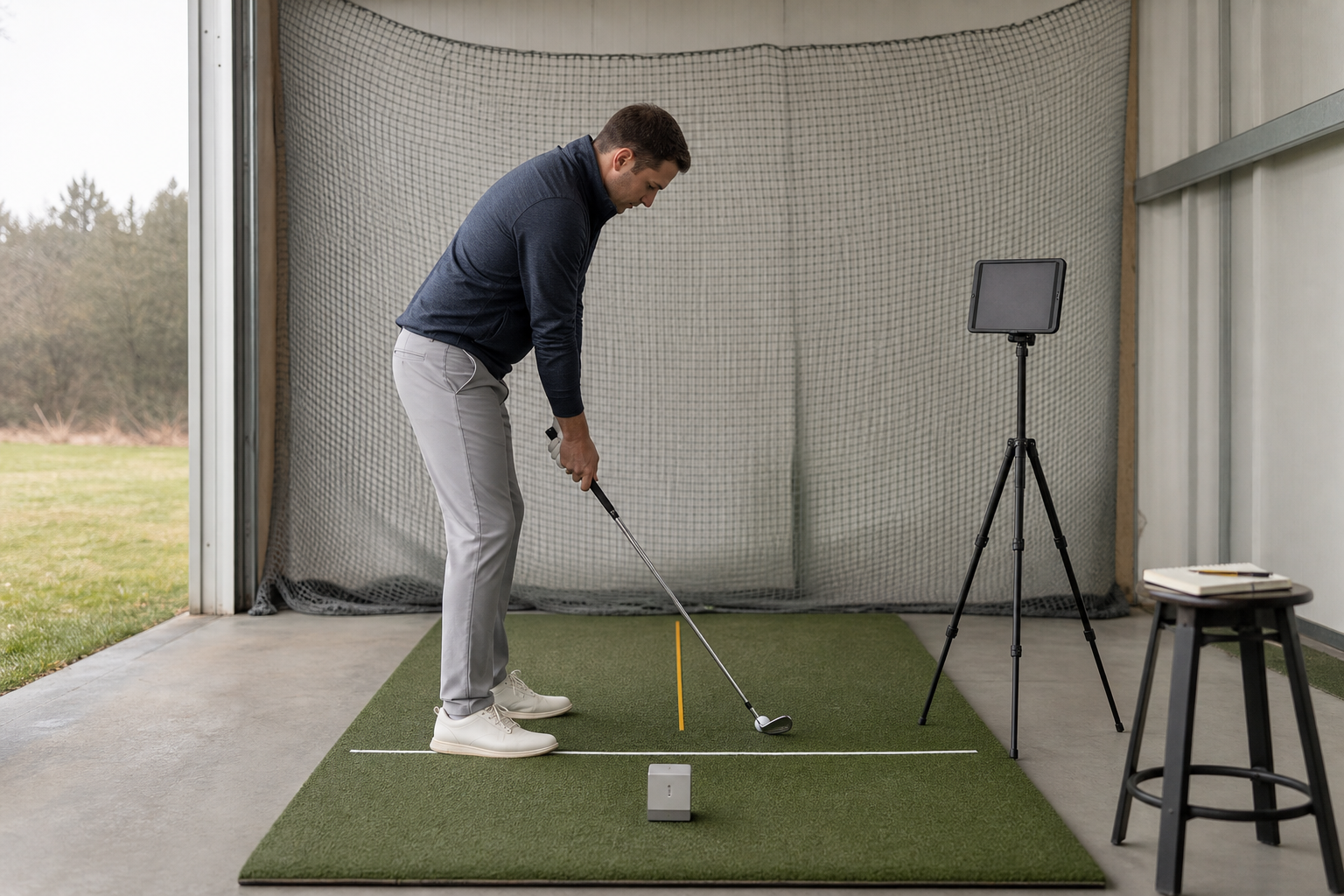
A monitor that is useful in a spacious, carefully arranged bay may be frustrating in a narrow spare room or a garage shared with bicycles. Measure the area you can actually use, not the empty room at its best. Include the golfer’s stance, the ball location, the sensor position, the intended target direction, and safe clearance for the swing you plan to make. Then consider repeatability. Can the mat return to the same spot? Can you place the device the same way? Can you practice without moving furniture each time? A simple tape mark can be more valuable than an ambitious setup that changes every session.
Guild recommendation: Make a dry layout with tape before buying. If you cannot establish a safe hitting area and repeatable device location, solve the space constraint before deciding that a monitor is the answer.
Separate evidence from impressive-sounding claims.
A personal launch monitor is an objective-feedback tool, so its claimed capabilities deserve a clear basis. The Federal Trade Commission notes that objective advertising claims should have a reasonable basis. For a shopper, that means looking beyond broad promises and asking what the claim means in your intended setting. Read the product information for the stated measurement, the conditions required for use, the setup instructions, and any limits that could affect your room or practice routine. Avoid filling gaps with assumptions based on a product image, a retail label, or a list of terms you do not plan to use.
Guild recommendation: Keep a comparison sheet with four columns: the practice question, the feedback you need, the required setup, and the source that supports each claim. Do not treat a capability as a buying reason until you can connect it to all four.
Plan the feedback loop before you bring anything home.
The best home setup is not the one that produces the longest post-session report. It is the one you will use on a Tuesday evening when you have 25 minutes and want to leave with a decision. Choose where results will go: a notebook, a simple session log, or a review screen you can understand between shots. Decide in advance how many balls form a group and what would count as a more repeatable result. This protects you from chasing a single standout swing. It also gives the monitor a proper role: observe, compare, and inform the next practice choice rather than pronounce a verdict on your technique.
Guild recommendation: Use five-shot groups and record one result per group for your first several sessions. Add another measurement only when the first one consistently helps you make a better practice decision.
Know when a lower-tech practice session is the better session.
A monitor is not required for purposeful practice. If your immediate limitation is unsafe space, inconsistent ball position, or no clear target, work on the foundation first. Marking your setup, rehearsing a consistent routine, and observing a simple target outcome can provide useful structure without adding a device. Conversely, a monitor can earn its place when visual observation alone leaves you uncertain about a result you need to manage. The deciding factor is not whether technology is available; it is whether the feedback resolves a real uncertainty in your practice.
Guild recommendation: Choose a launch monitor only after you can describe the uncertainty it will reduce. Choose a simpler practice plan when the next improvement depends more on setup consistency, safety, or a clearer target than on additional measurement.
Try this · 25 minutes.
The One-Question Home Practice Check
Choose one club, one safe target direction, and one repeatable ball position. Mark the mat or floor so the ball location and your alignment can be recreated, and place the launch monitor according to its own instructions. Before starting, write one question that the device can help you observe, such as whether your shots are starting closer to your intended target line.
- Hit five comfortable baseline shots without changing your setup, and record only the one measurement or shot result connected to your written question.
- Choose one modest, safe intention for the next five shots, such as making the same rehearsal or aiming at the same target line, rather than attempting a wholesale swing rebuild.
- Record the same result for those five shots, then compare the two groups for a pattern rather than reacting to one unusually good or poor shot.
- Repeat one more five-shot group using the intention that produced the more repeatable result, while keeping club, ball position, and monitor placement unchanged.
- Finish by writing one sentence describing what you will repeat in the next session and one condition that needs to stay consistent, such as ball position or monitor placement.
What progress looks like: The session succeeds when you finish with a repeatable setup, a recorded comparison of three small shot groups, and one specific next-session intention, even if the shots did not improve immediately.
Put the guide to work
These searches are a starting point—not a substitute for the fit and comparison criteria above.
Compare home launch monitor measurement needs
Use this search after deciding which single measurement or shot outcome will guide your practice, then compare whether each candidate clearly explains how it provides that feedback and what setup it requires.
Compare indoor practice setup requirements
Use this search after measuring your intended practice area, then compare the stated placement and hitting requirements against the space you can reproduce every session.
Compare launch monitor practice workflow
Use this search after choosing how you will record results, then compare whether the display and review process help you focus on a small, usable set of feedback.
If you buy through these links, Guild of Golf may earn a commission at no extra cost to you.
The practical takeaway
- Buy for a defined practice question, not for the largest list of displayed numbers.
- A measurement is useful only when it changes the decision you make on the next few shots.
- Measure and mark your real practice space before treating any device as a solution.
- Compare stated capabilities, required conditions, and setup instructions rather than relying on broad promotional language.
- Small shot groups and one recorded outcome create a more usable home-practice feedback loop than a stream of unexamined data.
Frequently asked questions
What is the first question to ask before buying a home launch monitor?
Ask which recurring shot pattern you want to understand and which single result would help you make a better next-shot decision.
How many measurements should I use in a home practice session?
Start with one measurement or shot outcome tied to your goal, then add more only when the first feedback is consistently useful and does not distract from the task.
Why should I measure my space before shopping?
The hitting area, device location, target direction, and ability to recreate the setup can determine whether feedback is consistent enough to support meaningful comparison from session to session.
How can I evaluate product claims responsibly?
Match each claimed capability to your practice question, read the stated conditions and setup instructions, and seek a clear basis for objective claims before making it part of your buying decision.
Sources used for this draft
- PGA of America: Practice With Purpose — The principle that practice should have a defined purpose and measurable structure.
- FTC Advertising and Marketing Basics — The guidance that objective product claims should have a reasonable basis.
Guild of Golf may earn a commission from qualifying purchases made through affiliated shopping links, at no additional cost to the reader.