
evergreen guide
Choose a Game-Improvement Driver by Your Strike Pattern, Not Its Label
A practical framework for selecting a more playable driver by measuring where you strike the face, how your misses curve, and which option produces a usable next shot.
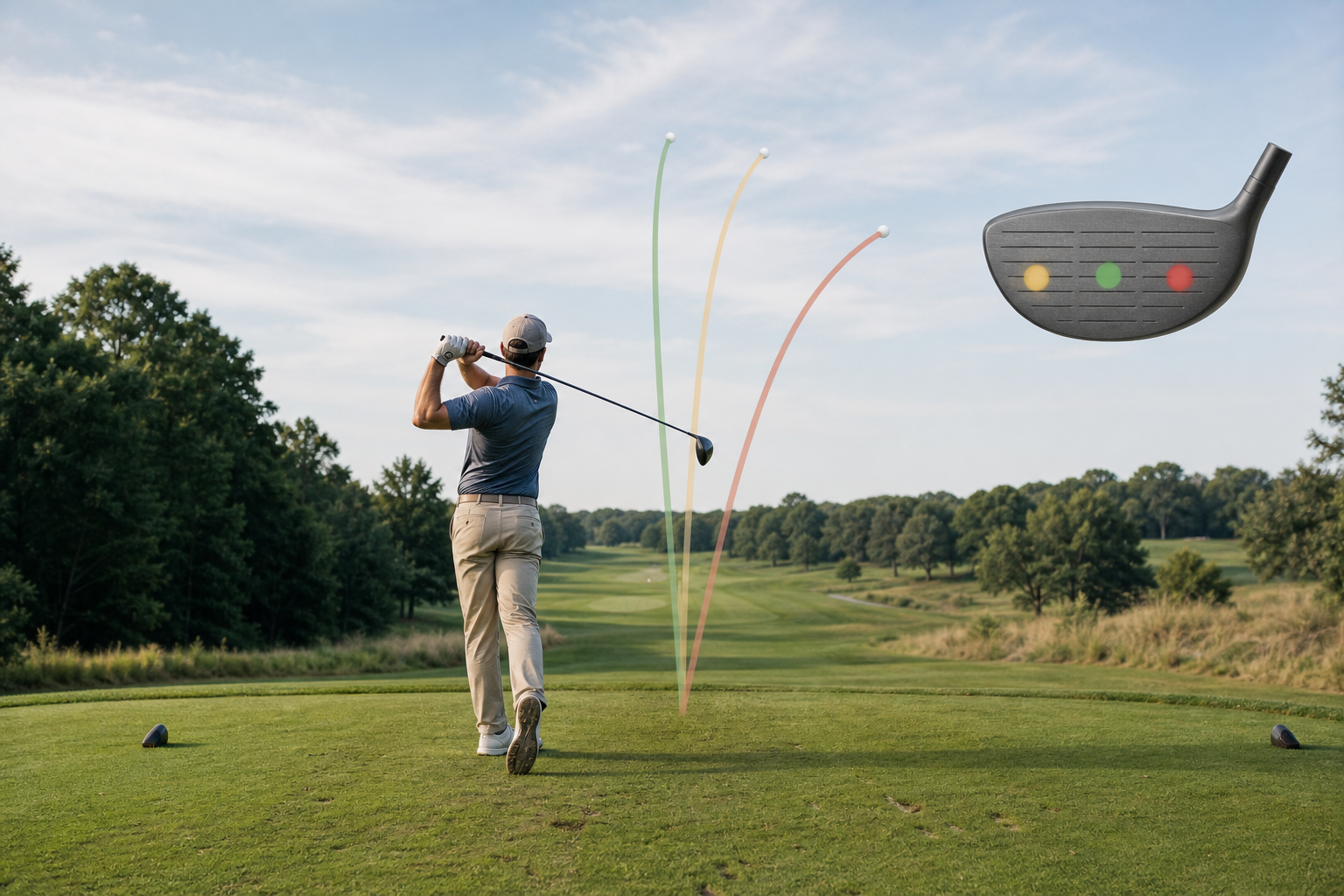
Built for: Golfers who want a more playable driver and prefer to judge strike consistency, dispersion, launch, and confidence rather than rely on a broad game-improvement label.
The tee shot that finds the fairway after a modest miss is usually worth more than the occasional perfect drive. Start with your strike pattern, define the miss you can play from, and compare drivers through measured results.
The quick verdict
Choose the driver that turns your common imperfect strike into the most predictable, playable result during a measured comparison, rather than the one carrying the most reassuring category label.
Best for This approach suits golfers whose drives vary across the face or whose usual curve repeatedly leaves an awkward next shot.
Skip it if Skip a driver change if your current club already produces a repeatable strike pattern and manageable dispersion, because fitting evidence may show that a setup or practice change is the more useful next step.
The tee-shot problem is rarely solved by a label.
You stand on a tight par 4, make a familiar swing, and watch a drive start right before peeling farther into trees. On the next hole, you catch the face low or toward the toe and lose the ball short of the group. Calling a replacement a game-improvement driver does not tell you which of those outcomes will improve. The better question is simple: which club produces the most usable result when your normal swing is not perfect? Conforming-club requirements apply regardless of the marketing category, so the category itself does not replace a proper comparison of legal equipment and your own results.
Guild recommendation: Treat “game-improvement” as a starting point for a fitting shortlist, not as proof that a driver will make your common miss playable.
Start with impact location before chasing a ball-flight promise.
A centered strike is helpful, but a useful purchase decision comes from knowing what happens on your frequent off-center contact. A golfer who routinely marks the toe needs to see whether candidate drivers keep those toe strikes in a manageable part of the landing area. Another golfer may strike high on the face, launch the ball in a way that changes carry and total distance, and need measured comparison rather than an assumption based on appearance. Face-contact feedback, a fitting strike display, or carefully observed impact marks can turn “I am inconsistent” into a pattern you can evaluate.
Guild recommendation: Record center, heel, toe, high, and low contact over several ordinary swings, then bring that pattern to a club-fitting conversation.
Define a playable miss in terms of the next shot.
Dispersion is not merely a left-right number. A gentle curve that finishes in short grass on the safe side of the hole can be far more valuable than a longer drive that repeatedly crosses into penalty trouble, trees, or a blocked approach. Imagine a right-handed player whose typical ball begins near the target and curves right. If the course’s trouble is also right, that player should judge candidates by whether the usual miss stays short of that trouble, not by whether one swing produces the biggest carry. The same logic applies to a golfer whose usual miss goes left toward a boundary. A playable miss is specific to your course, your usual starting direction, and the shot you are likely to face next.
Guild recommendation: Set fairway-like left and right boundaries during comparison, and favor the club whose ordinary misses leave the clearest route to the green.
Use launch and carry as comparison evidence, not isolated targets.
Launch can affect what you see in the air, but a single high-looking shot or a single long carry is thin evidence. Compare normal swings in groups and look for a pattern in carry, starting line, curvature, and finish. PGA of America fitting guidance emphasizes that fit and measured results matter when comparing options. That makes a fitting especially valuable when two drivers appear similarly forgiving but one consistently produces a more useful launch window and tighter playable dispersion for your swing. The goal is not to force a universal launch pattern; it is to find the result you can repeat.
Guild recommendation: Ask to compare multiple normal shots with each candidate and judge the cluster of outcomes, including imperfect strikes, before deciding.
Confidence is useful only when it survives a fair test.
A driver can look inviting behind the ball and still fail to improve your on-course pattern. Equally, a club that initially looks unfamiliar may prove easier to aim once you hit a meaningful sample. Notice whether you can set the face squarely to the target, make a normal swing without steering, and accept the result when the strike is not perfect. Those are observable confidence signals. Do not let appearance overrule a measured result, but do not dismiss the way a club helps you commit either; a repeatable setup and committed swing are more relevant than a fleeting first impression.
Guild recommendation: During a comparison, alternate candidates against the same target and retain notes only on normal, committed swings.
A fitting should answer a narrow, useful question.
Instead of asking for the most forgiving driver, arrive with a clear question: which option makes my common strike and common curve more playable? Tell the fitter where your drives usually contact the face, what your typical start line and curve look like, and which side of the hole causes the most damage. Then compare candidates under the same conditions and use measured results to separate a genuine improvement from a lucky sequence. Confirm that the final club is conforming under the applicable equipment rules if you play in competitions where conformity matters.
Guild recommendation: Leave only when you can state the observed tradeoff, such as slightly less peak distance in exchange for more shots finishing inside your playable corridor.
Try this · Thirty to forty minutes.
Map the Miss You Can Play
Use your current driver on a practice range with a clear target line and a broad landing area. Bring alignment sticks or two visible ground references, plus enough balls to hit three sets of six shots. If a launch monitor is available, record carry, starting direction, and offline result; if not, record the visible start line, curve, and finishing area.
- Pick a target that represents the center of a fairway, then define a left and right boundary that would still leave a comfortable next shot.
- Hit six normal drives without trying to manufacture a new swing. After each shot, note the strike location if visible, the starting direction, the curve, and whether it finished inside your playable boundaries.
- Repeat for two more sets of six shots, keeping the same target and same intention.
- Review the pattern rather than the best ball. Identify the strike location that appears most often and the ball flight that most often crosses a playable boundary.
- When comparing drivers in a fitting, repeat the same target-and-boundary exercise and ask for measured results across a group of normal swings rather than a comparison based on one longest drive.
What progress looks like: The useful outcome is a clearly documented common strike and a defined miss that remains within your chosen playable boundaries more often.
Put the guide to work
These searches are a starting point—not a substitute for the fit and comparison criteria above.
Compare adjustable drivers.
Compare how confidently you can aim the club and whether a fitter can measure a tighter playable dispersion with different settings.
Compare standard and higher-loft driver heads.
Use this search to identify options to bring to a measured fitting when your normal launch and carry need comparison.
Buy strike-location feedback supplies.
Impact tape can help you record a recurring face-contact pattern during the practice plan.
If you buy through these links, Guild of Golf may earn a commission at no extra cost to you.
The practical takeaway
- A game-improvement label cannot identify your best driver; your recurring strike and realistic dispersion can.
- The best miss is not necessarily the smallest curve, but the one that leaves a practical next shot.
- Compare groups of normal swings and include off-center contact rather than selecting a driver from its best drive.
- Measured fitting results should guide the decision, while confidence should be judged by whether you can aim and swing normally.
- Check conformity when competition use matters, because equipment requirements apply independently of a marketing category.
Frequently asked questions
What is a playable miss with a driver?
A playable miss is a common imperfect drive that finishes in an area from which you can realistically advance the ball or play toward the green, rather than creating penalty, obstruction, or recovery trouble.
Should I choose the driver that produces my longest drive?
Not automatically. Compare a group of ordinary swings, because a club that produces slightly less standout distance but keeps more common misses in a usable corridor may help your scoring opportunities more.
How many swings should I use to compare drivers?
Use enough normal swings to reveal a pattern instead of relying on a highlight shot. Three sets of six shots is a practical starting structure for observing strike, start line, curve, and playable finish.
Does an adjustable driver guarantee a better fit?
No. Adjustment can create options to compare, but only measured results from your normal swings can show whether a setting improves your launch, dispersion, and playable miss.
Do game-improvement drivers have different conformity rules?
No. Conforming club requirements apply regardless of the marketing category, so check the applicable rules when conformity is important for your play.
Sources used for this draft
- USGA Equipment Rules — The guidance that conforming-club requirements apply regardless of marketing category.
- PGA of America: Club Fitting — The recommendation to compare club options through fit and measured results.
Guild of Golf may earn a commission from qualifying purchases made through selected links, at no additional cost to you.