
comparison
Putting Mirror vs. Putting Mat: Choose Feedback That Makes Practice Count
A practical comparison for golfers deciding whether their home putting time needs setup feedback from a mirror or ball-roll feedback from a mat.
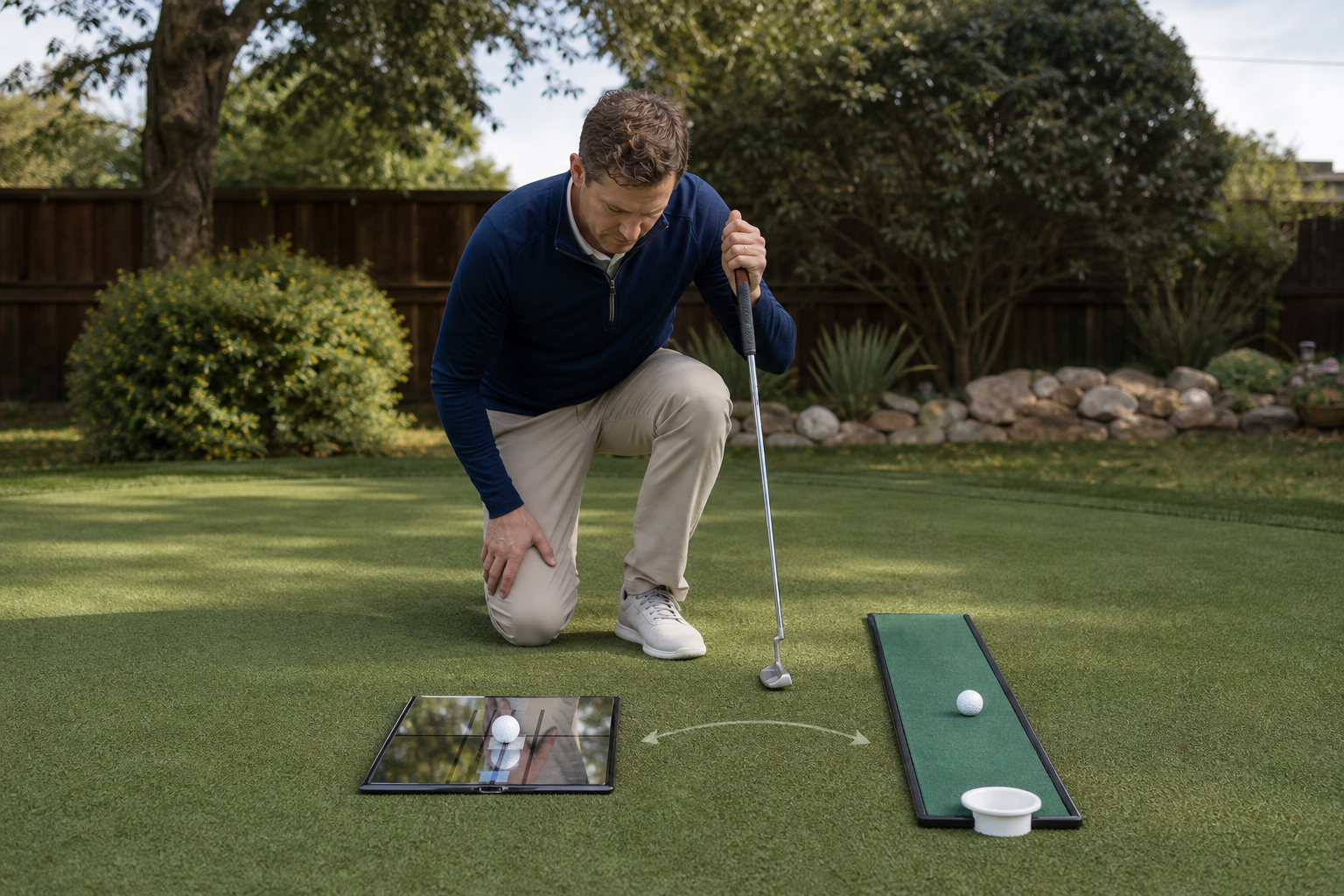
Built for: Golfers choosing one practice aid and deciding whether they need setup feedback or ball-roll feedback.
When a three-footer keeps missing, it is tempting to buy more practice rather than better information. A putting mirror helps make your starting picture repeatable; a putting mat gives each stroke a visible roll outcome. Choose the tool that answers the question you can actually act on at home.
The quick verdict
Buy a putting mirror if your main uncertainty is how you set up to the ball; choose a putting mat if you need a repeatable place to judge whether a ball starts and rolls as intended. If you can name neither problem, begin with a simple, structured drill before adding either aid.
Best for The mirror is best for golfers who want a consistent visual checkpoint before the stroke. The mat is best for golfers who will practice short putts with a defined start-line target and a repeatable routine.
Skip it if Skip a mirror when you are unlikely to pause and use its reference points, and skip a mat when space or a level practice area prevents you from making the same stroke repeatedly.
First, decide which moment needs feedback
A home session can fail before the first ball moves. You may stand over a putt wondering whether your eyes, face, and ball position look the same as they did on the previous stroke. That is a setup-feedback problem, and a mirror gives you a visual reference before you putt. Or you may feel comfortable at address but have no clear way to judge whether the ball began toward a chosen target. That is a ball-roll-feedback problem, and a mat gives you a repeatable place to observe the result.
Guild recommendation: Choose the mirror when your useful question happens before the stroke, and choose the mat when it happens after the ball leaves the face.
What a putting mirror makes easier to practice
A mirror rewards a golfer who is willing to stop, look, and set a consistent starting picture. For example, a player preparing for a round may spend ten minutes rehearsing the same address checkpoint before short putts instead of rapidly hitting balls. The constraint is attention: if you only glance at the mirror and immediately chase makes and misses, it becomes decoration rather than feedback. A mirror also does not create a target or tell you how a ball will travel across different greens.
Guild recommendation: Buy a mirror if a consistent pre-stroke picture would make your practice more deliberate, and skip it if you want the aid to supply the entire putting task.
What a putting mat makes easier to practice
A mat is most useful when it turns an open-ended carpet putt into the same short assignment again and again. Set a target, begin each ball from the same place, and judge whether it starts where you intended. This is helpful for the golfer who has only a narrow hallway or a brief evening window and needs a ready-made station. The tradeoff is that a mat emphasizes a particular home surface and target arrangement; it cannot reproduce every on-course contour, speed, or decision.
Guild recommendation: Choose a mat if repeatable starts toward a target are the missing ingredient in your home routine, and skip it if you primarily need to check your address picture.
Purpose matters more than a fuller practice corner
The PGA of America advises golfers to practice with purpose and structure. Apply that idea by assigning one observable job to each session rather than alternating between alignment, pace, and mechanics after every miss. A mirror session might be about returning to one address reference. A mat session might be about starting ten balls toward one target. The Rules of Golf provide the on-course context for putting greens and lines of play, but home practice works best when it does not pretend to duplicate every condition you will face on the course.
Guild recommendation: Before buying, state the exact result you will track in a 15-minute session. If you cannot state it, use the practice plan first and identify the feedback you lack.
If you can buy only one
Choose the mirror for the golfer whose confidence drops at address: the ball may look too far forward on one stroke and too far back on the next, and a visible reference would create a calmer routine. Choose the mat for the golfer who already likes the look of address but needs a consistent target and surface to make short-putt repetitions meaningful. Neither is automatically the better aid. The better purchase is the one that fits your space, available time, and one defined question.
Guild recommendation: For setup uncertainty, take the mirror. For repeatable start-line practice, take the mat. For an undefined problem, delay the purchase and practice with one simple target first.
Try this · 15 minutes.
The One-Question Putting Session
Use either a mirror with a ball and a small target, or a mat with a target cup. Choose a short, comfortable distance that lets you make a controlled stroke, and use the same starting spot for every putt.
- Write one question before starting: “Can I return to the same setup picture?” for a mirror, or “Can I start the ball toward the same target?” for a mat.
- Hit five putts while observing only that question. With a mirror, pause before each stroke and establish the same visual setup reference; with a mat, watch whether each ball begins toward the target.
- Take a one-minute reset, then hit a second group of five putts with the same task and starting spot.
- Record a simple result: the number of times you completed your chosen setup checkpoint or started the ball toward your chosen target.
- End after two groups rather than changing the task mid-session.
What progress looks like: The useful signal is a more repeatable result in the second group while keeping the same single question, not a claim about the cause of any missed putt.
Put the guide to work
These searches are a starting point—not a substitute for the fit and comparison criteria above.
Compare setup-reference mirrors
Look for reference features you can understand at address and a size that fits the place where you will actually practice.
Compare compact putting mats
Compare the available practice length, target design, and whether the mat can lie flat in your intended space.
Compare simple start-line targets
A small target can add a clear ball-start task to either type of practice station.
If you buy through these links, Guild of Golf may earn a commission at no extra cost to you.
The practical takeaway
- A putting mirror is a pre-stroke feedback tool for building a repeatable setup picture.
- A putting mat is a post-stroke feedback tool for observing a repeated ball-start task.
- One question per session makes either aid more useful than unfocused repetition.
- Home practice should build a repeatable task, not claim to recreate every condition found on a putting green.
Frequently asked questions
Can a putting mirror and a putting mat be used together?
Yes. Use the mirror to establish one setup checkpoint, then use the mat and target to observe the ball’s start. Keep the session focused by tracking only one of those outcomes at a time.
Which aid is better for a small apartment?
The better fit depends on the usable floor space and your practice question. A mirror can suit a very compact setup-focused routine, while a compact mat can suit a short target-based routine if it can lie flat in the available area.
Will a putting mat prepare me for every green?
No home surface can stand in for every on-course putting situation. A mat can still be valuable when it gives you a consistent target-based task and a structured way to repeat it.
Do I need an aid to practice putting with purpose?
No. You need a defined task, a repeatable setup, and an observable result. An aid is worthwhile when it makes that feedback easier to see.
Sources used for this draft
- PGA of America: Practice With Purpose — The recommendation to use a defined, structured practice task.
- USGA Rule 13: Putting Greens — The rules context for putting greens and lines of play.
Guild of Golf may earn a commission from qualifying purchases made through shopping links, at no extra cost to you.