
evergreen guide
Choose a Home Launch Monitor for the Practice You Actually Need
A practical framework for deciding whether a personal launch monitor can turn home swings into useful, measurable practice.
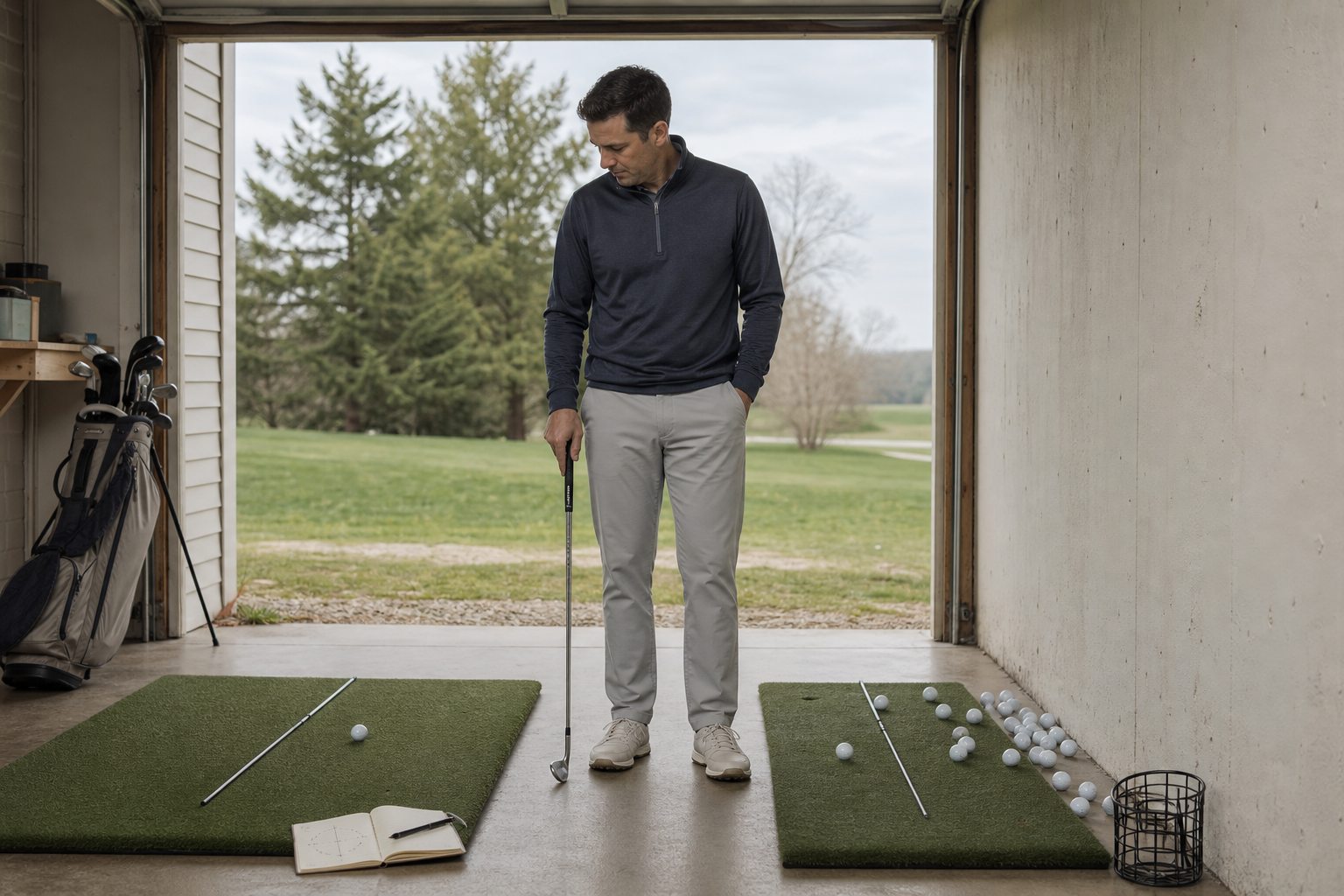
Built for: Golfers deciding whether a personal launch monitor provides the measurements and setup their practice actually needs.
The tempting purchase is the monitor with the longest feature list. The useful purchase is the one that gives you a repeatable number, fits the space you truly have, and answers a question you can act on before your next round.
The quick verdict
Buy a personal launch monitor only after you can name the one or two practice questions it must answer, confirm that its required setup fits your hitting area, and see how you will record a baseline and a change. More displayed data is not automatically more useful data.
Best for Golfers with a dependable home hitting space who will use a small set of measurements to structure short, repeatable practice sessions.
Skip it if Skip or delay the purchase if your space changes from session to session, you do not have a safe way to hit balls, or you mainly want the device to tell you what to fix without a defined practice goal.
Start with the shot that keeps costing you strokes
A launch monitor is easy to overbuy when the decision begins with features. Begin instead with the hole where uncertainty shows up. Perhaps your 8-iron flies a different distance after work than it does on the course. Perhaps you are practicing indoors and cannot tell whether a better-feeling swing is producing a more useful ball flight. Or perhaps you simply need a consistent carry reference for a small set of clubs.
Turn that frustration into a sentence with an observable outcome: “I want to establish a dependable carry window for my wedges,” or “I want to see whether my intended start line is becoming more consistent.” That sentence is the standard by which a monitor earns its place. The PGA of America advises purposeful practice with defined, measurable structure; a device is most helpful when it supports that structure rather than replacing it.
Guild recommendation: Choose a monitor around one primary question and one supporting measurement. A golfer working on wedge distance control may value a consistent carry reference, while a golfer building a start-line drill may prioritize a clear directional outcome.
Treat your room as part of the equipment decision
The monitor does not practice for you, and neither does an impressive display solve an awkward bay. Measure the usable area you can keep consistent: where the ball will sit, where you will stand, the intended target direction, and the clearance needed to swing safely. Also consider the practical routine. Can you place the unit in the same location each time, or will it move around bicycles, storage boxes, and a parked car?
A compact space can still support disciplined practice if the task is narrow and the layout is repeatable. It becomes a poor match when setup changes every session, the target line is compromised, or you cannot hit balls safely. Before relying on any stated operating requirement or accuracy claim, review the manufacturer’s current instructions and ask whether the claim is supported for your intended environment. Objective product claims should have a reasonable basis, a useful principle when comparing advertising with your own constraints.
Guild recommendation: Make a simple floor plan before shopping. If you cannot preserve a safe ball position, swing area, and consistent device position, solve the practice space first.
Separate measurements from decisions
A measurement is only useful when it changes what you do next. Imagine two sessions with a 7-iron. In the first, you collect many readings but do not know which one matters. In the second, you hit ten shots toward one target, record the same small group of outcomes, and decide whether your next set should focus on a different target, club, or tempo cue. The second session has a purpose.
Build a short hierarchy. Your primary measurement is the number or result tied directly to the goal. Your supporting measurement helps explain a pattern. Everything else is optional until it proves useful. This approach reduces the common trap of chasing a single unusually good or bad shot. Look for patterns over a planned sample, not a verdict from one swing.
Guild recommendation: For each metric you expect to use, write a corresponding action: “If this pattern shifts, I will change this practice task.” If you cannot write the action, do not let that metric drive your purchase.
Judge the workflow, not just the data list
Home practice usually happens in short windows. A device that requires a lengthy reset, confusing placement, or frequent interruptions can turn a 30-minute plan into a setup exercise. Consider how you will begin a session, identify the correct club or target, retain a small baseline, and review results afterward. The useful workflow is the one you will repeat on a Tuesday evening, not merely admire on a product page.
Ask practical questions while comparing options. Can you understand the reading without leaving the hitting area? Can you keep a simple record from one session to the next? Does the display encourage you to focus on a few shots, or tempt you to chase every number? The best answer varies by golfer. A data-minded player may enjoy reviewing a session later, while a beginner may benefit more from one clear result and a notebook.
Guild recommendation: Favor the simplest workflow that preserves your goal, baseline, and next action. Complexity is worthwhile only when you will use it consistently.
Make the purchase prove its usefulness in the return window
Once you have narrowed the field, use a written acceptance test rather than a vague feeling of excitement. In your actual hitting space, repeat the same club-and-target task on two separate days. Check whether you can set up safely and consistently, whether the readings are understandable, and whether they help you choose a next practice task. Do not frame the test as a diagnosis of your swing; frame it as a test of whether the equipment supports your routine.
Keep claims in proportion. A product description may promise a wide range of insights, but your decision should rest on the particular claims that matter to you and on whether those claims fit your space and planned use. The FTC’s advertising guidance emphasizes a reasonable basis for objective claims, which is a sound standard for a careful buyer to carry into comparison shopping.
Guild recommendation: Keep the monitor only if it helps you complete the same purposeful drill twice with a clearer record and next step than you had without it.
Try this · 25 minutes.
Establish a Useful Baseline Before You Shop
Use the club, ball type, and safe hitting area you expect to use most often at home. Put a target line or alignment aid on the ground, choose one full-swing target, and prepare a notebook or phone note with columns for shot number, intended outcome, and observed result.
- Write one question that matters to your game, such as whether you can start a short iron closer to your intended line or produce a more predictable carry window.
- Hit five unhurried shots after a warm-up. Record only the outcome you can observe consistently, such as whether the ball started left, near, or right of your intended line, plus any number a monitor you are considering is meant to supply.
- Take a short break, then repeat the same five-shot task without changing club, target, or setup.
- Compare the two groups. Circle the one or two outcomes that stayed meaningful enough to guide your next practice decision.
- Use that short list as your shopping filter. If a prospective monitor does not present those outcomes clearly in your available space, its additional data should not decide the purchase.
What progress looks like: The plan succeeds when you finish with one or two repeatable practice questions and a clear idea of which readings would help you make a specific next-session adjustment.
Put the guide to work
These searches are a starting point—not a substitute for the fit and comparison criteria above.
Compare portable monitor options
Use this search after defining the few measurements you will actually track and the space in which you will use them.
Compare home practice enclosures
Use this search if your purchase decision depends first on creating a safe, repeatable hitting area.
Compare simple tracking tools
Use this search if a written baseline will help you turn monitor readings into a repeatable practice routine.
If you buy through these links, Guild of Golf may earn a commission at no extra cost to you.
The practical takeaway
- Define the practice question before comparing feature lists.
- Measure and protect the safety and repeatability of your home setup before buying a device.
- Track a small number of outcomes that lead to a specific next practice action.
- Evaluate setup friction and record-keeping as seriously as the measurements offered.
- Use a two-session acceptance test to determine whether the monitor improves your practice routine.
Frequently asked questions
What is the first measurement I should look for in a home launch monitor?
Start with the measurement that directly answers your most common practice question. If you are building wedge distance control, a dependable carry reference may be central. If you are running a target-line drill, a clear directional outcome may matter more. Add other readings only when they lead to a decision in your practice plan.
Do I need every available data point to practice effectively at home?
No. Purposeful practice needs a defined goal and a way to observe progress. A small set of readings that you understand and record consistently is more useful than a large set of numbers with no planned response.
How can I tell whether my space is suitable?
Confirm that you can swing and hit balls safely, place the ball and device consistently, and maintain the same intended target direction from session to session. Review the current operating instructions for any model you are considering before treating the space as suitable.
How should I compare accuracy claims?
Identify the exact claim that matters for your intended use, review the supporting information provided by the seller or manufacturer, and test whether the device helps you repeat your planned drill in your actual setup. Treat broad promotional language as less useful than a claim connected to your specific practice question.
Sources used for this draft
- PGA of America: Practice With Purpose — The recommendation to give practice a defined purpose and measurable structure.
- FTC Advertising and Marketing Basics — The guidance to examine the basis for objective product claims when comparing equipment.
Guild of Golf may earn a commission from qualifying purchases made through shopping links, at no extra cost to you.