
comparison
Putting Mirror vs. Putting Mat: Choose Setup Feedback or Ball-Roll Feedback
A putting mirror and a putting mat solve different home-practice problems, so the better choice depends on whether you need to see your setup or observe the ball’s journey to a target.
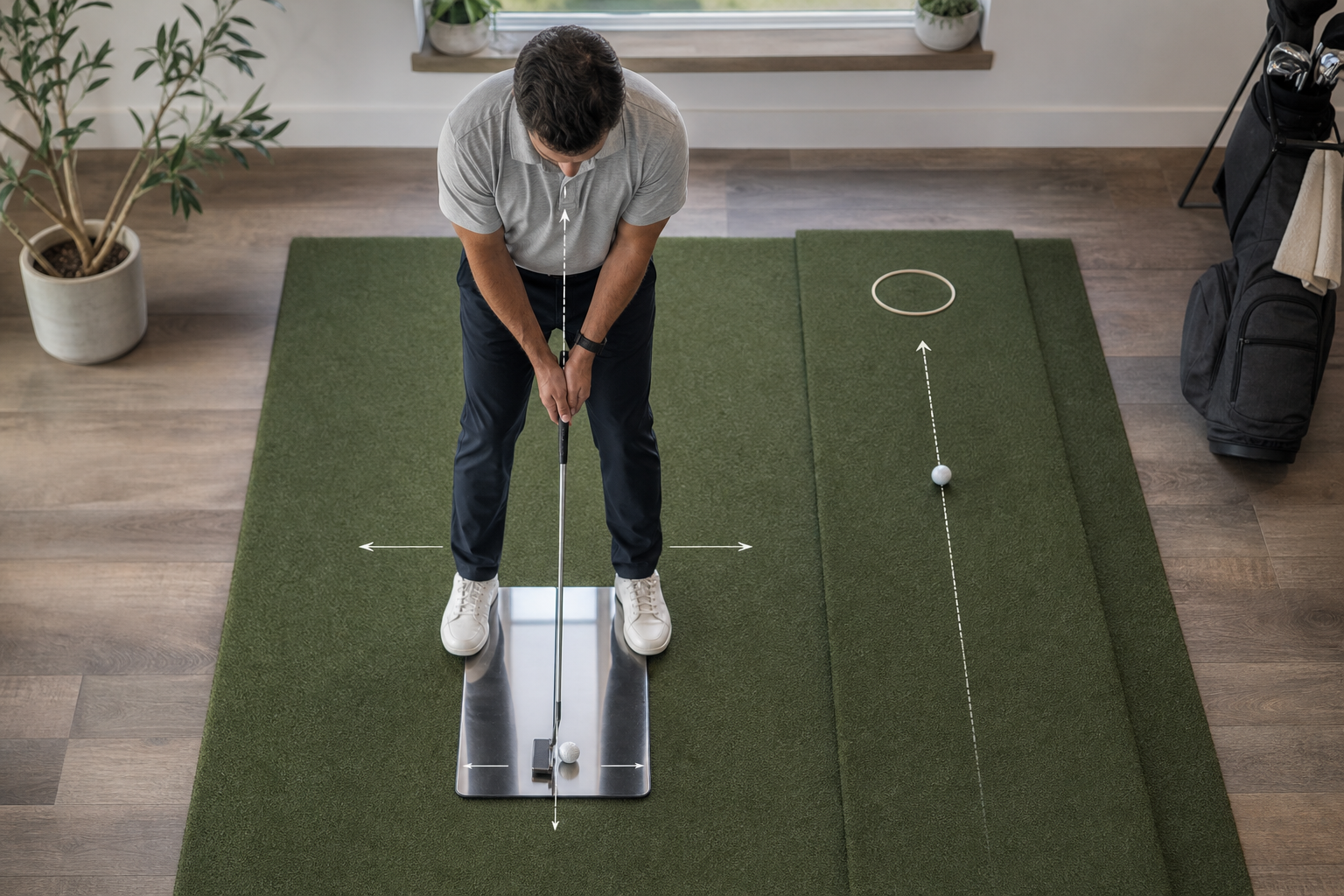
Built for: Golfers choosing one practice aid and deciding whether they need setup feedback or ball-roll feedback.
When short putts keep starting in different directions, it is tempting to buy the aid that looks most complete. Start with the miss you can observe: choose a mirror when you need a repeatable view of address, and choose a mat when you need a defined roll, destination, and distance task.
The quick verdict
Choose a putting mirror when the useful question is, “Can I arrive in the same address position each time?” Choose a putting mat when the useful question is, “Can I start the ball at a target and deliver it to a defined finish?”
Best for A mirror is best for golfers who want simple visual setup feedback before making a stroke, while a mat is best for golfers who stay engaged by rolling balls toward a target with a clear distance task.
Skip it if Skip a mirror if staring at positions makes practice feel static, and skip a mat if you have not first defined what you will observe beyond whether a putt went in.
The choice begins before the stroke.
A mirror answers an address question. You set the ball down, take your normal posture, and use the reflection to check whether a chosen feature of your setup looks repeatable. That makes it valuable when your practice tends to drift into blind repetition: ball after ball is struck, but you cannot say whether you began each one from the same picture.
A mat answers a ball-journey question. It gives the ball a dedicated route and makes a destination task easy to repeat. That is useful when your attention needs to stay on start direction and finish rather than on your body position. Neither aid automatically fixes a putting stroke; each simply makes a different part of the practice task easier to observe.
Guild recommendation: Buy the aid that reveals the variable you are currently unable to judge during a normal home session.
Choose a mirror when your problem is an uncertain pre-putt picture.
Consider the golfer who stands over a four-foot putt, backs away, and resets because the ball alternately seems too close, too far forward, or oddly placed beneath their eyes. A mirror can turn that vague discomfort into a single, repeatable visual check. Its strength is the pause before motion.
Keep the assignment narrow. Choose one checkpoint that you can see at address and use it for a short set of putts. Trying to monitor every line, angle, and body part at once dilutes the feedback. The aim is not to force a theoretically perfect position; it is to build a setup picture you can reproduce under a simple task.
Guild recommendation: Choose a mirror if you can name one address checkpoint you want to make more consistent before you worry about the result of the putt.
Choose a mat when your problem is an unmeasured roll.
Now consider the golfer who can make a few putts on a carpet but has no meaningful target, no fixed distance, and no way to tell whether the ball began where intended or merely wandered into a wide area. A mat creates a repeatable lane for the session. With a target at the end, each ball supplies two observable pieces of information: its initial direction and its finish relative to the target.
That structure can make practice easier to sustain because the outcome is immediate. Yet a made putt is not the only useful result. A ball that starts on the intended path but finishes short or long still gives you a pace observation. Preserve that value by keeping the start point and target unchanged long enough to see a pattern.
Guild recommendation: Choose a mat if a fixed route, target, and distance will help you turn casual rolling into a repeatable task.
Purpose matters more than how much equipment covers the floor.
The PGA of America emphasizes that practice is more useful when it has defined purpose and structure. Applied here, a mirror without a stated checkpoint becomes something to glance at, while a mat without a target standard becomes a pleasant surface for random putts. The aid does not create purposeful practice by itself.
Set a modest pass condition before the first ball. On a mirror, it might be repeating one address picture for six attempts. On a mat, it might be starting four of six balls toward the same target and having them finish near it. These are observations, not diagnoses. They tell you which task deserves another set, without claiming to identify why a result occurred.
Guild recommendation: Use short sets, one observation, and one recorded result so your home practice has a defined purpose.
Keep home feedback in its proper place.
Rule 13 provides the rules context for putting greens and lines of play during golf. A home mirror or mat is a practice environment, not a substitute for reading the surface, reacting to changing conditions, or making the on-course decisions that arise on an actual putting green. The useful bridge is modest: carry one simple setup cue or one pace intention from home to the course, rather than expecting an indoor routine to reproduce every putting situation.
If your on-course difficulty is largely choosing a line on changing greens, neither aid is a complete answer. If your difficulty is arriving at the ball with an inconsistent picture or practicing without a measurable roll task, the distinction between mirror and mat is much more relevant.
Guild recommendation: Treat the chosen aid as a focused rehearsal tool, then keep your on-course attention on the putt in front of you.
Try this · 10 minutes.
The 12-Ball Setup-to-Roll Check.
On a flat, clear indoor surface, set a cup, small bowl, or other stable target at a comfortable short-putt distance. If using a mirror, place it where it lets you view your address before the stroke and putt from its intended ball position. If using a mat, use its target area or place the target at its end. Keep the target, distance, and starting spot unchanged for all 12 balls.
- State one purpose before beginning: with a mirror, make it “repeat the same address picture”; with a mat, make it “start each ball toward the same target and finish with controlled pace.”
- Roll six balls one at a time. Before each mirror repetition, pause at address and compare only one chosen visual checkpoint, such as whether your eyes appear in the same relationship to the ball. With a mat, watch only the ball’s initial direction and whether it reaches the target area without racing past it.
- After the sixth ball, take a short break and name one observable pattern, without assigning a swing fault. For example, note that your address picture varied, that several balls began left of the target, or that several finished beyond it.
- Roll six more balls with the same single purpose. Do not add a second checkpoint or change the distance mid-set.
- Finish by recording one number: how many of the final six met your chosen standard. A mirror standard can be six address pictures that look acceptably repeatable; a mat standard can be balls that start toward the target and finish in its immediate area.
What progress looks like: The session is successful when your final six balls produce a clearer, more repeatable result than the first six under one unchanged task, even if every putt does not finish in the target.
Put the guide to work
These searches are a starting point—not a substitute for the fit and comparison criteria above.
Compare reflective setup aids after deciding that address feedback is your first
Compare the usable reflective area, the way the ball is positioned, and whether the aid leaves enough room for your normal address routine.
Compare rolling surfaces after deciding that a target and distance task is your
Compare the available roll length, the target arrangement, and whether the surface fits the flat space where you will actually practice.
If you buy through these links, Guild of Golf may earn a commission at no extra cost to you.
The practical takeaway
- A putting mirror provides visual feedback about the setup you bring to the ball before the stroke.
- A putting mat provides a repeatable route, target, and distance task for observing ball roll.
- One narrow checkpoint or outcome standard is more useful than trying to inspect everything at once.
- Choose the aid that makes your current unknown observable, then practice in short, unchanged sets.
Frequently asked questions
Can a beginner use a putting mirror?
Yes, if the beginner uses it for one simple and repeatable address observation rather than trying to copy multiple positions at once.
Does a putting mat replace putting on a real green?
No, because a home mat does not replace the changing surface conditions and line-of-play decisions encountered on an actual putting green.
Which aid is better if I can buy only one?
Buy a mirror when repeatable address is the missing feedback, and buy a mat when a target-based ball-roll task is the missing feedback.
Should I use a mirror and mat together?
They can complement each other, but begin with one aid and one purpose so you can tell which observation is improving.
Sources used for this draft
- PGA of America: Practice With Purpose — The value of defining a clear purpose and structure for practice.
- USGA Rule 13: Putting Greens — The rules context for putting greens and lines of play.
Guild of Golf may earn a commission from qualifying purchases made through affiliate links.