
evergreen guide
Who Draw-Bias Drivers Suit—and When a Right Miss Needs Another Answer
A practical guide for right-handed golfers deciding whether a draw-bias driver matches a repeatable right miss, or whether face, path, strike, or setup deserves attention first.
Built for: Right-handed golfers considering draw bias for a recurring right miss who need to separate face, path, strike, and setup effects.
A ball that starts right, curves right, or simply leaks into the next fairway can feel like one problem. Before choosing a draw-bias driver, identify the version of the miss you actually see and use measured ball flight to make the decision.
The quick verdict
A draw-bias driver is most worth considering for a right-handed golfer whose recurring, measured driver pattern finishes right and remains reasonably consistent across several shots. It is not a reliable shortcut when the miss changes from shot to shot, contact moves around the face, or an open setup is the more visible pattern.
Best for Golfers who can describe a repeatable right-sided ball-flight pattern, want to compare that pattern in a fitting, and are prepared to judge the club by measured results rather than by one flushed swing.
Skip it if Skip the purchase decision for now if some drives start left, others start right, strike location is highly variable, or alignment and ball position have not been checked. Those observations make a fitting and a short practice check more useful than assuming one head design is the answer.
The tee-shot tension: “right” is not one miss
You stand on the 11th tee with trouble all along the right side. The previous drive started well right and stayed there; the one before that began near the fairway and faded away late. Both finish right, but they are not necessarily the same decision problem.
Start by describing the shot without interpreting it. Did it begin left, near the intended line, or right? Did it finish left, near the intended line, or right? Was the contact similar to recent drives? Did your alignment look consistent? Those plain observations keep a club purchase from becoming a guess about a swing.
A draw-bias driver may be a sensible category to compare when your measured, repeatable driver pattern is right-sided. The important word is compare. PGA of America fitting guidance says club fitting should account for the individual golfer and measured ball flight. A right miss that repeats under similar setup and contact is useful fitting information; a collection of unrelated misses is less decisive.
Guild recommendation: Bring a simple description of your common start direction, finish direction, and strike consistency to a fitting. Ask to compare results across more than one shot, not to select a driver from a single standout drive.
Sort the four observations before you sort the drivers
Face, path, strike, and setup are useful buckets because they prevent one visible outcome from being treated as a complete explanation. They are not a home diagnosis kit, and this guide does not ask you to assign technical blame.
Face is the ball’s starting picture: where did it launch relative to your target? Path is the shape picture: after starting, did it continue on a similar line or curve away from it? Strike is the contact picture: did impact appear repeatable or scattered? Setup is the pre-shot picture: were ball position and body alignment consistent with what you intended?
Consider a golfer whose ball routinely begins near the fairway but ends right. That golfer has a different fitting conversation from the golfer whose ball begins immediately right on nearly every tee shot. A third golfer may see both patterns because contact and setup vary. In that case, a draw-bias head could be compared, but the evidence from the session should carry more weight than the label on the head.
Guild recommendation: Use the 12-ball audit before shopping. If your notes reveal several different shot pictures, take that variability to a qualified fitter rather than trying to match a driver category to the last bad drive.
The golfer a draw-bias comparison can help
The strongest candidate is not simply a golfer who dislikes a slice. It is a right-handed player with a repeatable, right-finishing driver pattern who can set up in a reasonably repeatable way and wants to see whether a draw-bias design changes measured ball flight into a more playable result.
Picture a golfer who hits eight of 12 drives into the right half of the range, with a similar start-and-finish pattern and no obvious setup change from ball to ball. That golfer has a useful question for a fitting: does a draw-bias option produce a tighter, more useful dispersion without creating an opposite-side miss? The answer should come from the golfer’s own measured shots.
The category is a weaker match for the player whose main problem is uncertainty. If one drive starts left, the next starts right, and the next is struck in a visibly different place, there is not yet one recurring outcome to evaluate. A fitting can still help because it considers the individual golfer and measured ball flight, but a draw-bias label should not be treated as a verdict.
Guild recommendation: Choose the category for comparison when the desired outcome is observable: fewer repeat drives finishing in the right-side trouble and a dispersion pattern you can live with.
What to compare in a fitting or a responsible trial
Ask for a process that keeps the question narrow. Establish a baseline with your current driver, then compare a draw-bias option using enough shots to reveal a pattern. Record start direction, finish direction, general dispersion, and the quality of contact you observed. Do not discard every poor strike, but do note when a result came from a visibly different strike or setup.
The decision is not “did one ball draw?” A more useful question is whether the group of shots becomes more playable for your course. A golfer whose normal miss threatens water right may value a pattern that finishes nearer the intended corridor. Another golfer with trees or out-of-bounds left may decide that any leftward shift is a poor trade, even if a few shots look better.
Drivers, whether adjustable or non-adjustable, must conform to the applicable equipment rules. That matters when comparing options, but conformity does not establish that a particular model suits a particular golfer. Fit remains individual and should be judged against measured ball flight.
Guild recommendation: Ask the fitter to show your baseline and comparison groups side by side. Keep the option only if the measured pattern improves in the direction that matters on your usual tee shots.
Avoid replacing observation with a quick fix
A draw-bias driver can be part of a sensible equipment conversation, but it cannot turn an unclear pattern into a clear one. The golfer who frequently changes ball position, aims unknowingly right, or sees inconsistent contact should first make those observations visible. That is not a demand for a swing overhaul. It is a way to ensure the club is being asked to address a repeatable playing problem.
There is also a course-management angle. If your reliable shot finishes right but remains in play, a fitting goal might be tighter dispersion rather than a dramatic change in curve. If the right miss regularly reaches penalty trouble, the desired result may be a more conservative, playable finish. In either case, define success before the comparison begins.
The best purchase is therefore conditional. Compare a draw-bias driver when the right miss is repeatable and measurable. Pause when the pattern is mixed. The restraint may save you from choosing a club for a shot that is not actually your normal shot.
Guild recommendation: Write one sentence before any fitting: “My usual driver miss starts __, finishes __, and costs me ___ on the course.” If you cannot complete it honestly, practice observation before buying.
Try this · 20 minutes.
The 12-Ball Right-Miss Audit
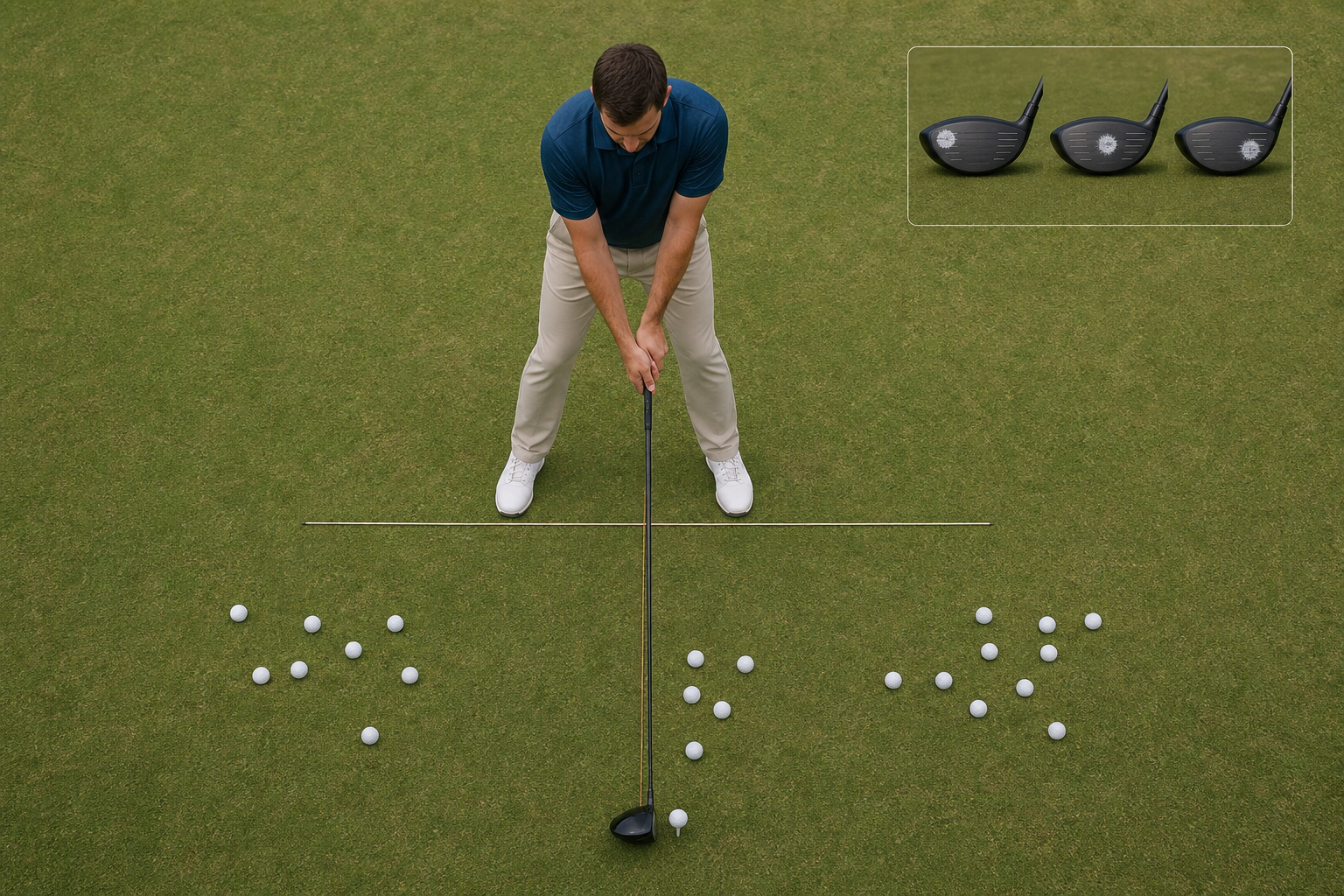
Use a range target or a clearly chosen landing corridor. Place one alignment stick or club on the ground parallel to the intended target line, outside the ball and clear of your stance. Use a tee height and ball position you would normally use, and bring a notebook or phone note for simple observations.
- Hit four balls with your normal setup. After each shot, record only where the ball began relative to the target corridor and where it finished: left, near, or right.
- Hit four more balls while checking that your feet, hips, and shoulders appear parallel to the ground reference. Do not make a swing change; use the check only to make the setup repeatable.
- For the final four balls, use the same setup and note whether contact appears broadly similar or noticeably scattered across the face. A dry-erase face marker or impact tape may help if you already have it, but it is not required.
- Review the 12 observations. Look for one repeated picture, such as balls that regularly begin right and finish right, rather than assigning a cause to any single shot.
What progress looks like: The useful result is a clear description of your common miss that repeats in at least several of the 12 shots, plus an honest note of whether setup and contact appeared stable enough to take that pattern into a fitting.
Put the guide to work
These searches are a starting point—not a substitute for the fit and comparison criteria above.
Compare draw-bias driver options
Use this search only after you can describe your recurring ball-flight pattern. Compare available head configurations with a fitter or against measured ball flight, not by assuming every right miss calls for the same design.
Check adjustable driver options
This is useful for golfers who want a fitting conversation around an adjustable design. Any adjustable or non-adjustable driver should conform to the applicable equipment rules.
Track strike pattern during practice
Impact tape can make a changing contact pattern easier to observe during the practice audit. It is an observation tool, not a diagnosis or a substitute for measured ball flight.
If you buy through these links, Guild of Golf may earn a commission at no extra cost to you.
The practical takeaway
- A right-finishing drive is an outcome, not a complete explanation. Record start direction, finish direction, contact consistency, and setup consistency before selecting a driver category.
- A draw-bias driver is best treated as an option to compare for a repeatable, measured right-sided pattern, not as an automatic answer to every slice or push.
- Club fitting should account for the individual golfer and measured ball flight, so judge a comparison by the shot group rather than one memorable drive.
- If your misses alternate sides or contact is scattered, make the pattern clearer before expecting a head design to provide a dependable answer.
- Both adjustable and non-adjustable driver designs must conform to applicable equipment rules.
Frequently asked questions
Should every right-handed golfer with a slice buy a draw-bias driver?
No. A right finish can arise in several observable shot patterns, and the supplied fitting guidance supports evaluating the individual golfer through measured ball flight. First establish whether your common drive begins right, curves right after beginning near target, or varies from shot to shot.
What should I tell a fitter if my drives keep going right?
Describe what you observe: where the ball usually starts, where it finishes, whether contact seems similar, and whether your setup is consistent. Also explain the on-course consequence, such as right-side trees, water, or a lost angle into the green. That gives the fitting a measurable and practical target.
Can I use the practice plan to diagnose my swing?
No. The plan is designed to organize observations, not diagnose a swing. If it shows a stable right-sided pattern, that information can make a fitting conversation more productive. If it shows mixed results, it identifies the need for more observation or qualified help.
Are adjustable drivers allowed?
Adjustable and non-adjustable driver designs must conform to the applicable equipment rules. Confirm that any club you consider is a conforming design for the play you intend.
Sources used for this draft
- USGA Equipment Rules — The statement that adjustable and non-adjustable driver designs must conform to the applicable equipment rules.
- PGA of America: Club Fitting — The recommendation that club fitting account for the individual golfer and measured ball flight.
Guild of Golf may earn a commission from qualifying purchases made through shopping links or searches, at no extra cost to the reader.