
comparison
Alignment Sticks vs. Tempo Trainers: Choose the Feedback You Need
A practical way to choose between alignment sticks and a swing tempo trainer by matching the aid to the feedback you can observe at the range.
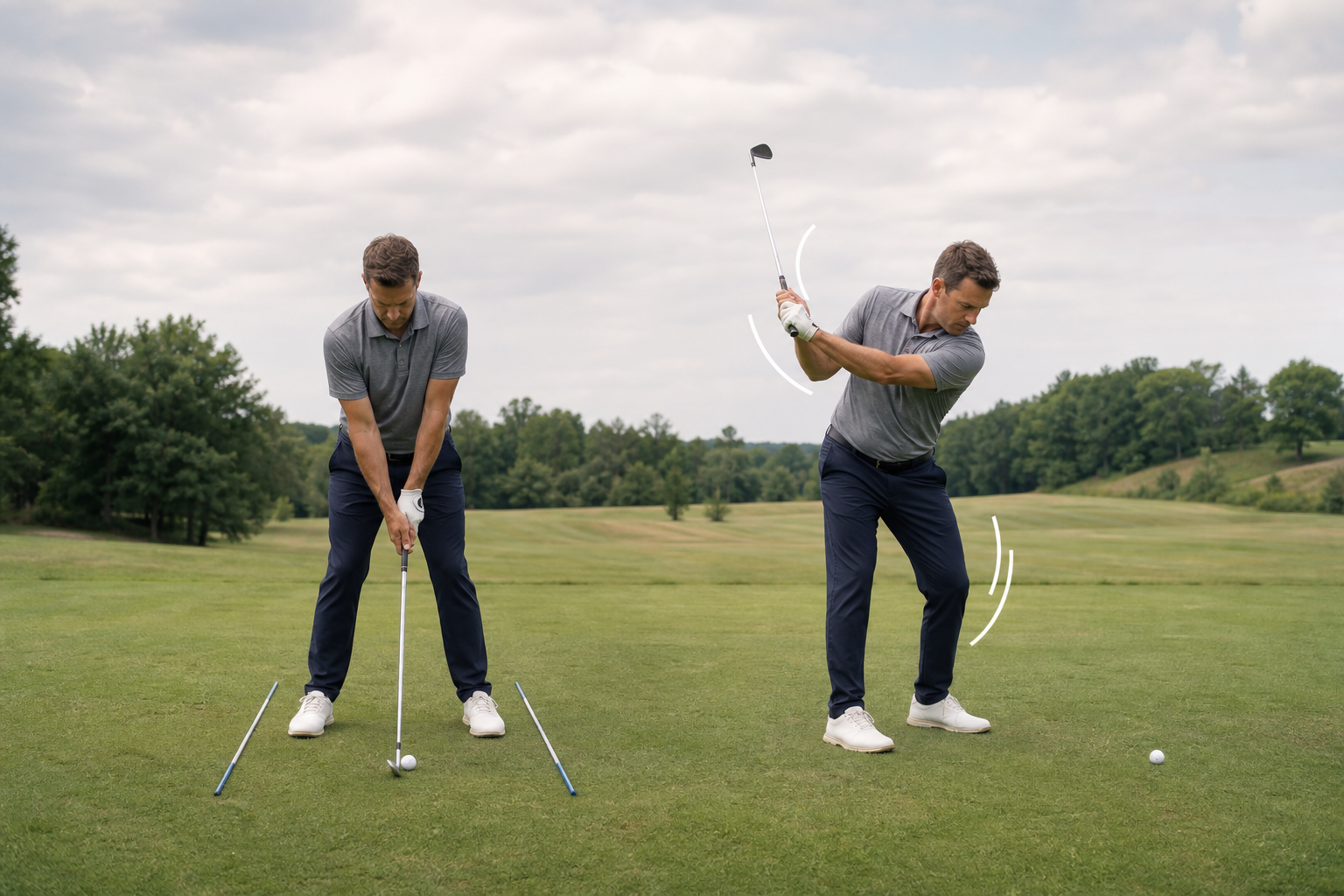
Built for: Golfers choosing between inexpensive practice aids for alignment, movement, rhythm, or speed awareness.
When a practice session produces one straight shot and five different misses, buying another gadget will not clarify much. Start with the question your practice needs to answer: Where am I aimed, or how does my swing move through time?
The quick verdict
Choose alignment sticks when you need a visible reference for setup, target line, ball position, or swing-space boundaries. Choose a swing tempo trainer when your intended focus is the pace and continuity of your movement rather than where you are aimed.
Best for Alignment sticks suit golfers who can describe a directional or setup question before a shot. A tempo trainer suits golfers who want to repeat a chosen rehearsal pace and notice whether rushed or interrupted motion changes their strike pattern.
Skip it if Skip both for now if you cannot state a single practice goal or observe a simple result, such as start direction, contact location, or whether a rehearsal stayed continuous.
The choice is not line versus speed; it is visible reference versus felt sequence.
Alignment sticks are most useful when the problem begins before the club moves. A golfer who alternates between aiming left, standing open, and placing the ball in a different spot needs an external reference that makes one setup variable easier to see. Put a stick on the ground, establish a chosen line, and compare each address position with that line. The useful outcome is not a prettier station; it is a setup you can reproduce without guessing.
A swing tempo trainer serves a different decision. It directs attention toward the sequence of the motion: whether the takeaway is hurried, whether the transition feels abrupt, or whether the through-swing loses continuity. Its value is the repeatable rehearsal, not a promise to cure a particular fault. If your target line is uncertain, tempo work can become a polished motion aimed in an unclear direction. If your setup is already deliberate but each swing arrives with a different pace, another ground line may not answer the question you are actually asking.
Guild recommendation: Name the feedback you lack before buying: choose sticks for a visible setup reference, and choose a tempo trainer for a repeatable movement rehearsal.
Use alignment sticks when the shot starts with an address question.
Imagine a player on the range who hits a solid seven-iron that starts well right, then moves the next ball left without changing targets. Before changing the swing, that player can use a ground stick to make the intended line concrete. Another player may feel cramped with the ball too close or too far away; a safely placed stick can provide a consistent spatial boundary during slow rehearsals. In both cases, the stick does not diagnose why the ball moved. It helps the golfer stop changing the reference from swing to swing.
This is why alignment sticks are a strong first purchase for golfers building a reliable practice station. They can support a narrow, observable task: set the clubface, feet, and ball position in the same relationship to a chosen reference, then watch initial direction. Keep the task modest. A stick is not a reason to turn a range session into a maze of lines.
Guild recommendation: Choose alignment sticks if you want to reduce uncertainty about where you are aimed or how you are arranged at address.
Use a tempo trainer when a deliberate rehearsal changes the shot more than another line.
Consider the golfer whose setup looks settled, yet whose contact changes when the round feels hurried. That player may benefit more from a consistent movement cue than from additional alignment marks. A tempo trainer can make the rehearsal itself the task: complete the motion at one chosen pace, keep balance, and notice whether the same pace is available on the next swing.
The constraint matters. Do not turn tempo work into an attempt to manufacture speed, and do not chase a prescribed rhythm that does not fit your current practice goal. Compare a few repetitions at a comfortable pace with a few ordinary shots. If continuity and balance become easier to notice, the trainer is providing useful feedback. If you cannot tell what changed, return to a simpler goal or seek instruction rather than adding more devices.
Guild recommendation: Choose a tempo trainer if you already have a clear target reference and want a repeatable cue for the pace and continuity of your motion.
Make the purchase serve purposeful practice.
Purposeful practice ties an activity to a specific goal, according to the PGA of America. That principle makes the comparison simpler. “Work on my swing” is too broad for either aid. “Set up to one target line for ten balls” is a workable alignment-stick goal. “Make ten balanced rehearsals at one comfortable pace before hitting” is a workable tempo-trainer goal.
Use one aid for a short block, record one outcome, and then decide whether it earned another session. Initial direction, repeatability of address, quality of contact, and whether the movement stayed continuous are all observations a golfer can make without claiming to diagnose a swing. Avoid switching aids after every poor shot. The point is to create enough consistency in the task that the result means something.
Guild recommendation: Buy the less complicated tool that supports the single goal you can measure during your next practice session.
Keep practice aids in their proper place on the course.
A practice aid can be useful on the range and still be unsuitable during a stipulated round. The USGA notes that equipment and its use during a stipulated round are governed by applicable rules. Before carrying or using any aid in competition or another formal round, check the rules that apply to that event and the product’s intended use.
That boundary is helpful even in casual play. Build the reference in practice, then play the shot by selecting a target and committing to it. The better aid is the one that eventually leaves you with a clearer routine rather than another object you feel unable to play without.
Guild recommendation: Treat the aid as a practice reference, and verify applicable rules before using equipment during a stipulated round.
Try this · 20 minutes.
The One-Question Feedback Trial
Use a clear practice area, a small set of balls, and a target. For the alignment portion, place one alignment stick on the ground as a reference without creating a tripping hazard. For the tempo portion, use a swing tempo trainer only with adequate space and according to its instructions. Keep other people well outside your swing area.
- Write one setup question, such as whether your feet and clubface are consistently set to the intended target line, and one movement question, such as whether your backswing and through-swing feel continuous.
- Hit six calm shots with the ground reference in place. Before each shot, set up, look at the reference, then look at the target; record only the initial direction you observe and whether your setup looked repeatable.
- Remove the ground reference and make six unhurried rehearsals with the tempo trainer, using the same counted pace for every rehearsal. Pause if you feel yourself forcing speed or losing balance.
- Hit six more shots after the rehearsals. Record only whether the motion felt continuous and whether contact or initial direction was more repeatable than in the first set.
- Choose the aid that made one observation clearer. Use that aid for the next practice session with the same single question rather than trying to fix several things at once.
What progress looks like: The trial succeeds when you can say which aid gave you a repeatable reference and name the observable outcome you will track next time.
Put the guide to work
These searches are a starting point—not a substitute for the fit and comparison criteria above.
Simple ground-reference option
Compare length, visibility, and whether the sticks can be placed securely on the ground for the reference you intend to use.
Movement-feedback option
Compare the trainer’s intended use instructions with the pace, balance, and swing-space constraints of your practice area.
If you buy through these links, Guild of Golf may earn a commission at no extra cost to you.
The practical takeaway
- Alignment sticks answer setup and target-reference questions; tempo trainers focus attention on the pace and continuity of movement.
- A useful aid produces an observation you can repeat, not merely a sensation you hope will last.
- Practice one question at a time, record a simple outcome, and keep the tool only if it makes that outcome clearer.
- Check applicable equipment rules before using a practice aid during a stipulated round.
Frequently asked questions
Should a beginner buy alignment sticks or a swing tempo trainer first?
Start with alignment sticks if the beginner needs a clear, visible reference for a repeatable practice setup. Start with a tempo trainer only when the practice goal is specifically to rehearse a comfortable, continuous pace and the golfer can keep the task simple.
Can I use both aids in one practice session?
Yes, but give them separate blocks and separate questions. Use the alignment reference to observe setup or initial direction, then use the tempo trainer for a paced rehearsal; avoid trying to interpret both forms of feedback on every swing.
Will either aid fix a slice or a hook?
Neither aid should be treated as a diagnosis or automatic correction for a ball-flight pattern. An alignment stick can clarify your chosen reference, while a tempo trainer can make a movement rehearsal more consistent; use the resulting observation to guide focused practice or a conversation with a qualified instructor.
May I use these aids during a competition round?
Equipment and its use during a stipulated round are governed by applicable rules. Check the rules and any event conditions that apply before using an aid during competition.
Sources used for this draft
- PGA of America: Practice With Purpose — The principle that purposeful practice connects an activity to a specific goal.
- USGA Equipment Rules — The note that equipment and its use during a stipulated round are governed by applicable rules.
Guild of Golf may earn a commission from qualifying purchases made through links associated with our affiliate program, at no additional cost to you.