
evergreen guide
High-MOI Drivers: Useful Forgiveness, Real Limits, and a Better Test
A practical guide to deciding whether a high-MOI driver belongs in your bag, using strike patterns and measured results rather than a forgiveness label alone.
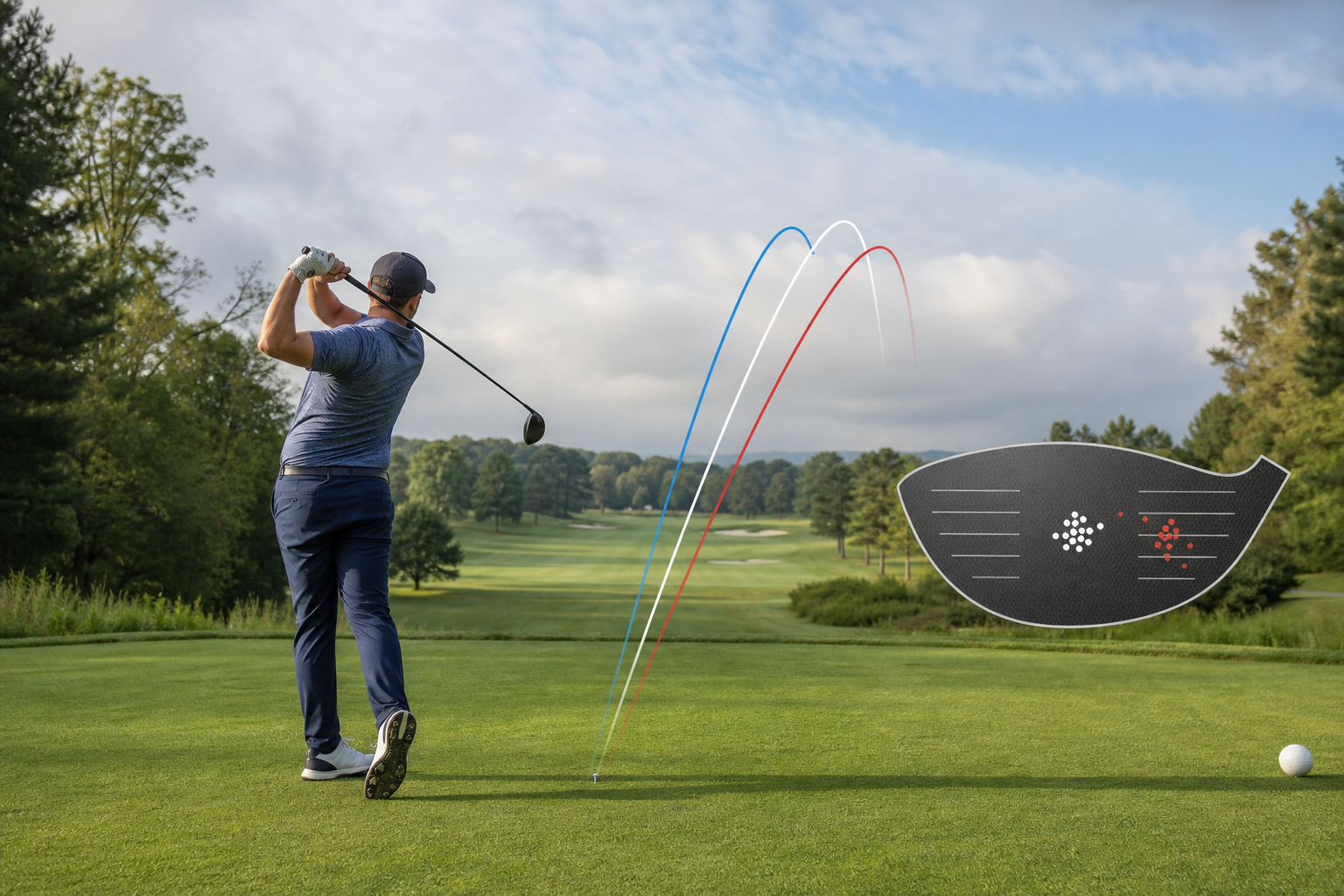
Built for: Golfers whose off-center strikes lose too much speed or curve unpredictably and who need to distinguish forgiveness from swing correction.
When a tee shot catches the heel or toe, it is tempting to buy the most forgiving driver available and expect the miss to disappear. A high-MOI option can be a sensible fitting candidate when it produces a tighter playable pattern on your usual misses, but it cannot replace a repeatable setup, strike location, or delivery.
The quick verdict
Consider a high-MOI driver when comparable shots produce a more playable dispersion and more consistent strike results, then confirm the choice in a measured fitting.
Best for Golfers with recurring off-center contact who want to make their ordinary miss less costly without rebuilding their swing on the tee box.
Skip it if Skip a blind purchase if your strike location, start direction, and curve vary wildly from shot to shot, because a fitting and a simple contact-pattern check will reveal more than a forgiveness label.
The tee-box problem is not always the driver
You hit a ball that starts right, another that curves left, then a third that feels solid but finishes short of the spot you expected. The natural conclusion is that the driver is unforgiving. Sometimes the more useful conclusion is simply that you need to identify what repeats. A high-MOI driver should be evaluated as an option for making your normal pattern more playable, not as a cure for every poor swing or every changing strike.
Guild recommendation: Before changing clubs, record ten to fifteen ordinary drives aimed at one target and look for a repeatable contact area, start line, and curve.
What forgiveness can usefully mean in a fitting
For this decision, define forgiveness by an outcome you can observe: with comparable swings, does one driver leave more shots in a playable area and make the result of your common off-center strike less extreme? That standard keeps the focus on your golf rather than on a label. A golfer who repeatedly catches the ball toward one side of the face has a testable reason to compare a high-MOI candidate. A golfer whose contact marks cover the entire face and whose ball starts in several directions has a less stable comparison.
Guild recommendation: Ask the fitter to compare candidates against your current driver using the same target and a meaningful sample of normal swings, rather than selecting a head from appearance alone.
High-MOI is not swing correction
A club choice cannot tell you why contact moves from heel to toe, why aim changes, or why one tee shot begins far from the intended line. It also cannot make a single test swing representative if you are trying to manufacture perfect contact. This matters on the course: a player with a predictable heel-side miss may seek a driver that keeps that miss more manageable, while a player whose miss changes every hole first needs a clearer picture of the pattern.
Guild recommendation: Treat a new driver as an equipment decision after you recognize your usual miss, not as a substitute for lessons or for a repeatable pre-shot routine.
Use measured fitting results instead of one spectacular drive
The PGA of America describes club fitting as an evaluation of equipment for the individual golfer using measured results. That approach is especially valuable here because a single centered strike can flatter almost any candidate, while several ordinary swings reveal the result you are more likely to take to the course. Compare the consistency of your shot pattern, your contact pattern, and your confidence addressing the ball. Do not let one long shot outweigh a broader, playable group.
Guild recommendation: Request a fitting comparison that includes your current driver and enough normal swings to show whether the candidate improves your usual result.
Conformance and sensible expectations
Driver design and conformance are governed by the USGA Equipment Rules. For the player, the practical takeaway is modest: stay focused on a conforming club and on the performance you can verify in a fitting. The best choice is not necessarily the head with the strongest forgiveness claim; it is the conforming option that gives your ordinary swing a clearer, more playable result.
Guild recommendation: Confirm that the driver you intend to use meets the applicable rules, then make the final choice from measured fitting evidence rather than marketing language.
Try this · 20 minutes.
Twenty-Minute Driver Pattern Check
Use your current driver, a safe practice range, ten to fifteen balls, alignment sticks or two clubs to mark a target line, and optional face-impact spray or removable impact tape.
- Choose one fairway-width target and place the alignment aid on the ground so you can return to the same aim each shot.
- Hit five shots at a comfortable playing speed, noting only where the ball starts, its general curve, and whether contact marks cluster in one area of the face.
- Take a short pause, then hit five more shots with the same target and speed rather than trying to correct every previous shot.
- If you have impact marks, group them as mostly centered, repeatedly toward one side, or scattered across the face.
- Bring these observations to a club fitting and ask to compare candidates using the same target, similar effort, and measured results.
What progress looks like: The useful result is a clearly observable baseline: a recurring strike area and a repeatable ball-flight pattern, or confirmation that the pattern is too scattered to judge a driver change reliably.
Put the guide to work
These searches are a starting point—not a substitute for the fit and comparison criteria above.
Compare driver face-impact feedback tools
Use one simple feedback method to see whether your contact has a repeatable pattern before comparing driver heads.
Compare alignment aids for tee-shot practice
A consistent target line makes it easier to separate changing aim from changing ball flight during a range session.
If you buy through these links, Guild of Golf may earn a commission at no extra cost to you.
The practical takeaway
- A high-MOI driver is most useful when it improves the outcome of a repeatable, ordinary miss.
- Forgiveness is an equipment outcome to compare, not a promise of swing correction.
- A scattered strike pattern makes it difficult to judge any driver fairly.
- Measured fitting results provide a better decision basis than one unusually good shot.
- Use a conforming driver and evaluate it against your current club under comparable conditions.
Frequently asked questions
Should I buy a high-MOI driver if I miss the center of the face?
It is worth comparing if your off-center contact occurs in a recognizable area and a fitting shows a more playable pattern with the candidate. If contact is scattered across the face, first establish a baseline pattern so the comparison means something.
Can a forgiving driver fix a slice or hook?
A driver can be evaluated for the ball-flight result it produces with your normal swing, but it cannot explain or correct the reason your start direction or curve changes. Use the club decision and swing improvement as separate tasks.
Why should I bring my current driver to a fitting?
Your current driver provides the comparison point. Measured results against the club you already play help show whether a candidate delivers an observable improvement rather than merely producing one memorable shot.
How many shots should I use to compare drivers?
Use enough normal swings to reveal a pattern, not just one or two perfect strikes. A fitter can guide the measured comparison for your individual swing.
Sources used for this draft
- USGA Equipment Rules — The statement that driver design and conformance are governed by the equipment rules.
- PGA of America: Club Fitting — The recommendation to use measured results in an individual club-fitting evaluation.
Guild of Golf may earn a commission from qualifying purchases made through shopping links, at no additional cost to the reader.