
evergreen guide
Choose a Game-Improvement Driver by Your Strike Pattern, Not the Label
A practical framework for choosing a more playable driver by looking at where you strike the face, how your misses finish, and which setup earns confidence on the tee.
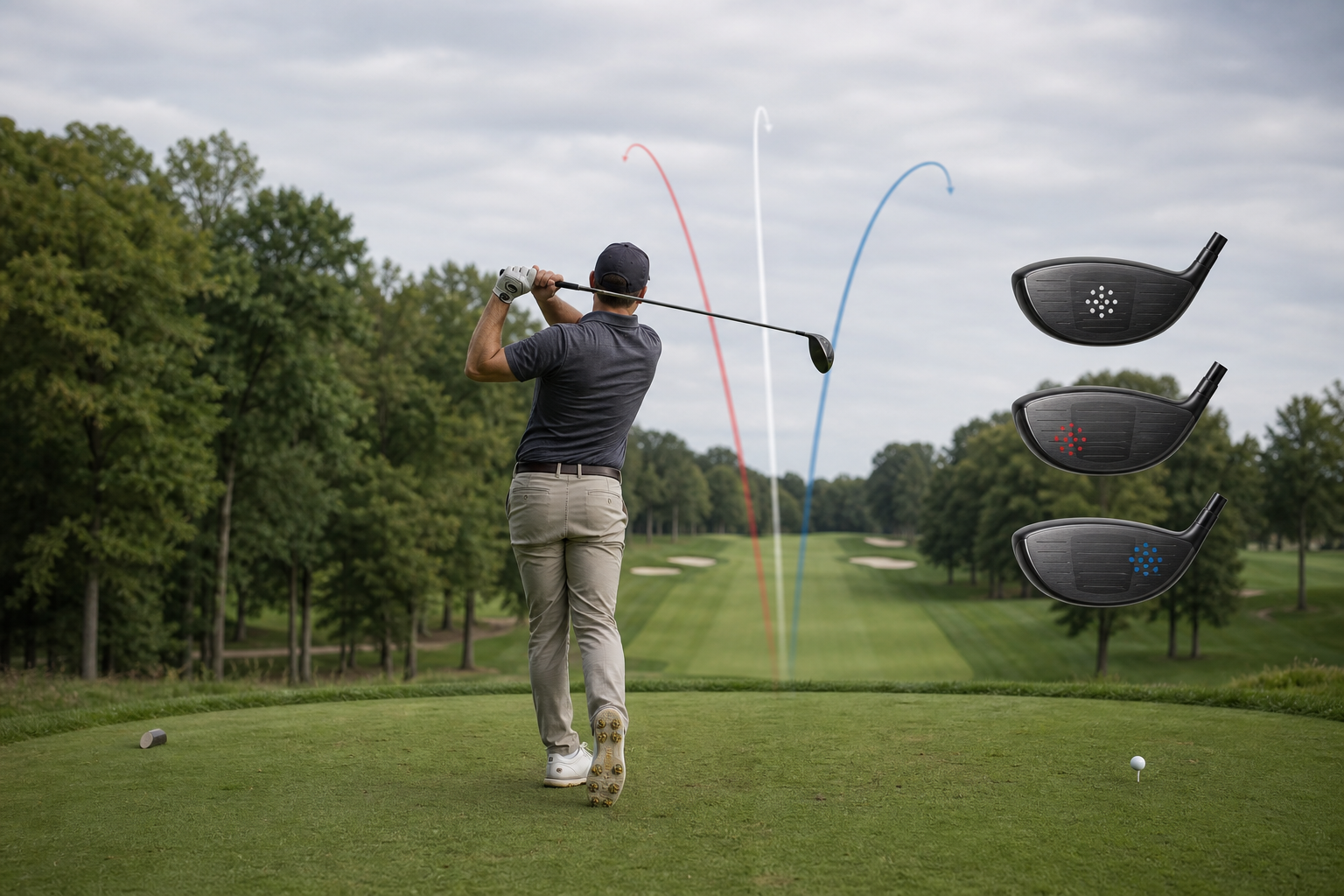
Built for: Golfers seeking a more playable driver who want to evaluate strike consistency, dispersion, launch, and confidence without relying on a vague game-improvement label.
When one tee shot starts in the fairway and the next leaks into trouble, a broad game-improvement label offers little help. Start with your recurring strike and your playable miss, then compare drivers through measured results and an honest on-course decision.
The quick verdict
Choose the driver that makes your common miss less punishing and your repeatable strike easier to trust, rather than the one carrying the most reassuring category label.
Best for Golfers who can describe where contact tends to occur on the face and whether their costly shots finish too far left, too far right, too low, or too high.
Skip it if Skip a driver change as the first answer if you have not yet observed a repeatable pattern across several tee shots; gather that information before treating equipment as the solution.
The tee-shot problem is rarely just distance
A golfer standing on a tight par four is not choosing between abstract labels. The real choice is whether to aim at the fairway bunker, take a safer line away from it, or reach for less than driver because the usual miss brings trouble into play. A more playable driver should improve that decision by making your typical result easier to anticipate.
Begin with the outcome that costs you shots. If a ball that finishes right is usually still in play while a left finish reaches trees or hazard, those misses are not equal even when they travel the same distance. The opposite may be true on your home course. Your driver choice should reflect the miss that leaves you a realistic next shot, not an idealized straight ball that appears occasionally.
Guild recommendation: Define your playable miss in course terms: the side of the hole, height, and starting line that most often still leave a recoverable next shot.
Read the strike pattern before comparing heads
Strike consistency is a practical filter because it tells you whether your current contact tends to arrive in one general area or wanders across the face. Use an impact marker over a modest set of normal swings, not only the best swings you make after several attempts. A player whose contact is commonly toward one side of the face has different comparison needs from a player whose marks are broadly scattered.
Do not turn a single strike mark into a verdict. Look for the tendency that repeats across a session. For example, a golfer who sees mostly heel-side contact and a recurring right finish has a usable comparison brief for a fitter. A golfer with marks spread from heel to toe should first prioritize a setup that produces a more repeatable overall pattern during the fitting.
Guild recommendation: Bring a simple record of contact location and finish direction to a fitting, then compare options using measured results rather than a marketing category.
Separate dispersion, launch, and confidence
Dispersion answers where the shots finish relative to the target. Launch describes the initial height picture you see from the tee. Confidence is whether the club lets you make a normal committed swing when the hole asks for driver. All three matter, but they should not be collapsed into one impression from a single well-struck ball.
A useful comparison is a small group of normal swings with the same target. Notice whether one option produces a finish pattern that fits the safe side of the hole more often. Then consider whether its launch picture suits the carry you need over the trouble in front of you. Finally, ask whether you would willingly use it on the first tee, not merely whether one shot looked impressive on a launch monitor.
Measured fitting results are valuable when comparing club options. They give structure to what you are seeing and help prevent a decision based on one memorable swing.
Guild recommendation: During a fitting, compare groups of shots against one target and ask which option produces the most usable pattern for your usual miss.
Use the label as a starting point, never the decision
Game-improvement is a broad shopping shorthand, not a personal playing diagnosis. Two golfers can both want a more playable driver for entirely different reasons: one needs a more predictable right-side miss on wide fairways, while another needs confidence to launch the ball over a forced carry. The same label cannot establish which result either golfer will see.
Conforming club requirements apply regardless of how a club is marketed. That is another reason to move past the label and toward the individual comparison: your strike marks, your dispersion, your launch needs, and the holes you actually play. If a driver helps your ordinary swing produce a result you can choose and manage, it has made a stronger case than a category description ever could.
Guild recommendation: Keep any candidate driver within the applicable equipment rules, then make the final choice from fit and measured performance on your normal swing.
A simple decision card for the fitting bay and the course
Before you compare options, write three short statements. First: “My most common face contact is __.” Second: “My costly finish is __.” Third: “My playable miss is ___.” This keeps the conversation tied to outcomes rather than to a promise of automatic improvement.
For instance, a player on tree-lined courses may decide that a modest right-side miss is acceptable but a left finish is not. Another player facing frequent carry hazards may put more weight on a launch picture that clears the hazard with a normal swing. Neither player needs a universal answer. Each needs a driver choice that makes a specific on-course decision less stressful and more repeatable.
Guild recommendation: Choose the option that best supports your stated playable miss across a group of normal swings, not the option associated with your single longest shot.
Try this · 25 minutes.
Twenty-Ball Strike-and-Finish Check
Use a driving range with a clear target line. Place one alignment stick or club on the ground aimed at the target, then use face-impact spray or removable impact tape if permitted. Hit only normal, comfortable tee shots with the same ball position and tee height for the full set.
- Hit five warm-up drives without recording results.
- Hit 15 additional drives in three sets of five, using the same target and normal on-course intent.
- After each shot, note the general face-contact area as heel, center, or toe, and note the finish as left of target, near the target corridor, or right of target.
- At the end, count the most common contact area and the most common finish pattern. Do not try to fix either pattern during this session.
- Use those two observations when comparing driver options, and ask a fitter to measure the options rather than relying on appearance or category language alone.
What progress looks like: The session is useful when you can state one repeatable contact tendency and one repeatable finish tendency, such as “mostly heel contact with shots finishing right,” without needing to judge your swing mechanics.
Put the guide to work
These searches are a starting point—not a substitute for the fit and comparison criteria above.
Impact-location feedback
Compare products that make face contact visible, because a clear strike pattern gives you a better starting point than a broad driver category.
Range alignment aid
Compare simple alignment aids that help you keep one target line during your observation session, so left and right finishes are easier to record consistently.
If you buy through these links, Guild of Golf may earn a commission at no extra cost to you.
The practical takeaway
- A game-improvement label is less useful than a clear record of face contact, finish direction, and the miss you can play from.
- Treat heel, center, and toe contact as observations to bring to a fitting, not as a self-diagnosis of swing mechanics.
- Compare dispersion, launch, and confidence separately, because each affects a different on-course decision.
- Favor a repeatable group of normal shots that keeps your typical miss playable over one standout drive.
- Use measured fitting results to compare options, and confirm that the club conforms to applicable equipment rules.
Frequently asked questions
What is a playable miss with a driver?
A playable miss is the result that still leaves you a realistic next shot on the courses you play. It might be a finish on the wide side of the fairway, short of a particular hazard, or in light rough rather than in trees.
Should I choose a driver based on my worst miss?
Start with the miss that occurs often enough to shape your tee-shot decisions. One isolated disaster shot is less useful than a pattern you can observe across a group of normal swings.
How many shots should I use to compare drivers?
Use enough normal swings to reveal a tendency rather than relying on one excellent strike. Recording a small group against the same target is more useful than chasing a single longest result.
Can a fitting help if I do not know my swing mechanics?
Yes. You can arrive with observable information instead: where you tend to contact the face, where shots finish, what carry you need, and which miss is still playable. The PGA of America notes that fit and measured results matter when comparing club options.
Does a game-improvement driver label guarantee a better result?
No. The label is a starting point for shopping, while your own comparison should be based on fit, measured results, strike consistency, and the shot pattern you can use on the course.
Sources used for this draft
- USGA Equipment Rules — The point that conforming club requirements apply regardless of marketing category.
- PGA of America: Club Fitting — The recommendation to compare club options through fit and measured results.
Guild of Golf may earn a commission from qualifying purchases made through shopping links or searches associated with this article, at no additional cost to the reader.