
comparison
Two-Piece vs. Three-Piece Golf Balls: Choose by Your Scoring Miss
A priority-led comparison of two-piece and three-piece golf balls that helps golfers evaluate feel, durability, flight, and short-game control without treating construction as a guarantee.
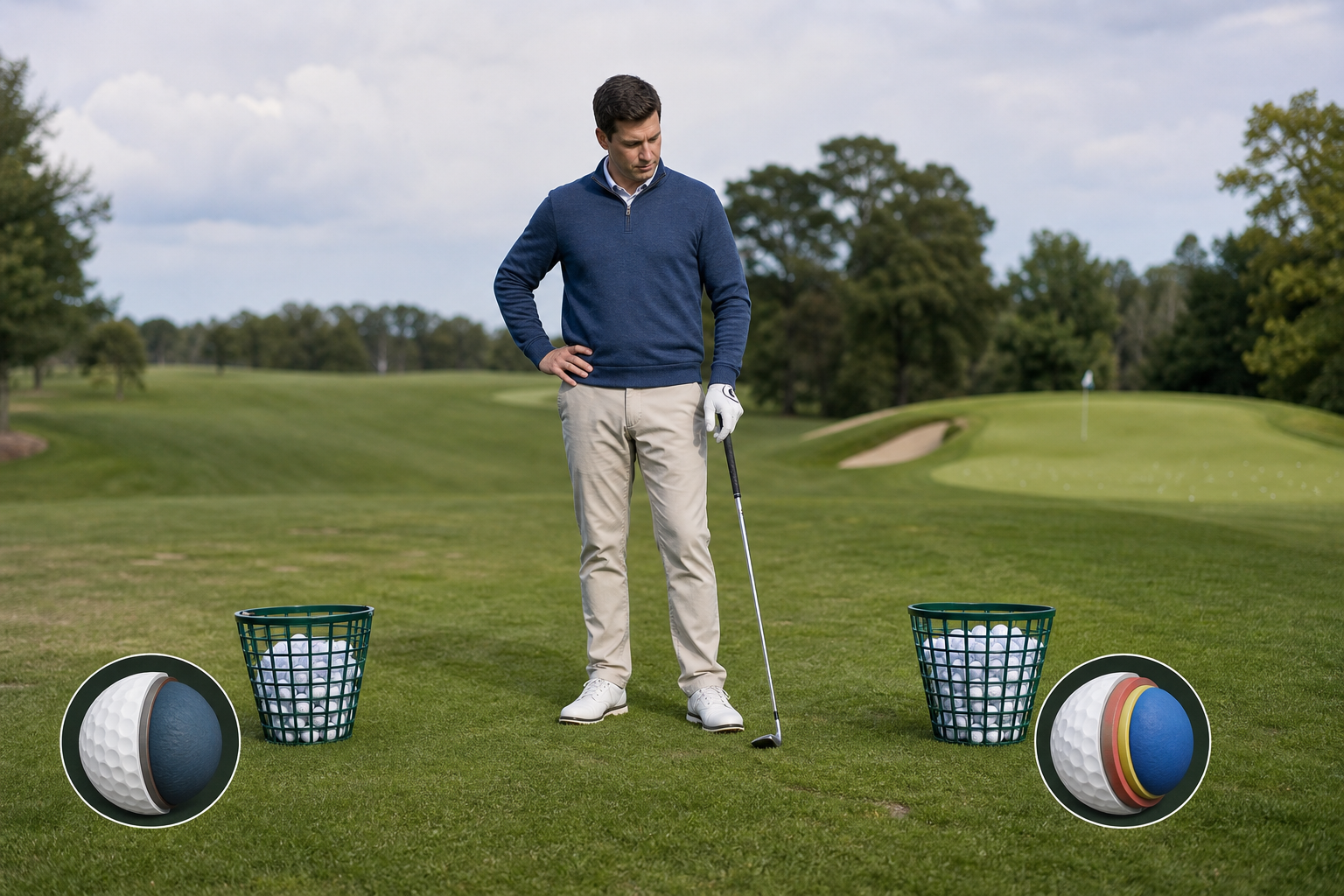
Built for: This guide is for golfers comparing golf-ball construction while balancing feel, durability, flight, and short-game control.
The wrong ball decision often shows up after a decent approach: the strike felt fine, but the ball finished somewhere you did not expect, or a scuff leaves you questioning the next tee shot. Start with the scoring outcome you want to improve, then compare a two-piece and a three-piece option under the same conditions.
The quick verdict
Choose the ball that produces the most repeatable results in the shots that cost you strokes, rather than assuming that two-piece or three-piece construction settles the question by itself.
Best for A two-piece versus three-piece comparison is most useful for golfers willing to test one option from each construction label and record launch, landing behavior, feel, and cover condition over a short session.
Skip it if Skip a construction-first choice if you have not identified whether your immediate priority is keeping a ball in service longer, liking the feedback at impact, managing a particular flight window, or improving predictability around the green.
Begin with the shot that creates doubt
Construction becomes a useful filter only after you name the problem. A golfer who loses confidence when a ball shows visible wear has a different decision to make from the golfer whose frustration comes on a 25-yard pitch that repeatedly finishes farther from the hole than expected. Likewise, a player trying to manage a familiar tee-shot window should judge that outcome in a controlled comparison, not from a single drive in changing wind.
Guild recommendation: Write down one primary priority and one secondary priority before shopping, such as cover condition first and greenside finish pattern second.
What the labels can and cannot decide
A two-piece or three-piece label describes construction, but it does not replace observation of the ball you are actually considering. Do not turn the label into a promise about feel, durability, flight, or short-game control. Those are the outcomes to compare with your clubs, your typical strike, and your usual course conditions. This approach also prevents a familiar mistake: choosing a ball for an imagined ideal swing while ignoring the shots you actually face on the course.
Guild recommendation: Treat construction as the way to organize a head-to-head test, then keep the option that best addresses your stated priority.
If durability is the constraint
For the golfer who dislikes replacing a ball after visible cover marks, inspect both candidates after the same number of comparable shots. Avoid comparing one ball that struck a cart path, tree, or other hard object against one that did not. The useful question is not whether either construction label is supposed to last longer; it is whether the specific ball remains acceptable to you after normal practice and play.
Guild recommendation: Choose the option whose post-round cover condition gives you confidence to keep playing it, provided its other results remain acceptable.
If feel and short-game control are the constraint
Around the green, vague impressions are less useful than finish patterns. Hit alternating chips from the same grass and toward the same landing area. Then ask a concrete question: which option more often leaves your next putt from the distance you prefer? Pair that record with a simple impact note, because a ball can feel appealing yet produce a less useful pattern for your touch.
Guild recommendation: Favor the ball that combines a repeatable greenside finish pattern with feedback you can trust when the score matters.
If flight is the constraint
Flight comparisons need restraint. A different strike, wind change, or target line can overwhelm a small sample, so do not declare a winner based on one high or low shot. Instead, alternate balls toward the same target and note the starting direction, apparent height, and landing area over several swings. The aim is to see whether either option repeatedly fits the window you are trying to play, not to assign a universal flight trait to a construction count.
Guild recommendation: Keep the ball that most often fits your intended target window without asking you to make an unusual swing adjustment.
Confirm eligibility when the round requires it
Golf balls used under the Rules of Golf must meet applicable equipment requirements. The USGA Conforming Ball List identifies balls that have been submitted and evaluated for conformance. If a competition or your committee requires a conforming ball, check the exact model rather than assuming that a construction label establishes its status.
Guild recommendation: Verify the precise ball against the current conforming list before an event in which conformity matters.
Try this · Thirty minutes.
The Same-Shot Ball Comparison
Bring equal numbers of one ball labeled two-piece and one ball labeled three-piece, plus a marker, a notebook, a wedge, and a putter. Use a quiet practice green with one short chip location and one level putting location, and keep the lie, target, club, and starting distance the same for each alternating ball.
- Mark the two groups with a simple private symbol so you can record them separately without mixing them.
- Hit six chips with each ball from the same lie, alternating one ball from each group. Record whether each ball finishes short, near, or past a chosen stopping zone, and note any difference you can consistently feel at impact.
- Roll six putts with each ball from the same distance to the same hole. Record the number that finish within a putter-length of the cup and write one brief feel note for each group.
- Inspect the balls after the session in the same light. Record visible cover marks rather than deciding from memory.
- If you have an appropriate practice range, repeat the alternating format with six tee shots toward one clear target and record the starting direction and landing area you observe. Do not alter your swing to make either ball work.
What progress looks like: One option earns the clearer choice when it repeatedly gives you a preferred finish pattern, impact feedback, or cover condition across the same shots, rather than merely producing one memorable shot.
Put the guide to work
These searches are a starting point—not a substitute for the fit and comparison criteria above.
Compare two-piece choices
Use this search after deciding that your comparison needs an explicitly labeled two-piece option and after identifying the shots you will use to judge it.
Compare three-piece choices
Use this search after deciding that your comparison needs an explicitly labeled three-piece option and after identifying the same test shots.
Check conformity before competition
Use this search only as a starting point, then verify the exact ball on the current USGA conforming list if you will use it in an event played under the Rules of Golf.
If you buy through these links, Guild of Golf may earn a commission at no extra cost to you.
The practical takeaway
- Let your most expensive scoring miss set the comparison: visible wear, uncertain feel, an unwanted flight pattern, or unpredictable greenside finishes.
- A two-piece or three-piece label is a starting category, not a performance guarantee.
- Alternate balls from identical locations and record results before committing to one option.
- Use the exact USGA Conforming Ball List entry to confirm a ball’s status when the Rules or a competition require conformity.
Frequently asked questions
Is a three-piece ball automatically the better choice for short-game control?
No. Construction count alone does not establish how a particular ball will finish on your chips and pitches. Compare specific options from the same lie and keep records of where they finish.
Is a two-piece ball automatically the better choice for durability?
No. If cover condition matters to you, inspect the specific balls after comparable use. A consistent, like-for-like comparison is more useful than a conclusion drawn from the label.
Can I use either construction in a competition?
Construction count does not by itself establish conformity. Golf balls used under the Rules must meet applicable equipment requirements, and the USGA Conforming Ball List identifies balls submitted and evaluated for conformance.
How many shots should I hit before deciding?
A short alternating session of six or more comparable shots per ball for each test is enough to expose a pattern worth investigating. If results are mixed, repeat the session on another day instead of forcing a verdict.
Sources used for this draft
- USGA Equipment Rules — The statement that golf balls used under the Rules must meet applicable equipment requirements.
- USGA Conforming Ball List — The statement that the list identifies balls submitted and evaluated for conformance.
Guild of Golf may earn a commission from qualifying purchases made through affiliate links, at no additional cost to the reader.