
evergreen guide
Choose a Home Launch Monitor That Serves Your Practice Plan
A practical framework for deciding whether a personal launch monitor offers measurements, feedback, and a home setup that support purposeful golf practice.
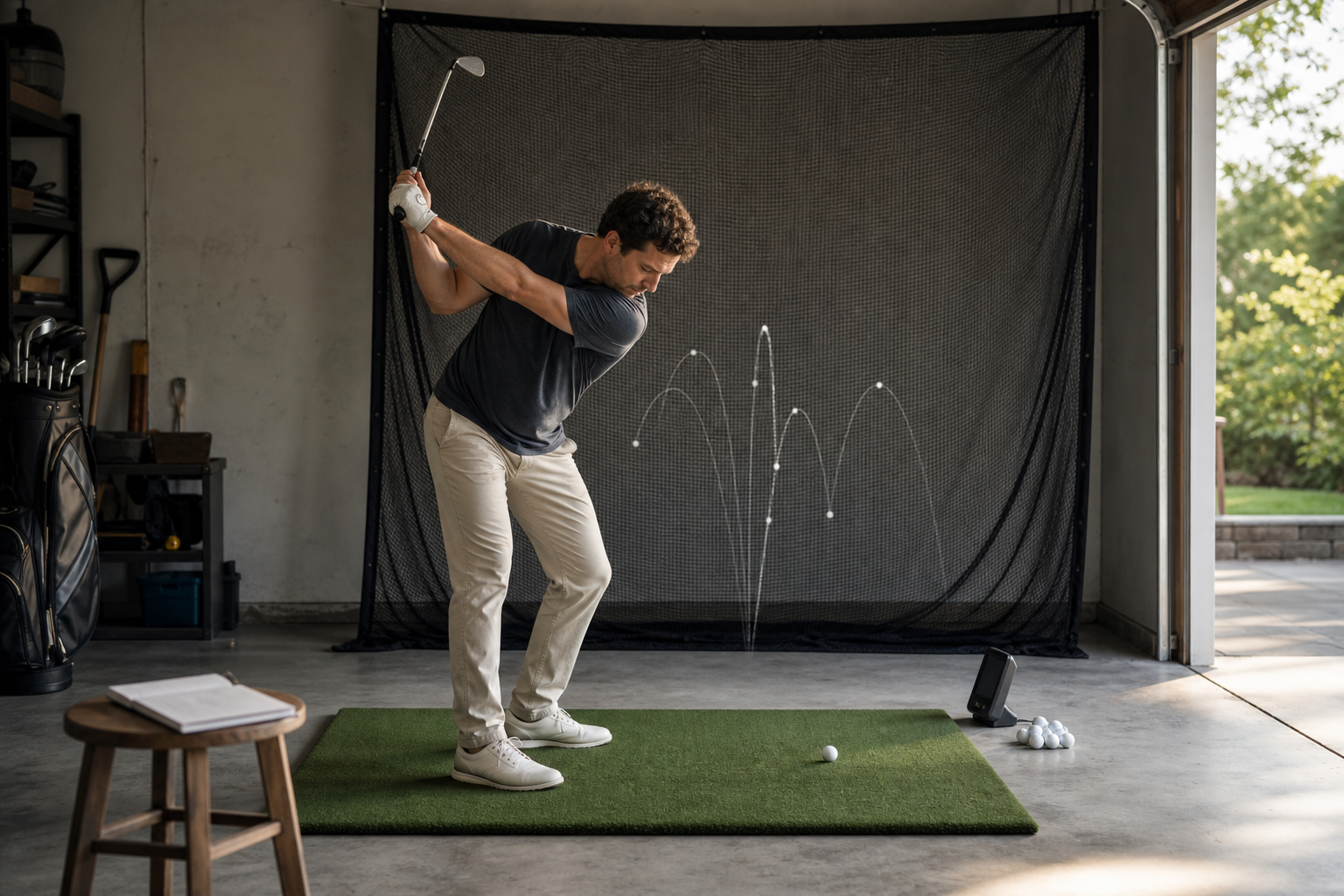
Built for: Golfers deciding whether a personal launch monitor provides the measurements and setup their practice actually needs.
A launch monitor can make a practice session more measurable, but only if the information it provides changes what you do on the next ball. Start with your practice goal, verify the product’s stated capabilities, and make sure the setup fits the space and routine you will actually use.
The quick verdict
Buy a personal launch monitor only when you can name a repeatable home-practice goal, identify the specific feedback that will guide your next attempt, and verify that the unit’s stated requirements fit your available space and budget.
Best for Golfers who already practice with a defined purpose and want a measurable way to repeat one focused task over several shots.
Skip it if Skip it for now if your practice space is uncertain, you do not yet know what decision the data will change, or you expect a device to replace a clear practice plan.
Begin with the shot problem, not the device
The familiar trap is buying a monitor because the promise of more feedback feels productive, then discovering that every session becomes a scroll through readings with no next decision. Start instead with a moment from your game: perhaps you want to make your practice more repeatable before a weekend round, or you want a simple way to compare two intentional attempts. The PGA of America advises practicing with a defined purpose and measurable structure. That principle gives a personal launch monitor a job: it should make one practice task easier to observe and repeat.
Guild recommendation: Write down one practice question before shopping. If you cannot finish the sentence, “I would use the feedback to decide whether to…,” delay the purchase and refine the practice goal first.
Make a short list of feedback you will act on
A useful monitor is not necessarily the one that presents the most information. It is the one whose displayed results you can understand well enough to connect to an observable practice decision. For example, a golfer working on a repeatable target pattern may value a result that helps compare attempts; a golfer who mainly wants a more structured range routine may value a display that makes a five-shot baseline easy to record. These are different jobs, and they can justify different products.
Guild recommendation: Limit your must-have list to one or two feedback items or outcomes. For each item, write the action it would change on the next ball; remove anything that is merely interesting to see.
Audit the home-practice setup before comparing claims
A monitor that sounds appropriate on a product page can still be a poor fit if its stated setup cannot be repeated in your home space. Measure the usable hitting area, account for where the device would sit, and consider the practical routine around each session: placing balls, viewing feedback, keeping notes, and packing equipment away. Also decide whether you need an independent display, a separate screen, or a simple written record after each set. The best arrangement is the one you can set up consistently without turning a 20-minute practice window into a technical project.
Guild recommendation: Sketch your practice bay and compare it line by line with each manufacturer’s stated placement and space requirements. Do not assume that a product described for home use will suit your particular room, garage, or net arrangement.
Treat product claims as items to verify
Marketing language can make two monitors appear comparable even when they describe their feedback, setup, or intended use differently. The Federal Trade Commission says objective advertising claims should have a reasonable basis. As a shopper, apply that standard by reading the maker’s current documentation and identifying precisely what is claimed, under what conditions, and what additional equipment or service may be needed. If a capability matters to your purchase, look for a clear statement rather than inferring it from a broad feature label.
Guild recommendation: Create a verification column for every finalist: stated measurements or outcomes, stated setup requirements, how feedback is viewed, ongoing requirements, and what remains unclear. Choose only after the essentials are documented clearly enough for your use case.
Choose the monitor that supports a repeatable session
Home practice becomes valuable when the same task can be performed, observed, and reviewed again next week. A complicated data view may be worthwhile for a golfer who will study it carefully, while a simpler presentation may be better for the player who has limited time after work and needs one clear comparison from set to set. Neither approach is automatically superior. The right choice is constrained by your time, space, willingness to record results, and the specific practice decision you want help making.
Guild recommendation: Favor the option that lets you run the One-Task Feedback Check twice a week with minimal friction. Skip options whose required setup or information load would cause you to abandon that routine.
Try this · 20 minutes.
The One-Task Feedback Check
Choose one club, one safe target arrangement appropriate to your space, and one launch-monitor measurement or result display that you believe relates to your chosen task. Keep the hitting position, ball position, and target arrangement unchanged, and have a notebook ready.
- Write one outcome goal in plain language before hitting, such as producing a more repeatable starting pattern or narrowing the variation you are trying to manage.
- Hit five comfortable shots without making a mid-set equipment or setup change, and record only the selected result plus a simple note on whether each shot matched your intended task.
- Review the five results, choose one modest adjustment to your next attempt, and state it before you hit again.
- Hit a second set of five shots using that one adjustment, recording the same information in the same way.
- Compare the two sets for repeatability and usefulness, rather than searching for a single ideal reading.
What progress looks like: The session succeeds when you can write one clear sentence explaining whether the displayed feedback helped you make a more informed next-shot decision.
Put the guide to work
These searches are a starting point—not a substitute for the fit and comparison criteria above.
Compare measurement needs
Use this search after you have written the one or two measurements or results that would genuinely guide your practice task.
Compare home setup requirements
Use this search to compare each product’s stated space, placement, and compatible-practice requirements against your actual hitting area.
Compare display and record keeping
Use this search if you need feedback that is easy to read and record during a short, focused session.
If you buy through these links, Guild of Golf may earn a commission at no extra cost to you.
The practical takeaway
- Purposeful practice comes first; a launch monitor should support a defined and measurable task rather than supply unfocused information.
- Select only the feedback you can connect to a next-shot decision.
- Verify stated measurements, setup conditions, display method, and any continuing requirements before buying.
- A compact, repeatable home routine is more useful than a feature list you will not use.
- Judge the purchase by whether it helps you compare intentional attempts over time.
Frequently asked questions
Do I need a launch monitor to practice effectively at home?
No. The supplied guidance supports purposeful, measurable practice, not the need for any particular device. A monitor is worth considering when it gives you feedback that makes a specific home-practice task more observable and repeatable.
What should I compare first between personal launch monitors?
Compare the feedback you will act on, the manufacturer’s stated home setup requirements, how you will view and record results, and any conditions or continuing requirements that affect your routine.
How many numbers should I use during a practice session?
Use as few as you need to make a sound next-shot decision. For many home sessions, one selected result plus a brief note on whether the attempt matched the task is a more workable starting point than trying to interpret every available display.
How can I check whether an advertised capability matters to me?
Translate the claim into your practice plan. Ask what you would do differently after seeing that result, then verify the claim and its stated conditions in current manufacturer documentation before treating it as a reason to buy.
Sources used for this draft
- PGA of America: Practice With Purpose — The recommendation to use a defined purpose and measurable structure for practice.
- FTC Advertising and Marketing Basics — The recommendation to verify objective product claims and the conditions attached to them.
Guild of Golf may earn a commission from qualifying purchases made through affiliate links, at no additional cost to you.