
comparison
Putting Mirror vs. Putting Mat: Choose Feedback That Changes Your Practice
A purposeful guide to choosing a putting mirror or putting mat when home practice needs either setup feedback or ball-roll feedback.
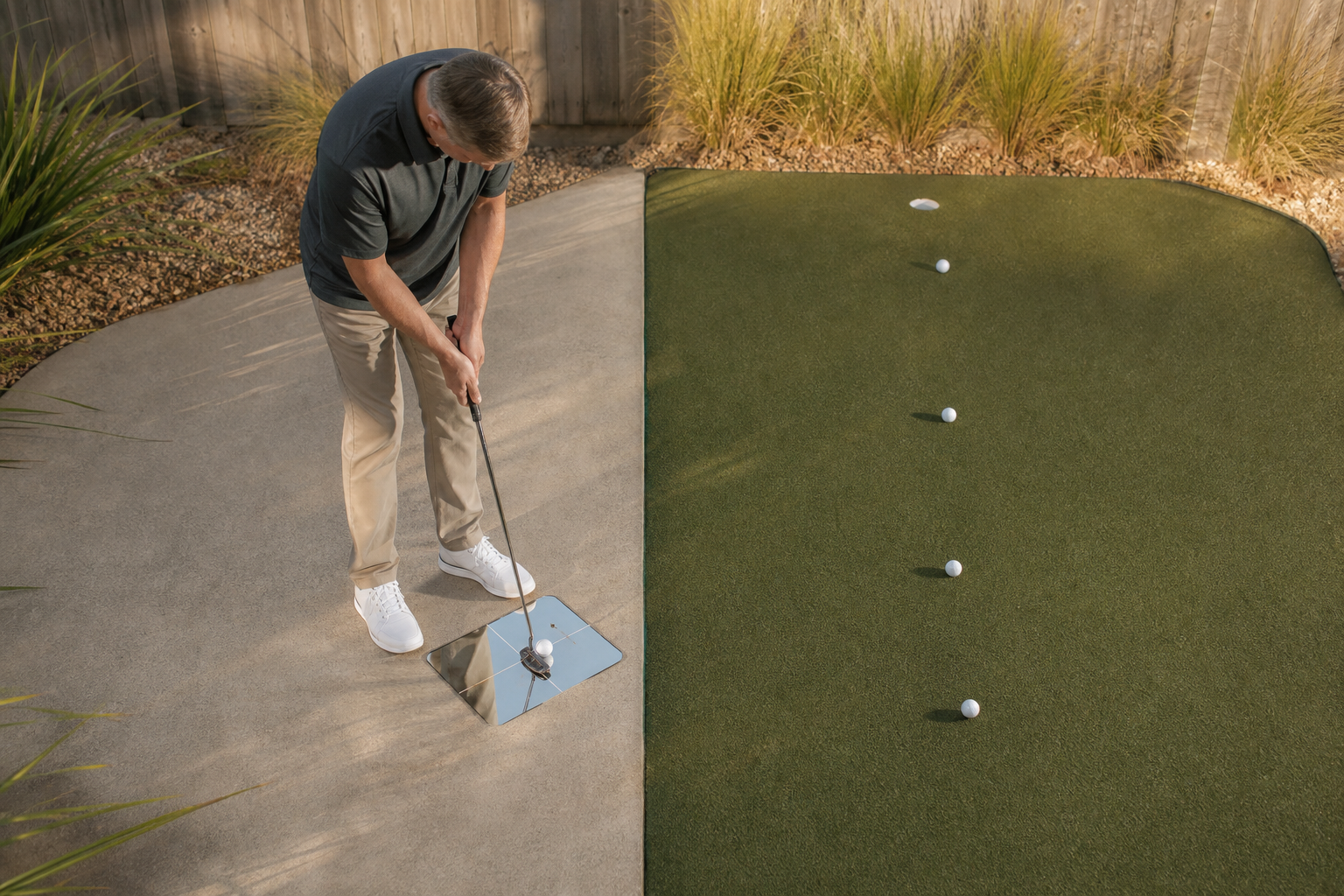
Built for: Golfers choosing one practice aid and deciding whether they need setup feedback or ball-roll feedback.
If a straight five-footer keeps starting left, the useful question is not which aid looks more serious on the floor. It is whether you need to see your address position before the stroke or judge what the ball does after it leaves the face.
The quick verdict
Choose a putting mirror when the main uncertainty is how you aim, set your eyes, or return the putter at address. Choose a putting mat when you need a repeatable place to rehearse start line and pace with a ball rolling toward a target.
Best for A mirror is best for golfers who can name a setup checkpoint they want to observe. A mat is best for golfers who will practice short putts regularly and want each repetition to end with an observable ball-roll result.
Skip it if Skip the mirror if you are unlikely to pause and check a setup reference before each set. Skip the mat if space is limited or if you expect a home surface to answer every question about changing course conditions.
Begin with the miss you can actually observe
Picture the familiar living-room session: ten balls are struck, several disappear into a cup or target, and nothing is learned about why the next putt starts poorly. Purposeful practice begins by narrowing the job. The PGA of America advises golfers to practice with defined purpose and structure, which makes the mirror-versus-mat decision much simpler. Choose the tool that reveals the part of the putt you are prepared to watch.
A putting mirror is primarily a pre-stroke tool. It gives the golfer a chance to inspect a repeatable address picture before the ball moves. A putting mat is primarily a post-stroke tool. It gives the ball a consistent home runway so the golfer can observe whether it starts where intended and finishes with the intended pace. Neither replaces reading a real green, where the line of play and the putting-green context remain central to the game under Rule 13.
Guild recommendation: If your practice notes sound like “I do not know where I was aimed,” start with a mirror. If they sound like “I want to see whether the ball starts and arrives where I intended,” start with a mat.
What a mirror can make visible
The strongest case for a mirror is a golfer who rushes the address position. For example, a player may practice four-footers after work yet rarely know whether each ball was set down with the same visual picture. A mirror inserts a useful pause: set the putter, look at one reference, then make the stroke. The value is not in staring longer. It is in making the same brief check often enough that practice has a defined beginning.
That constraint is also its limitation. A mirror does not make the ball travel toward a distant target for you, and it cannot tell you how a putt will react on a sloped, changing outdoor green. It is a focused choice for golfers willing to separate setup observation from ball-roll practice instead of trying to solve both in every stroke.
Guild recommendation: Buy a mirror when you can identify one address checkpoint you will use consistently, such as a repeatable view of your eyes, putter face, or ball position.
What a mat can make measurable
A mat earns its place when the golfer needs repetitions with a clear beginning and end. Set a target, roll a ball, and observe two plain outcomes: did it begin on the chosen line, and did it finish in the intended area? That is especially useful for the golfer who owns a sound pre-putt routine but has no convenient way to hit a sequence of short putts at home.
The tradeoff is that a mat can tempt a player to chase makes without defining the task. It also cannot reproduce every outdoor putting-green condition. The rules context matters here: putting on the course involves a line of play on the putting green, while a home practice surface is best treated as a controlled place to rehearse one narrow skill. Use the mat to build a repeatable process, then take that process to the course rather than assuming the surface has settled the read.
Guild recommendation: Buy a mat when you have enough clear floor space to leave it out or deploy it easily, and when you will use a fixed target to judge start line and finishing pace.
If you can buy only one, choose the friction you need removed
A single-aid decision is often a decision about friction. Some golfers have a hallway but no desire to get on the floor and inspect a reflective reference before every ball. Others have a compact setup area and want a quick visual check rather than a longer rolling surface. The better purchase is the one you will set up for ten focused minutes on an ordinary Tuesday.
Choose a mirror if the obstacle is uncertainty before the stroke. It suits the golfer rebuilding a dependable address routine, the player who changes ball position from rep to rep, or anyone whose home space favors a compact station. Choose a mat if the obstacle is a lack of repeatable ball-roll reps. It suits the golfer who wants a target, a fixed distance, and a visible result after every stroke.
There is no need to pretend the aids are rivals in every setting. A mirror and mat can complement one another later: observe the setup, then roll to a target. But the first purchase should answer the more immediate question, not create a larger pile of practice equipment.
Guild recommendation: For the most disciplined first purchase, write one sentence before shopping: “I need to observe my setup,” or “I need to observe my ball roll.” If the sentence feels unclear, wait to buy and complete the practice plan on the floor with a simple target first.
Turn home repetitions into course-ready attention
The point of home practice is not to make the room feel like a putting green. It is to make a useful part of your routine more dependable when the putt matters. On the course, the player still has to choose a line of play and respond to the particular putting green. Rule 13 supplies that putting-green context; a home aid supplies a narrower rehearsal environment.
Carry only one cue from home to the course. A mirror user might carry a brief, familiar address check before looking at the hole. A mat user might carry the commitment to choose a start line and let the ball roll toward it. One cue is portable. Several competing cues usually are not.
Guild recommendation: After two or three home sessions, use one observable home intention during a casual round and judge only whether you completed it before each putt, not whether every putt fell.
Try this · 15 minutes.
The Two-Question Home Putting Session
Use a flat, clear indoor area. Place a ball on your chosen aid or on the floor, choose a small target or reference point roughly a short-putt distance away, and use the same putter and ball position for the whole session. If using a mirror, choose one visible address reference to check. If using a mat, choose one start-line target and one finishing target.
- Spend the first five minutes making ten rehearsal setups without striking a ball. With a mirror, look only at your chosen address reference, then step away and reset. With a mat, place the ball behind the same starting point and aim it at the same target.
- Spend the next five minutes hitting ten putts. Before each stroke, state one simple intention: either “same setup picture” for the mirror or “start at the target” for the mat. Do not add a second technical task.
- Spend the final five minutes recording only the outcome that matches the aid. For a mirror, count how often you completed the same deliberate setup check before starting. For a mat, count how often the ball began on the intended line and reached the chosen finishing area. Repeat the session later with the same target rather than changing several variables at once.
What progress looks like: The session is working when you can report one consistent, observable result: repeated completion of the same setup check with the mirror, or an increasing number of balls that start on the intended line and finish in the selected area with the mat.
Put the guide to work
These searches are a starting point—not a substitute for the fit and comparison criteria above.
Compare putting mirrors
Compare the size of the viewing area, the stability on your practice surface, and whether its visible references help you check one specific address position rather than creating a cluttered routine.
Compare putting mats
Compare the available home space, the target layout, and whether the surface gives you enough uninterrupted room to repeat a short start-line and pace drill.
Compare simple target aids
A simple target can make either choice more purposeful if your current practice lacks a clear finish point for every ball.
If you buy through these links, Guild of Golf may earn a commission at no extra cost to you.
The practical takeaway
- A putting mirror is the more focused choice when you need to observe a repeatable address picture before the stroke.
- A putting mat is the more focused choice when you need repeated evidence of start line and finishing pace after the stroke.
- Purposeful practice needs one task and one observable result, not a long list of swing or stroke thoughts.
- A home aid can organize practice, but it does not replace adapting to the line of play and conditions on an actual putting green.
- The best first purchase is the aid that fits your available space and removes the biggest obstacle to regular, structured practice.
Frequently asked questions
Is a putting mirror or putting mat better for a beginner?
The better choice depends on the beginner’s immediate task. Choose a mirror if the priority is learning to pause and create a consistent address picture. Choose a mat if the priority is rolling repeated short putts toward a clear target. A beginner should avoid trying to monitor several checkpoints at once.
Can I practice putting effectively without either aid?
Yes. A clear starting point, a small target, and a defined scorekeeping method can create a purposeful session on a suitable home surface. A mirror adds setup observation, while a mat makes repeated ball-roll practice easier to organize.
Should I practice makes or start line on a putting mat?
Start with a defined start-line and finishing-area task. A made putt can be encouraging, but the more useful home observation is whether the ball began where intended and finished at the selected target with the intended pace.
Will a home putting mat prepare me for course greens?
It can help you rehearse a repeatable process, but it does not replace the need to read and respond to the particular putting green on the course. Treat it as controlled practice for one part of putting rather than a duplicate of every on-course condition.
Sources used for this draft
- PGA of America: Practice With Purpose — The recommendation to use a defined purpose, structure, and a narrow observable task in each practice session.
- USGA Rule 13: Putting Greens — The rules context for putting greens and lines of play, and the distinction between home rehearsal and on-course putting conditions.
Guild of Golf may earn a commission from qualifying purchases made through shopping links, at no additional cost to the reader.