
evergreen guide
Build Wedge Loft Gaps Before You Buy Another Wedge
A practical way to map the scoring clubs you already own, identify a usable gap, and buy only when a new wedge solves a clear on-course shot problem.
Built for: Golfers who have an awkward distance gap near the green and are considering a gap, sand, or lob wedge.
The familiar temptation is to blame one uncomfortable number—say, a partial approach that feels too hard for one club and too easy for the next—on a missing wedge. Start with the full scoring-club sequence instead. A sensible setup gives each wedge a job, while leaving room for the shots and course conditions you actually face.
The quick verdict
Do not choose a new wedge from its label alone. Write down the lofts of your pitching wedge and current wedges, test the carries you can reproduce, and add a club only when it creates a clear, useful space between two existing options.
Best for Golfers whose pitching wedge-to-highest-wedge progression contains one repeatable distance or trajectory problem that cannot be covered comfortably with a fuller or shorter swing.
Skip it if Skip a purchase when the problem is mainly inconsistent strike, uncertain existing lofts, or a desire for a specialty shot you rarely attempt on the course.
The bad number is usually a bag problem before it is a buying problem.
Picture a 70-yard approach over a bunker. Your sand wedge feels like too much club with a normal swing, but taking speed off it produces a strike you do not trust. It is easy to conclude that a lob wedge is the answer. Yet the better first question is whether the rest of the scoring end of the bag is organized around distinct jobs.
Start with the pitching wedge, not the new club you have in mind. Its loft sets the top of the wedge sequence, and the lofts of the wedges below it show whether the apparent hole is actually a large space, an overlap, or an uncertainty. If you do not know a club’s loft, check the club marking or ask a qualified fitter or shop to help identify the complete setup. PGA of America guidance describes fitting as an evaluation of both the golfer and the complete equipment setup, which is the right frame for a wedge decision.
Guild recommendation: Make a one-line inventory—pitching wedge, gap wedge, sand wedge, lob wedge—and record each club’s visible loft before researching a replacement.
Separate loft spacing from playable spacing.
Loft is a useful organizing tool, but the shot that matters is the one you can repeat. Two neighboring wedges may look neatly separated on paper yet produce nearly identical landing areas for you. The opposite can happen as well: a modest loft change may give you a noticeably different flight and carry because of how you deliver the club.
That is why a range map should guide the purchase. Use ordinary swings first. A club earns a place when it supplies a landing window that its neighbors do not cover comfortably. Avoid building the whole set around a single maximum effort or a once-in-a-round finesse shot. Those swings may be valuable, but they are weak foundations for a permanent slot in a limited bag.
For the golfer facing that bunker-carrying 70-yard shot, the observable question is simple: do the two surrounding wedges leave an uncovered landing area when both are swung in a controlled, repeatable way? If they do, a new loft may be justified. If one wedge already reaches the number with a manageable three-quarter swing, the purchase may solve less than practice will.
Guild recommendation: Use your own representative landing areas to decide whether a gap exists; do not treat evenly spaced loft stamps as proof that one does.
Give each wedge a primary job, then check for crowding.
A practical wedge setup often contains roles rather than trophies. The pitching wedge may cover the longest scoring approaches. A middle wedge may handle ordinary partial approaches. Another may be the club you prefer from sand or softer turf. The highest-loft option may be reserved for occasions when you need height and a short landing window. Your roles can differ, and that is the point.
Crowding occurs when two wedges ask you to hit essentially the same shot. If both are used for the same stock carry and neither has a reliable secondary job, carrying both may not improve your scoring choices. Conversely, a club with a narrower distance role can still earn its place if it gives you a dependable bunker option or a trajectory your adjacent wedge cannot provide comfortably.
Do not assume that a wedge’s common name determines its function. A “sand” or “lob” label is less useful than the shot you expect to play with it, the lies you commonly encounter, and the separation it preserves from the next club. Club design and conformance are governed by the USGA Equipment Rules; when purchasing, choose equipment that is appropriate for the rules under which you intend to play.
Guild recommendation: Write a short job description for every current wedge: longest approach, middle approach, bunker or soft-ground play, or high short-sided shot. Investigate any club whose job duplicates its neighbor.
Buy the smallest solution that fixes the identified hole.
Once your map shows one uncovered window, decide what kind of hole it is. A distance-only hole between the pitching wedge and current sand wedge points toward comparing a middle-loft option. A bunker or soft-condition problem may call for comparing sole behavior and the shots you can play from your usual sand and turf. A high, short-sided requirement may justify evaluating a higher-loft option, but only if it does not turn your current highest wedge into an unused duplicate.
This is where a fitting can be more useful than guessing from a rack. The PGA of America describes club fitting as an evaluation of the golfer and the complete equipment setup. Bring your loft list, your practice notes, and one or two specific on-course situations. That gives the fitting conversation a constraint: solve the uncovered shot without creating a new overlap.
There is also a good reason to leave a slot empty. If your current wedges cover your ordinary carries and you can vary trajectory with confidence, another wedge may add decisions without adding a clearer answer. Better information is a win even when it tells you not to buy.
Guild recommendation: Take your club inventory and three-target results to a fitting, and ask the fitter to evaluate the full scoring sequence rather than a single wedge in isolation.
Try this · 30 minutes.
The Three-Target Wedge Map
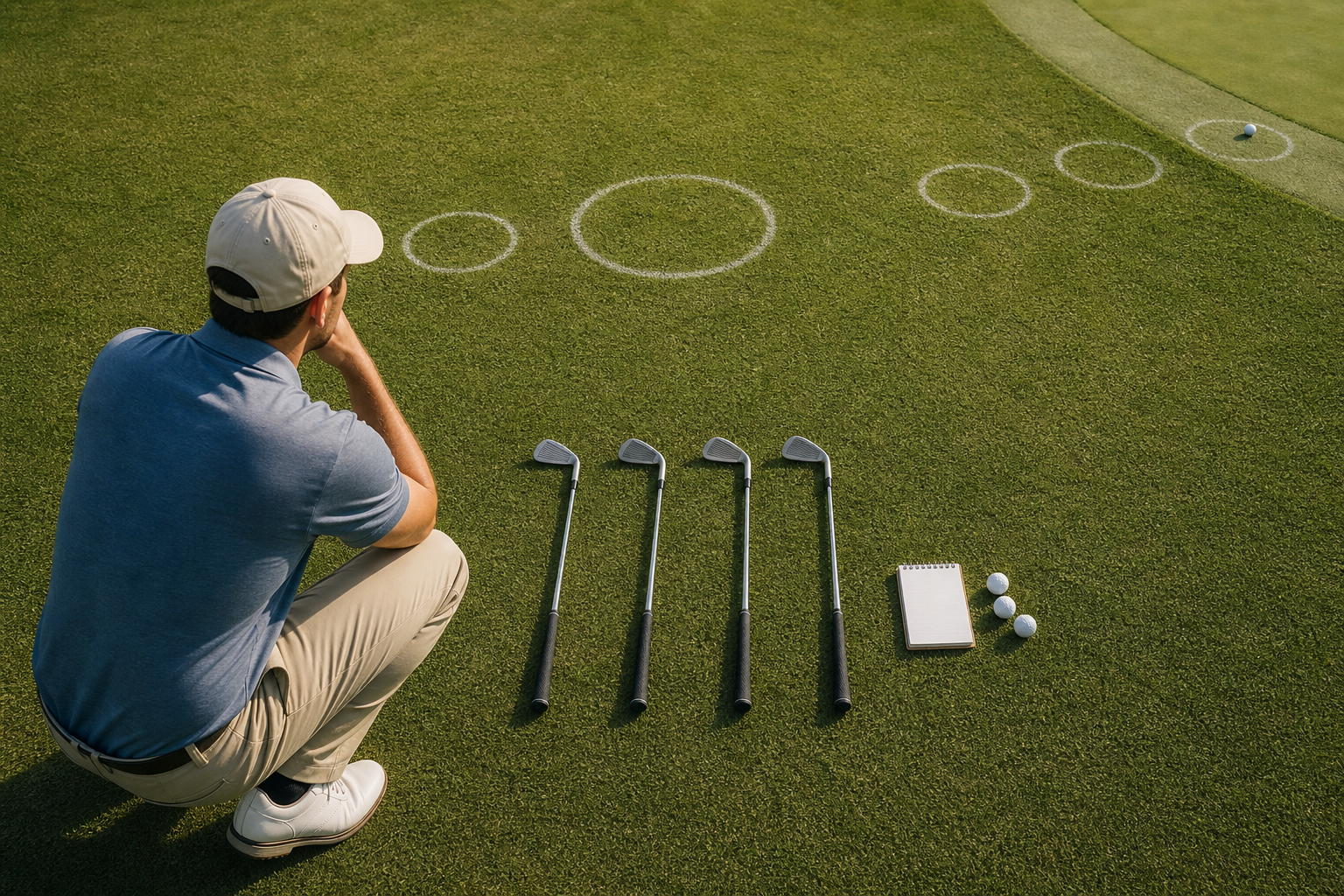
Use a practice area with three safe, visible targets or landing zones at different distances. Bring your pitching wedge and every wedge you currently carry, plus a notebook. Begin with the balls in one consistent lie, and use the same type of swing for each group rather than trying to manufacture specialty shots.
- Write down the stated loft on each scoring club if it is visible, and place the clubs in loft order from pitching wedge to highest loft.
- Choose a comfortable, ordinary stock swing length for each club. Hit five balls with the pitching wedge, then five with each wedge, aiming at the same middle target first.
- For every club, record the general landing area of the three most representative shots rather than chasing the single best strike.
- Move to the nearer and farther targets. Notice whether an adjacent pair gives you two clearly different, repeatable landing windows, or whether both clubs repeatedly crowd the same window.
- Circle only one problem at the end: a space where neither neighboring club reaches the intended landing zone with a comfortable swing. If no such space appears, keep the current set and practice the shot you already have.
What progress looks like: The useful result is a simple map that shows either a repeatable uncovered landing window or clear evidence that your existing wedges already overlap enough for the shots you play.
Put the guide to work
These searches are a starting point—not a substitute for the fit and comparison criteria above.
Compare loft-marked gap wedges
Use this only after you know the loft of your pitching wedge and the wedge below it, so you can compare candidates that fit the open space rather than duplicate a current club.
Compare sand wedges with varied sole shapes
A sand-wedge search is useful when the missing job is mainly bunker or soft-ground play, not simply a number on a yardage chart.
Compare higher-loft wedges
Consider higher-loft models only when you have identified a real need for a higher, shorter landing shot and can preserve useful separation from your current highest-loft wedge.
If you buy through these links, Guild of Golf may earn a commission at no extra cost to you.
The practical takeaway
- Begin with the pitching wedge and map every current scoring-club loft before shopping.
- A useful wedge gap is an uncovered, repeatable landing window, not merely an uneven-looking set of loft numbers.
- Give each wedge a primary on-course job, and question any pair that produces the same ordinary shot.
- Choose a new wedge only when it solves one defined problem without crowding the club beside it.
- A complete-setup fitting is a sensible next step when your own map reveals a persistent gap.
Frequently asked questions
How do I know whether I need a gap wedge?
You may need one when your pitching wedge and next wedge leave a repeatable landing area that neither club covers with a comfortable, ordinary swing. Confirm that result with a simple practice map before buying.
Should I choose a wedge by its name?
No. Treat names such as gap, sand, and lob as rough categories. Compare the club’s loft position in your present set and the specific shot job it must perform.
What should I bring to a wedge fitting?
Bring the loft list for your pitching wedge and wedges, notes from a controlled practice session, and examples of the on-course shots that cause trouble. A fitting evaluates the golfer and the complete equipment setup.
Can I keep my current wedges if the lofts are not perfectly even?
Yes, if the clubs create useful, repeatable landing windows and distinct jobs for your game. A visually uneven loft progression does not by itself prove that a new wedge is needed.
Sources used for this draft
- PGA of America: Club Fitting — The recommendation to consider fitting in the context of the golfer and the complete equipment setup.
- USGA Equipment Rules — The statement that club design and conformance are governed by the equipment rules.
Guild of Golf may earn a commission from qualifying purchases made through affiliate links, at no additional cost to the reader.