
comparison
Putting Mirror vs. Putting Mat: Choose Feedback That Fits Your Practice
A purposeful comparison for golfers choosing between setup feedback from a putting mirror and ball-roll feedback from a putting mat.
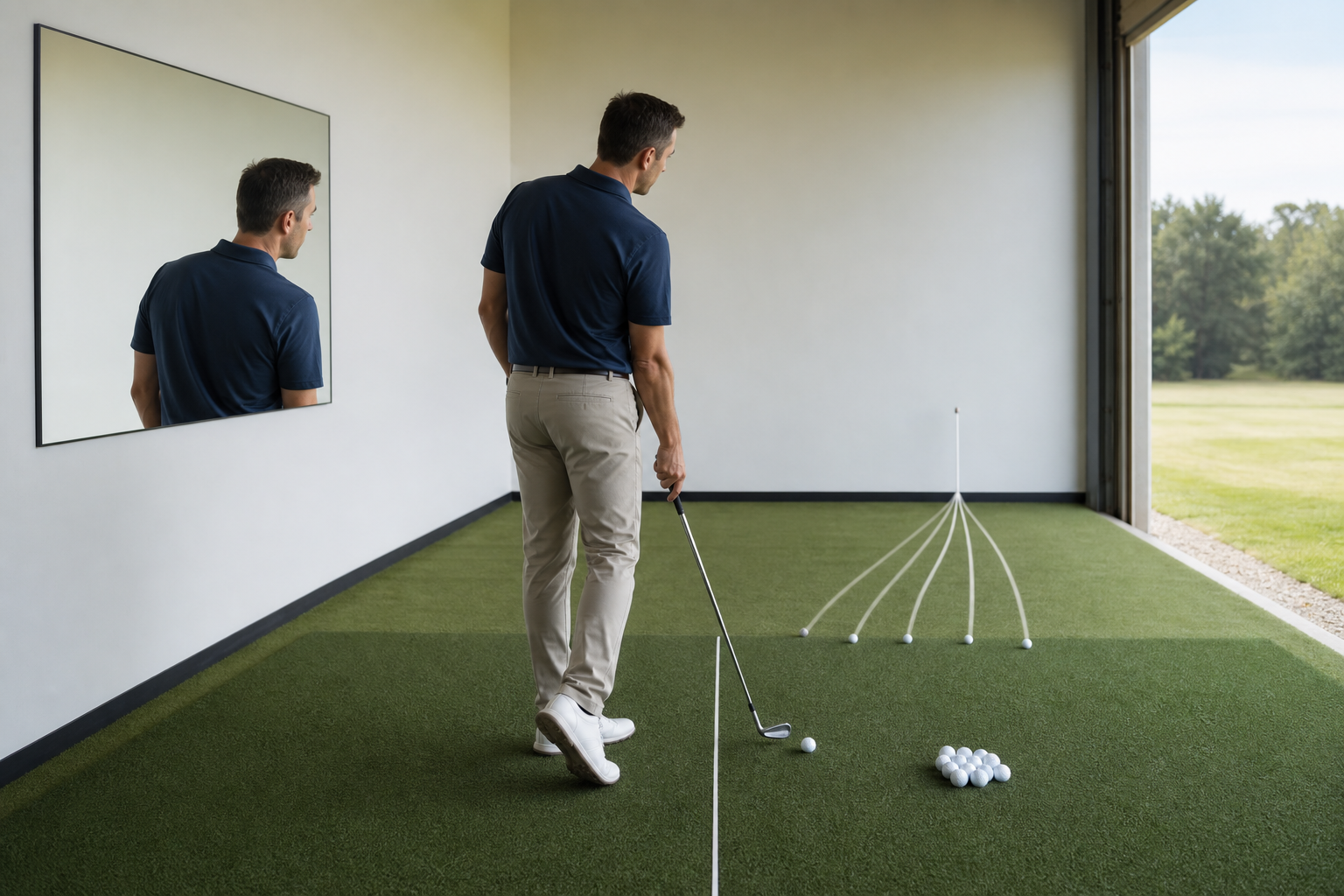
Built for: Golfers choosing one practice aid and deciding whether they need setup feedback or ball-roll feedback.
When a short putt misses at home, it is easy to hit another ten without learning anything. A putting mirror and a putting mat solve different parts of that problem: one makes your address position visible, while the other gives your putts a repeatable route to a target.
The quick verdict
Choose a putting mirror when your main question is whether you are setting up the same way each time; choose a putting mat when you need a defined place to rehearse pace, start line, and finish position.
Best for A mirror is best for golfers who want a clear pre-stroke checkpoint, while a mat is best for golfers who will use a target and record outcomes over repeated putts.
Skip it if Skip either aid if it will become a substitute for a defined practice task, because purposeful practice needs a specific objective and a way to observe whether you met it.
The decision is not mirror versus mat; it is question versus answer.
Picture the familiar living-room session: you roll putts toward a cup, make a few, miss a few, and leave with no useful explanation. The better purchase is the one that answers the question you actually have. A putting mirror makes the address phase visible before the ball moves. A putting mat gives the ball a defined travel space and target so you can observe what happened after impact. Neither is automatically more purposeful than the other. Purpose comes from pairing the aid with one stated objective and a repeatable result, an approach consistent with the PGA of America’s guidance to practice with purpose and structure.
Guild recommendation: Buy the mirror if your uncertainty occurs before you start the stroke; buy the mat if your uncertainty is where the ball starts, finishes, or stops.
Choose a mirror when the useful evidence is at address.
A mirror suits the golfer who stands over a three-footer and wonders whether the setup looked the same as it did on the last attempt. Its practical value is immediate visual feedback: set the ball down, take your address, look for the chosen picture, then putt. This can keep a session from turning into a series of unexamined strokes. The tradeoff is equally important. A mirror does not by itself create a meaningful result at the end of the putt. You still need a target and a simple score if your goal includes judging ball outcomes.
Guild recommendation: Choose a mirror for short sessions built around one repeatable address checkpoint, especially when space is limited and you can add a small target on the floor.
Choose a mat when you will measure the ball’s outcome.
A mat suits the golfer who benefits from seeing a ball travel repeatedly toward the same target. The useful constraint is that the task must be specific: a chosen start line, a target area, or a stopping area. For example, instead of trying to “putt better,” count how many of 10 balls finish in the marked area. That creates evidence you can compare from one set to the next. The tradeoff is that a mat can encourage mindless volume if every putt is treated as a fresh attempt rather than part of a defined drill.
Guild recommendation: Choose a mat if you have enough room to set a consistent target and are willing to track a simple outcome over a fixed number of putts.
A short-putt example makes the difference clear.
Suppose you repeatedly miss a short putt without knowing whether the issue begins before the stroke or becomes apparent as the ball travels. With a mirror, make the practice objective “repeat the same address picture five times.” Your evidence is visible before each putt. With a mat, make the objective “finish seven of 10 balls at the target.” Your evidence is where each ball ends. The first task is about a repeatable starting condition; the second is about a repeatable ball result. They are complementary, but they are not interchangeable.
Guild recommendation: If you can buy only one aid, select the one that answers the question you are most likely to ask during your next 10-minute session.
Keep home practice connected to the game.
A home aid is a practice tool, not a replacement for learning how to read changing greens and lines of play on the course. Rule 13 provides the rules context for putting greens and lines of play, while home work is best used to build a more deliberate routine around a narrow task. Use the mirror or mat to make one element observable, then take that clearer routine to the course rather than assuming an indoor result settles every putting question.
Guild recommendation: Use home practice to rehearse one observable task, then reserve on-course attention for the changing conditions and decisions that occur on an actual putting green.
Try this · 10 minutes.
Ten-Putt Feedback Split
Choose a flat, clear indoor area, one ball, a putter, and a small target such as a cup or marked stopping area. If using a mirror, place it where it lets you check your address before the stroke; if using a mat, use its target or mark a target at the far end.
- Decide on one task before starting: repeat the same address picture with the mirror, or send the ball to the target with the mat.
- Hit five putts, pausing before each one to make only the chosen observation. With a mirror, note whether your eyes and putter appear in the same relationship to the ball; with a mat, note whether the ball finishes at the intended target or stopping area.
- Record only a simple result: five repeated setup pictures, or the number of balls that reach the target area.
- Repeat five more putts with the same task and compare the second set with the first. Do not change the task midway through the set.
- Finish by choosing the aid that gave you a clearer answer about what happened on the putts.
What progress looks like: The session is successful when you can state one observable result, such as “eight of 10 putts reached the target area” or “my address picture matched on nine of 10 rehearsals.”
Put the guide to work
These searches are a starting point—not a substitute for the fit and comparison criteria above.
Compare putting mirrors
Compare the viewing area, the ball-position reference, and whether the mirror gives you a simple address picture you can repeat without adding several unrelated tasks.
Compare putting mats
Compare the available putting length, the clarity of the target, and whether the surface gives you enough room to run the same short-putt task repeatedly.
Compare simple start-line aids
Consider a start-line aid only if your chosen mirror or mat does not give you a clear, repeatable target for the distance you intend to practice.
If you buy through these links, Guild of Golf may earn a commission at no extra cost to you.
The practical takeaway
- A putting mirror is the clearer one-aid choice when you need visible feedback about your address position before the ball moves.
- A putting mat is the clearer one-aid choice when you need a repeatable target and a way to count ball outcomes.
- The productive purchase is the aid that supports one defined task, not the one that simply gives you more putts to hit.
- Record a simple result over 10 putts so the practice session produces evidence rather than a vague impression.
Frequently asked questions
Can a putting mirror improve ball roll?
A mirror can help you observe a chosen address checkpoint, but it does not by itself supply a target-based ball-roll result. Add a target and record outcomes if ball finish is part of your practice objective.
Can a putting mat help with setup?
A mat can provide a repeatable place to address the ball, but it is primarily the better choice when you want to observe repeated putts traveling toward a defined target. Choose a mirror when visible setup feedback is the priority.
Is a mirror and mat combination necessary?
No. One aid is enough when it answers your most important practice question and you use it with a specific task, a fixed number of repetitions, and an observable success signal.
What should I track during home putting practice?
Track one outcome that fits the aid: repeated address pictures for a mirror, or balls reaching a target or stopping area for a mat. Keep the measure simple enough to use for every putt in the set.
Sources used for this draft
- PGA of America: Practice With Purpose — The recommendation to use a defined objective, structure, and observable outcome in practice.
- USGA Rule 13: Putting Greens — The rules context for putting greens and lines of play.
Guild of Golf may earn a commission from qualifying purchases made through shopping links, at no additional cost to you.