
evergreen guide
Choose a Home Launch Monitor That Makes Practice More Useful
A practical framework for deciding whether a personal launch monitor supports a specific home-practice goal, workable setup, and measurable feedback loop.
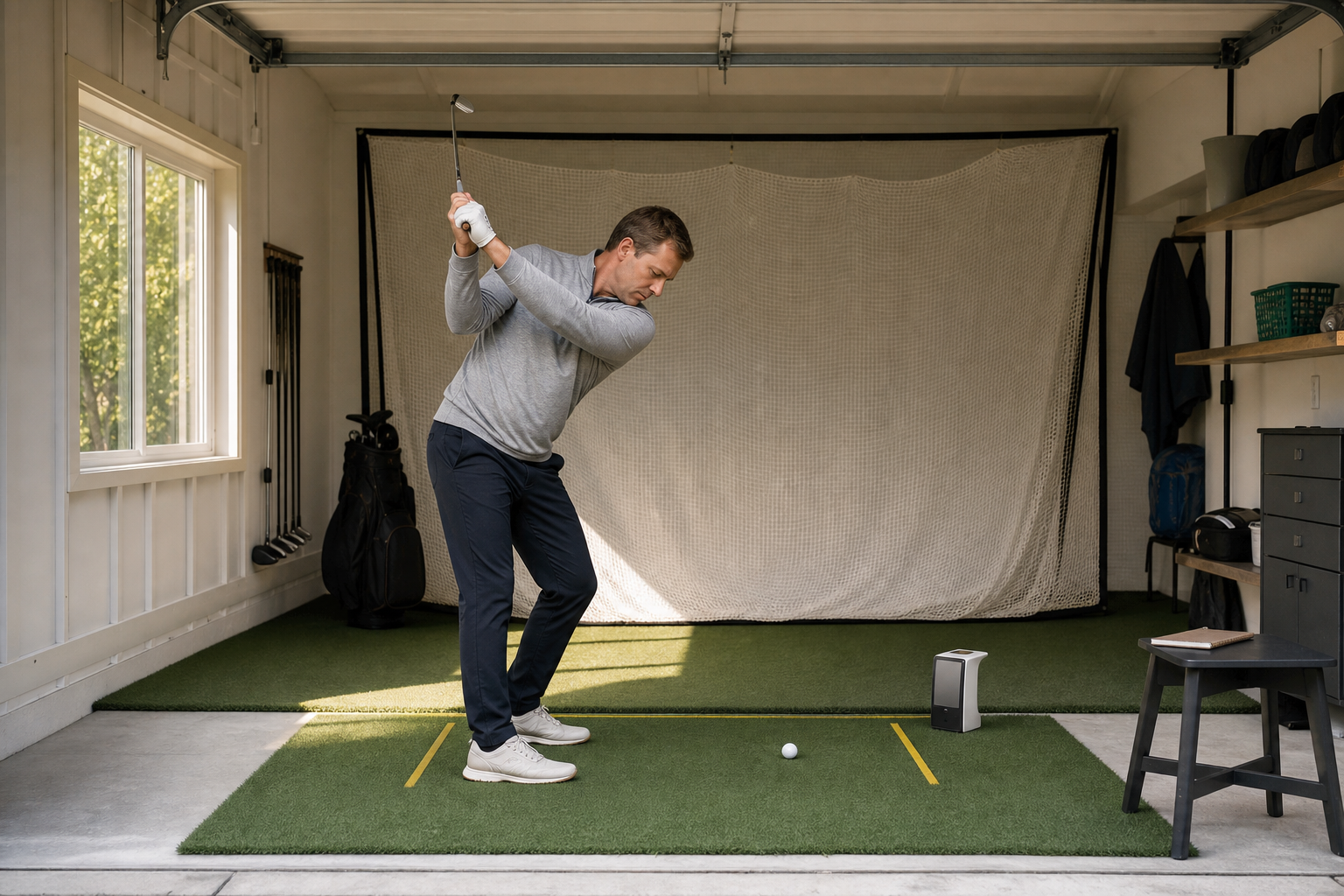
Built for: Golfers deciding whether a personal launch monitor provides the measurements and setup their practice actually needs.
The trouble starts when a golfer buys a screen full of numbers, then discovers the garage is too short, the routine is too vague, or the feedback never changes the next shot. Start with the practice decision you need help making, then evaluate the monitor and space around that decision.
The quick verdict
A home launch monitor is useful when it turns one defined practice goal into a repeatable shot-to-shot decision. Evaluate the feedback you will use, the physical setup you can repeat, and the manufacturer support behind objective claims before comparing features.
Best for Golfers with a consistent practice area who are willing to use a short, structured routine and record one or two meaningful results.
Skip it if Skip the purchase for now if you do not have a safe, repeatable place to hit balls or if you want a device to replace a clear practice plan.
Begin with the shot you cannot currently judge well
A launch monitor is easiest to value when a familiar practice frustration is named first. Perhaps your seven-iron shots feel solid but finish at noticeably different distances. Perhaps a net hides whether your starting direction was useful. Perhaps you are rehearsing a change, yet have no consistent way to decide whether the result improved. Choose one of those problems, not every problem in your game. Purposeful practice needs a defined aim and measurable structure, so the first question is not which device has the longest feature list. It is which displayed result would help you make a better decision after the next five balls.
Guild recommendation: Write down one club, one shot task, and one result you want to observe before you compare any models.
Treat your home bay as part of the purchase
A monitor that fits the budget but does not fit the room is not a practical practice tool. Measure the available hitting area and map the entire routine: where you stand, where the ball sits, where the target or net sits, where the device is placed, and where a struck ball could travel. Leave room to set the device in the same place each session and to step into the ball without negotiating furniture, doors, or stored equipment. A golfer using a garage for 20-minute evening sessions may value a quick, repeatable station more than a broader menu of displayed outputs. A golfer with a permanent bay may accept a more involved setup if it supports a more detailed routine.
Guild recommendation: Before shopping, draw a simple top-down layout and confirm that every position can be repeated safely.
Match the measurements to decisions, not curiosity
Ask the same question for every measurement listed in a product description: what would I do differently after seeing it? A distance-related result may help a golfer build a more consistent carry window for one club. A direction-related result may help another golfer judge whether target alignment and starting line are becoming more repeatable. If you cannot name the action the number will prompt, it is likely a distraction rather than a buying requirement. Start with one or two outputs you will record during practice. You can always broaden the routine later, but beginning narrowly makes it easier to see whether the monitor has changed the quality of your practice.
Guild recommendation: Make a two-column note titled “I need to know” and “I would merely like to know,” then prioritize only the first column.
Read objective claims like a careful buyer
Product pages may make objective claims about what a monitor measures, how it is used, or the conditions in which it works. Keep the manufacturer’s documentation, setup instructions, and stated conditions beside your room measurements and practice goal. The Federal Trade Commission’s advertising guidance emphasizes that objective advertising claims should have a reasonable basis. That does not make every feature irrelevant, but it gives you a useful buying habit: distinguish a specific claim you can verify in the documentation from an assumption based on a product image or a broad marketing phrase. When a claim matters to your purchase, look for the conditions and limitations that accompany it.
Guild recommendation: Save the product documentation for your finalists and compare its stated setup requirements against your actual practice space.
Build a routine that can prove the purchase useful
The most satisfying home setup does not have to make every practice session feel like a fitting. It should make a small question answerable. Set a target, pick a club, establish a realistic window for the one chosen result, and use the same pre-shot setup for a short set of balls. Record outcomes rather than trying to interpret every swing. This protects the golfer who tends to chase a good-looking number and gives the golfer with limited time a finish line for the session. PGA of America guidance on purposeful practice supports this kind of defined, measurable structure.
Guild recommendation: Use the practice check above three times before deciding whether the feedback is helping you practice with more clarity.
Compare only after the criteria are clear
Once you know the problem you want to solve, the space you can use, and the one or two results you will track, shopping becomes narrower and more useful. Compare each candidate against the same written checklist: the feedback it reports, the setup it requires according to its documentation, whether that setup works in your bay, and whether you can explain how the feedback changes your next shot. Avoid treating a longer specifications list as an automatic win. The better choice is the one you can set up consistently and use to complete a deliberate practice session.
Guild recommendation: Use the focused searches below to find candidates, then return to your checklist before making a final choice.
Try this · 25 minutes
The One-Feedback Home Practice Check
Use a safe hitting area with a target, the same ball position for each shot, and your launch monitor positioned according to its instructions. Select one measurement the device displays that relates to today’s stated goal, such as a distance-related or direction-related result. Keep a notebook or scorecard beside the hitting area.
- Write one plain-language goal before hitting, such as producing a more repeatable starting line toward the target or narrowing the distance window for a selected club.
- Hit five comfortable baseline shots without changing your motion to establish the results you normally see.
- Choose one simple, non-diagnostic adjustment to your routine, such as aligning the clubface to the target more carefully or pausing to confirm ball position before each shot.
- Hit two sets of five shots with the same club, recording only the chosen measurement and whether each shot met the goal.
- Compare the two five-shot sets, then finish with three normal shots while keeping the routine that produced the clearer pattern.
What progress looks like: The practice session is successful if you can identify which routine produced more shots inside your pre-set window, even if the window is modest.
Put the guide to work
These searches are a starting point—not a substitute for the fit and comparison criteria above.
Compare general home-practice models
Use this search after deciding which single feedback category would make your next practice session more specific.
Compare indoor-space-friendly options
Use this search after measuring your available bay and identifying where the unit, ball, target, and golfer must sit.
Find setup accessories after choosing a device
Use this search only after the device choice, so accessories support a repeatable station rather than add clutter.
If you buy through these links, Guild of Golf may earn a commission at no extra cost to you.
The practical takeaway
- Choose a launch monitor around one home-practice problem, not around the largest list of displayed outputs.
- A repeatable, safe hitting layout is a core requirement rather than an accessory to the purchase.
- Keep only the measurements that lead to a clear next-shot decision.
- Use manufacturer documentation to assess objective claims and stated setup conditions.
- A short recorded routine is the best test of whether the feedback will improve your practice.
Frequently asked questions
What is the first feature I should look for in a home launch monitor?
Look first for feedback that answers a specific practice question you already have, such as whether a selected club is producing a more repeatable distance or starting direction. The useful feature is the one that changes your next practice decision.
How much space do I need for a home launch monitor?
The required space depends on the unit and its stated setup conditions. Measure your bay before shopping, then compare that layout with the manufacturer documentation for each candidate.
Should I track every number the monitor displays?
No. Begin with one or two results tied directly to your stated goal. A smaller set of recorded feedback is easier to use consistently and less likely to turn practice into unfocused number chasing.
Can a launch monitor replace a lesson or a practice plan?
No. A monitor can provide feedback, but it does not supply a purpose for the session. Define the task, use a repeatable setup, and judge whether the recorded results are becoming more consistent.
Sources used for this draft
- PGA of America: Practice With Purpose — The recommendation to use a defined goal and measurable structure in practice.
- FTC Advertising and Marketing Basics — The recommendation to examine support for objective product claims and stated conditions.
Guild of Golf may earn a commission from qualifying purchases made through retailer links, at no additional cost to the buyer.