
evergreen guide
High-MOI Drivers: Forgiveness for Misses, Not Swing Fixes
A practical guide to deciding whether a high-MOI driver can make your common tee-shot miss more playable, and where equipment help ends.
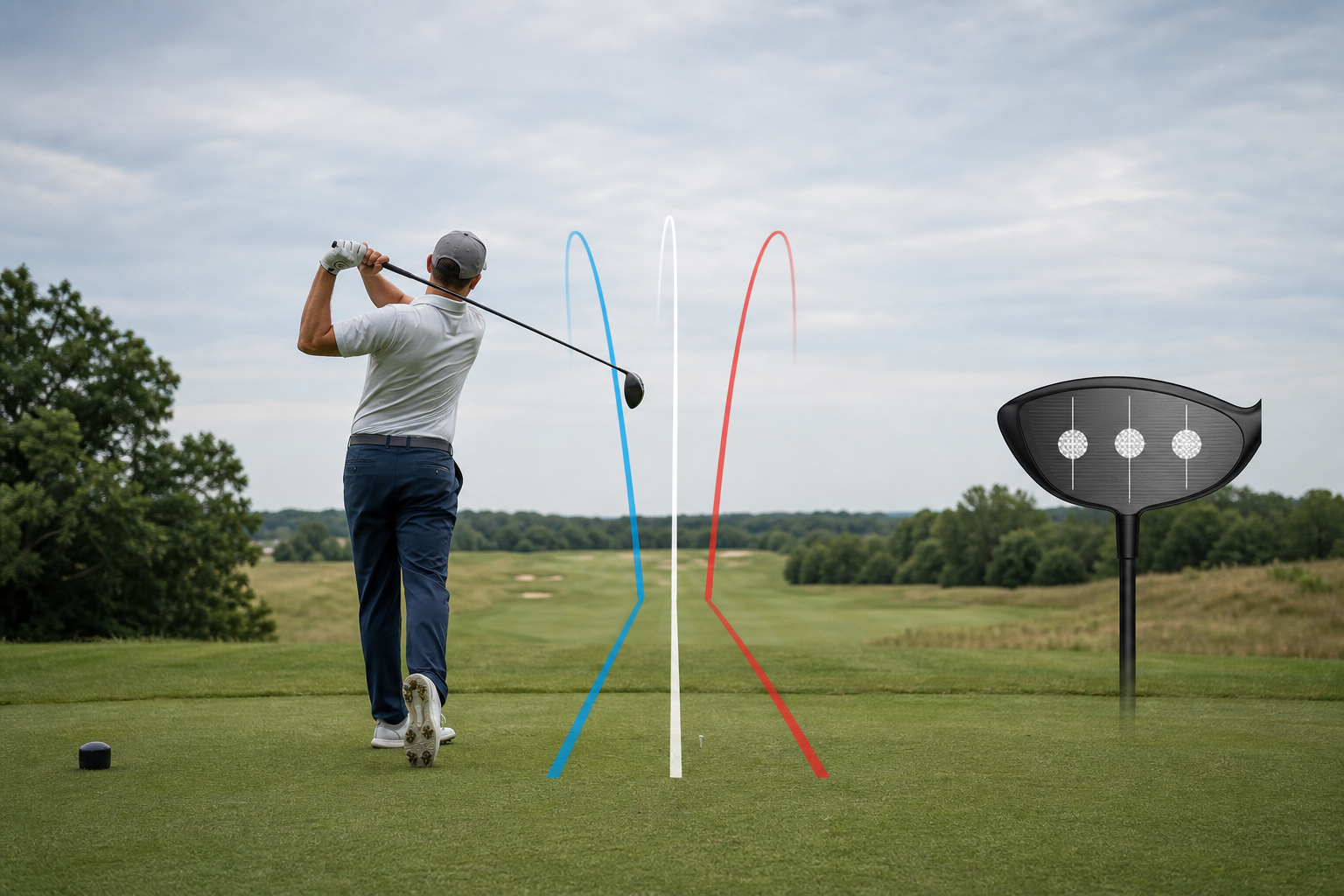
Built for: Golfers whose off-center strikes lose too much speed or curve unpredictably and who need to distinguish forgiveness from swing correction.
When a drive catches the toe and finishes in trouble, a more forgiving head can be appealing. The useful question is not whether forgiveness is good; it is whether your repeating miss is a strike-location problem, a start-line problem, or both.
The quick verdict
A high-MOI driver is most useful when your recurring issue is inconsistent contact across the face and you want the poorer strikes to produce more usable outcomes. It cannot reliably correct a face or path pattern that starts shots far from your intended line.
Best for Golfers who often find heel or toe contact, see large differences between their best and ordinary drives, and want a fitting based on measured results.
Skip it if Skip the assumption that a forgiving head alone will cure persistent blocks, pulls, or severe curvature that appears even when contact feels centered.
The tee-shot problem that forgiveness can address
You hit one drive from the middle of the face and find the fairway. On the next hole, a strike that feels only slightly off comes up short, bends more than expected, or leaves a difficult second shot. That gap between your good contact and your ordinary contact is the situation in which a high-MOI driver deserves attention.
Think of high MOI as a design approach aimed at making off-center impact less punishing. The practical benefit to seek is not a magic straight ball. It is a tighter gap between a centered strike and the misses you actually produce, especially when those misses occur repeatedly toward the heel or toe.
Start with an observable pattern. If your strike marks wander broadly across the face, a more forgiving head may give you a better chance of keeping routine misses playable. If most marks are near the center but the ball repeatedly begins well right or left of the intended line, changing the head may be a secondary decision rather than the primary answer.
Guild recommendation: Make impact location visible before shopping. A pattern of heel- or toe-side marks is a stronger reason to explore a high-MOI head than one memorable bad drive.
Forgiveness has a boundary: contact is not the whole ball flight
A forgiving driver can help soften the consequences of imperfect contact, but it does not choose your target, square the face for you, or replace a repeatable delivery. This matters on the course because golfers often label every right-curving ball as an equipment failure when the shot may have started too far right, curved too much, or both.
Use a simple two-question description after a drive: where did it start, and where did it finish? Then add a third question when you can see the face mark: where did I contact the face? Those observations keep the equipment decision grounded. A toe-side pattern and a right-starting pattern are not automatically the same problem, even when they create the same frustrating walk into the trees.
Do not expect a new head to turn a persistent two-way miss into a predictable one without changing anything else. Its sensible role is to reduce the penalty of the contact errors that remain while you work toward a more repeatable tee shot.
Guild recommendation: Choose a forgiving design to narrow the damage from your common contact miss, not as a promise that every ball will start on line.
Fit the driver to your measured pattern
The best way to assess a high-MOI driver is to compare it against your current club under similar conditions and pay attention to the shots you would normally count. A single towering drive is enjoyable, but the ordinary heel strike that stays in play may be the more valuable data point for a golfer whose score suffers from penalty areas and recovery shots.
The PGA of America describes club fitting as an evaluation of equipment for the individual golfer using measured results. That principle is especially useful here. Bring a clear account of your typical miss, your desired shot window, and the impact notes from the practice plan. A fitter can use measured outcomes to help distinguish a head that improves your usable dispersion from one that merely looks more confidence-inspiring at address.
Driver design and conformance are governed by the USGA Equipment Rules. That is another reason to make the choice within normal equipment evaluation rather than chasing exaggerated claims about what any one club can correct.
Guild recommendation: Book a fitting when possible, and ask to compare your current driver with candidate heads using the same target and a representative sample of swings.
What to compare once you know your miss
After you have established that off-center contact is the main constraint, compare drivers in a sequence that keeps the decision honest. First, judge whether the head shape and setup appearance let you aim comfortably. A club that makes you feel unable to start the ball at your intended target is a poor match, even if its forgiveness category appeals to you.
Next, compare the normal pattern: start direction, finishing area, and visible impact location. A useful candidate does not need to win every category on every swing. It should make your typical poor strike less costly without creating a new, repeatable miss that is harder to manage.
Finally, consider adjustability only as part of a fitting conversation and measured comparison. Settings are not a substitute for understanding your own pattern. They are most helpful when they support a clearly observed need rather than an attempt to rescue random outcomes.
Guild recommendation: Keep notes on five to ten representative drives per option, with extra weight given to the shots that would determine whether you have a clear next shot on the course.
Try this · 20 minutes.
Separate Contact From Direction at the Range
Use your current driver, a consistent tee height, and two alignment sticks or clubs placed on the ground to create a clear target line. Choose a target that gives you room on both sides, and use face-impact spray or removable impact tape if available.
- Hit five normal drives without trying to change your swing, noting only the starting direction and whether each shot finishes left, right, or near the target.
- Add face-impact spray or tape and hit another five normal drives. After each shot, record the contact as heel-side, center, or toe-side, along with its starting direction.
- Look for a repeating pairing rather than judging one swing. For example, repeated heel-side contact with varied launch may point to a contact-consistency constraint, while shots that start in the same unwanted direction despite mixed contact point to a direction pattern equipment may not solve alone.
- If you are comparing drivers later, repeat the same simple record with each fitted option and compare the ordinary shots, not only the single best strike.
What progress looks like: The session is successful when you can describe your usual miss in two parts—impact location and ball direction—rather than calling every poor drive a slice or a bad swing.
Put the guide to work
These searches are a starting point—not a substitute for the fit and comparison criteria above.
Compare high-MOI driver options
After identifying a repeatable contact issue, compare head shape, address appearance, and available fitting settings rather than assuming every forgiving model suits your delivery.
Check impact location
A temporary face-marking tool can show whether your poor drives cluster toward the heel, toe, high face, or low face.
Build a repeatable target line
Simple alignment sticks help you record start direction consistently during the practice plan and during a fitting.
If you buy through these links, Guild of Golf may earn a commission at no extra cost to you.
The practical takeaway
- A high-MOI driver is most relevant when off-center impact is a recurring, visible part of your tee-shot pattern.
- Separate face contact from start direction and curve before expecting equipment to solve the problem.
- Evaluate the ordinary miss, because that shot has more influence on scoring than a single exceptional drive.
- A fitting based on measured results is the soundest way to determine whether a forgiving head improves your own outcomes.
Frequently asked questions
Will a high-MOI driver fix my slice?
Not by itself. If your poor shots repeatedly start or curve away from your target even when contact is near the center, you are dealing with more than an off-center-strike issue. A forgiving head may reduce the penalty on imperfect contact, but it should not be treated as a swing correction.
How do I know whether I need more forgiveness?
Mark the face for a short range session and record where the ball starts and finishes. Repeated heel- or toe-side contact, combined with a large drop from your best drives to your typical drives, is a practical reason to compare forgiving options.
Should I get fitted for a high-MOI driver?
Yes, if you have access to a qualified fitting. The PGA of America notes that fitting evaluates equipment for the individual golfer using measured results, which is more useful than choosing from a category label alone.
What should I bring to a driver fitting?
Bring your current driver, a description of your usual miss, and any notes from an impact-location practice session. Ask to compare normal shots as well as your best swings.
Sources used for this draft
- USGA Equipment Rules — Driver design and conformance are governed by the equipment rules.
- PGA of America: Club Fitting — A fitting evaluates equipment for the individual golfer using measured results.
Guild of Golf may earn a commission from qualifying purchases made through shopping links, at no additional cost to the reader.