
comparison
Putting Mirror vs. Putting Mat: Choose the Feedback You Actually Need
A focused comparison for golfers choosing between setup feedback from a putting mirror and ball-roll feedback from a putting mat.
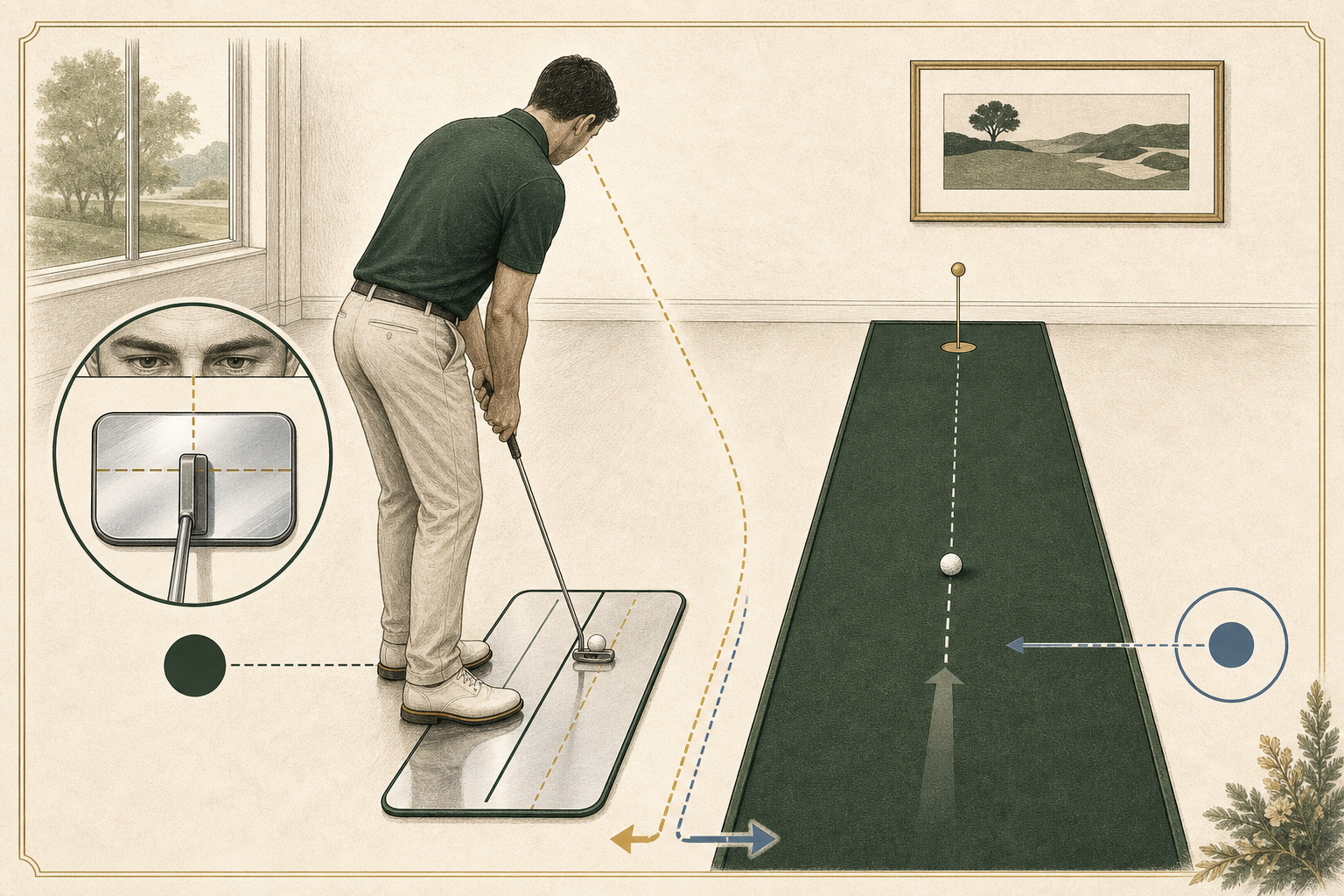
Built for: Golfers choosing one practice aid and deciding whether they need setup feedback or ball-roll feedback.
You miss a six-footer after feeling perfectly aimed, then head home unsure whether to work on your eyes and face position or simply start the ball on a better line. A putting mirror and a putting mat answer different questions, so the useful choice depends on which outcome you can observe and repeat.
The quick verdict
Choose a putting mirror when you need a visible, repeatable reference for address and alignment; choose a putting mat when you need to judge whether the ball begins on your intended line over a defined distance. Neither replaces purposeful practice, but each can make one part of putting practice less vague.
Best for A mirror is best for golfers whose main question is whether their setup looks the same from putt to putt. A mat is best for golfers who will practice starts, pace, and short-putt routines with a clear target.
Skip it if Skip a mirror if visual setup checks make you overly self-conscious or keep you from rolling balls. Skip a mat if you cannot name a start-line or distance task you intend to practice rather than simply hitting putts.
Start with the putt that keeps following you home.
The familiar frustration is not merely a missed putt; it is leaving the green without knowing what to rehearse. A ball that starts left of a short target can tempt a golfer to change aim, stroke, or setup all at once. Purposeful practice is more useful when it has a defined purpose and structure, which makes the first decision straightforward: choose the aid that gives feedback on the part of the task you can name. The PGA of America frames purposeful practice around defined, structured work rather than undirected repetition.
Guild recommendation: Before buying either aid, write one observable home-practice goal, such as “return to the same address reference” or “start 7 of 10 balls toward a coin 5 feet away.”
A putting mirror is for making address less mysterious.
A mirror gives a golfer a visual checkpoint before the stroke. That makes it the more direct option when the uncertainty is setup: where the eyes appear relative to the ball, whether the putter face returns to a chosen reference, and whether the player can recreate the same address without guessing. Consider the golfer who feels square on one putt and crowded on the next. For that player, a brief mirror check can turn a feeling into a repeatable reference. Its limitation is equally important: a mirror does not, by itself, tell you whether a struck ball began on the intended line or arrived with useful pace.
Guild recommendation: Choose a mirror if you will use it for a short pre-stroke check, then roll balls toward a real target. Skip it if you expect it to diagnose why putts miss.
A putting mat is for giving the ball a repeatable assignment.
A mat creates a designated place to roll putts and can make a short start-line drill easier to repeat at home. It suits the golfer who already has a reasonably settled address routine but needs a reason to hit fewer, more accountable putts. For example, instead of rolling twenty balls with no consequence, set a 4-to-6-foot target and count only balls that begin on the intended path. The tradeoff is that a mat may encourage quantity when the target and success measure are undefined. It also cannot show what your eyes or putter face looked like at address.
Guild recommendation: Choose a mat if a defined lane and target will help you practice start line and routine. Skip it if your chief uncertainty occurs before you move the putter back.
The decision is feedback first, convenience second.
If space limits you to one aid, do not turn the choice into a contest over which tool is more serious. Ask which feedback is missing from your current home practice. A golfer with a hallway and five minutes may benefit from a compact mirror plus a coin target on a level surface. Another golfer with a clear section of floor may benefit more from a mat because it makes a deliberate ten-putt session easier to set up and repeat. In either case, the goal is a narrow task with an observable result, not a promise that a single aid will fix putting.
Guild recommendation: Teach yourself what to compare first: a mirror should provide a clear setup reference in your available space, while a mat should provide enough usable roll and a target task you will repeat. Then use the focused searches below.
Keep home feedback in perspective when you return to the course.
Home practice can sharpen a routine, but putting on the course still requires attention to the putting green, the line of play, and the conditions in front of you. Rule 13 provides the Rules context for putting greens and lines of play. Treat mirror and mat work as rehearsal for a more deliberate process, not as a substitute for reading an on-course putt. The player who can return to a familiar address and start the ball toward a chosen line has a simpler job when it is time to make a real decision on the green.
Guild recommendation: Use one home cue on the course, such as settling into your familiar address, then let the actual line of play guide the putt.
Try this · 12 minutes.
Ten-Putt Setup-to-Start-Line Check
Use a level indoor floor, a putting mirror if available, and a cup, coin, or small safe target about 4 to 6 feet away. If using a mat, place the target at the end of its intended roll path. Choose one straight-looking line and use only one ball at a time.
- Make five rehearsal addresses without striking a ball. On each one, use the mirror only to return to the same eye and putter-face reference; do not search for a perfect-looking position.
- Hit five putts toward the target with the single task of starting the ball on the chosen line. After each stroke, note only whether the ball began on that line before judging whether it reached the target.
- Hit five more putts using the same pre-putt routine. If a putt begins off line, return to the same address reference for the next ball rather than making several changes at once.
- Record two totals: putts that began on the intended line and putts that finished at the target. End when the ten-putt set is complete, even if the result is uneven.
What progress looks like: The useful signal is a higher and more repeatable count of balls that begin on the intended line while your address reference remains consistent; it is not a claim about the cause of any miss.
Put the guide to work
These searches are a starting point—not a substitute for the fit and comparison criteria above.
Compare compact mirrors.
Compare the visibility of the address reference, the amount of floor space required, and whether the format lets you rehearse without slowing a short practice session.
Compare home putting mats.
Compare usable roll length, a clearly defined target, and whether the mat suits the straight-line distance you will actually practice at home.
If you buy through these links, Guild of Golf may earn a commission at no extra cost to you.
The practical takeaway
- A putting mirror provides setup feedback; a putting mat provides a repeatable ball-roll task.
- Buy the aid that answers the question you repeatedly have after a miss.
- A defined target and a simple count make either aid more useful than aimless repetition.
- Use home practice to rehearse a process, while treating each on-course putting line as its own decision.
Frequently asked questions
Should I buy a putting mirror or mat first?
Buy a mirror first if you need a consistent visual reference at address. Buy a mat first if you need a dedicated place to measure whether short putts begin on your intended line.
Can a putting mirror improve my start line?
It can help you repeat a chosen address reference, but it does not directly measure the ball’s initial roll. Pair the mirror with a coin or small target and count starts on the intended line.
Can I practice purposefully without either aid?
Yes. On a level indoor surface, use a coin or small target, choose a short distance, roll a fixed number of balls, and record how many begin on the intended line. The mirror and mat simply emphasize different forms of feedback.
Why not use both a mirror and a mat?
Using both can be sensible when you have the space and a clear sequence: check one address reference, then roll a limited set of putts to a target. If buying one, choose the feedback you lack most rather than duplicating a task you already perform well.
Sources used for this draft
- PGA of America: Practice With Purpose — The value of defined purpose and structure in practice.
- USGA Rule 13: Putting Greens — The Rules context for putting greens and lines of play.
Guild of Golf may earn a commission from qualifying purchases made through retailer links, at no additional cost to the reader.