
evergreen guide
Build Wedge Loft Gaps by Mapping Carry Distance First
A practical guide to deciding whether a gap, sand, or lob wedge solves a real scoring-distance problem before you buy.
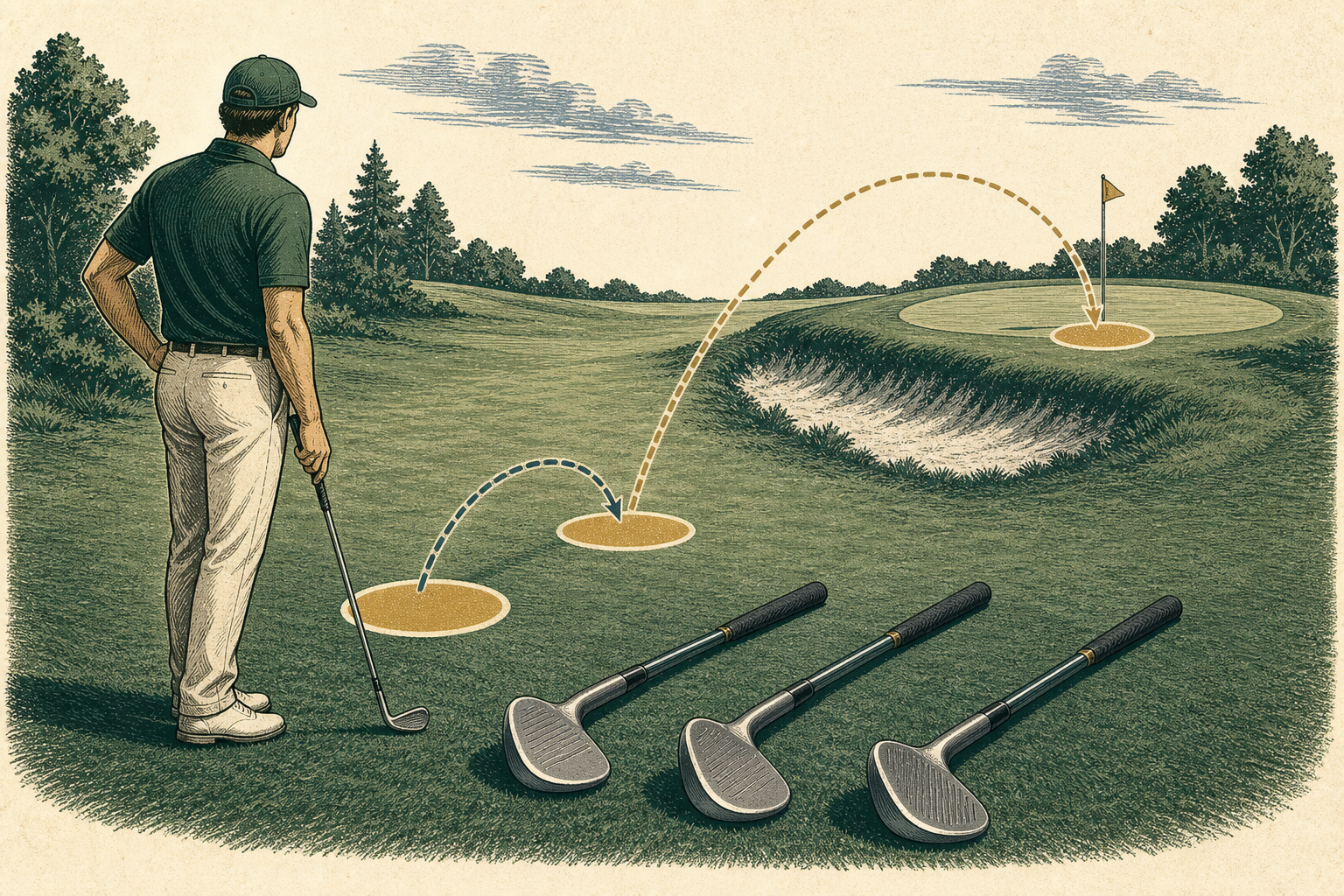
Built for: Golfers who have an awkward distance gap near the green and are considering a gap, sand, or lob wedge.
When a full wedge leaves you between clubs, the tempting answer is another loft. Start instead with the carries you can repeat, the shots you actually face, and the space left in your 14-club setup.
The quick verdict
Buy a wedge only after you identify a repeatable carry-distance hole and confirm that a new loft would fill it without creating a second, equally awkward overlap.
Best for Golfers whose current wedges produce one conspicuously uncomfortable full-swing yardage and who want a clearer decision between a gap, sand, or lob wedge.
Skip it if Skip a new wedge for now if the troublesome shot is mainly a partial-swing or lie-management problem, or if you have not measured how far your present wedges carry.
The familiar problem is not always a loft problem.
You are 75 yards out, your pitching wedge feels too strong, your sand wedge asks for more than a comfortable swing, and a new club seems like the obvious rescue. Yet that same golfer may already have a workable three-quarter shot, while another may have a genuine full-swing carry hole that appears several times each round. Those are different problems, so they deserve different answers.
Guild recommendation: Describe the troublesome shot in plain terms before looking at loft stamps: the usual yardage, lie, required trajectory, and whether you want the ball to stop or run.
Build the set from carries, not from the names on the soles.
Pitching, gap, sand, and lob wedges describe familiar roles, but the useful question is whether adjacent clubs create orderly, usable carry windows for your swing. Loft is a purchasing tool, not the outcome. A sensible set lets you select a club with a normal motion for important approach distances instead of repeatedly manufacturing an uncomfortable in-between swing.
Guild recommendation: Record typical full-swing carries for the wedges you own, identify the largest repeatable gap, and let that interval determine whether another wedge has a job.
Separate the full-shot decision from the greenside decision.
A new wedge can address two distinct needs: a missing approach carry or a missing greenside shot. The golfer who repeatedly faces an 85-yard approach needs evidence from normal carries. The golfer whose trouble begins in a bunker, from soft turf, or over a steep front edge needs to consider the shot requirement as well as distance. Adding a club for one purpose does not automatically solve the other.
Guild recommendation: If the gap appears on full shots, prioritize carry mapping; if it appears around the green, list the lies and trajectories that create the problem before choosing between sand- and lob-wedge roles.
Check the whole bag before you make room.
A wedge does not enter an empty bag. It may replace a long club, a specialty club, or a club you use frequently from a particular tee shot or recovery position. A fitting evaluates the golfer and the complete equipment setup, which is a useful reminder that the best wedge decision can depend on what you give up to carry it.
Guild recommendation: Before buying, name the club that would leave the bag and identify the on-course shot you would lose; keep the wedge only if the new scoring benefit is more useful to your game.
Use fitting and rules as guardrails, not substitutes for your notes.
A qualified fitting can evaluate both the golfer and the complete equipment setup, helping connect your carry map to a workable set composition. If you play events that require conforming equipment, club design and conformance are governed by the Equipment Rules, so verify the club’s status through the appropriate channels for the competitions you enter.
Guild recommendation: Bring your carry notes and your current wedges to a fitting, and confirm competition requirements before relying on any newly purchased club in a rules-governed event.
Try this · 30 to 40 minutes.
The Three-Wedge Carry Map
Use a driving range or practice area with clearly identifiable targets or measured markers, three or four balls of the same model, your pitching wedge and every wedge you currently carry, plus a notebook.
- Warm up with easy swings until contact feels normal, then choose one target line with enough room to observe where shots first land.
- Hit five normal, full-motion shots with each wedge, one club at a time, and record the carry of strikes that feel reasonably centered rather than trying to preserve every result.
- For each club, note a typical carry range instead of a single perfect number, then place the wedges in carry order.
- Circle the largest space between adjacent typical carry ranges, and write down the real course shot that would fall inside that space.
- Hit five controlled, shorter shots with the longer club and five controlled shots with the shorter club toward a target in the middle of that space, then compare which option produces the more predictable carry and finish.
What progress looks like: You finish with one clearly defined carry interval that neither current club covers comfortably at your normal swing length, or you learn that a controlled existing shot already covers it well enough.
Put the guide to work
These searches are a starting point—not a substitute for the fit and comparison criteria above.
Compare loft-marked gap wedges
After finding a genuine full-swing carry hole between your pitching wedge and sand wedge, compare loft options that sit between the lofts you already own.
Compare sand wedges for bunker and short-game needs
If the issue is often sand, soft turf, or a greenside shot rather than a full carry, compare sand wedges only after deciding that those situations drive the purchase.
Compare lob wedges for high, short shots
Consider a lob wedge when your course situations call for added height or reduced rollout and you can still preserve a sensible role for every wedge.
If you buy through these links, Guild of Golf may earn a commission at no extra cost to you.
The practical takeaway
- Measure typical carry ranges before deciding that another loft is necessary.
- Choose a wedge to fill a specific, repeatable shot problem rather than to complete a familiar set of labels.
- Treat full-swing distance gaps and greenside shot gaps as separate decisions.
- Account for the club that must leave the bag when a new wedge arrives.
- Use a complete-set fitting conversation when your carry map and course needs point in different directions.
Frequently asked questions
How do I know whether I need a gap wedge?
You may need one when your carry map shows a meaningful, repeatable full-swing space between your pitching wedge and your next most-lofted wedge, and controlled shots with either existing club do not cover the middle predictably.
Should I choose a sand wedge or lob wedge for a distance gap?
Start with the carry interval, then consider the shot role. A sand wedge may suit a golfer whose problem also involves bunker or soft-turf situations, while a lob wedge makes more sense when high, short greenside shots are the clear missing job; neither label replaces a carry test.
Can a fitting help even if I only want one wedge?
Yes. PGA of America guidance notes that a fitting evaluates the golfer and the complete equipment setup, which can help determine whether one added wedge improves the set more than an existing club or a different shot plan would.
Do wedge rules matter for ordinary play?
They matter most when you play under conditions requiring conforming equipment. The USGA states that club design and conformance are governed by the Equipment Rules, so check the applicable requirements for the events you play.
Sources used for this draft
- PGA of America: Club Fitting — The recommendation to evaluate a prospective wedge as part of the golfer’s complete equipment setup.
- USGA Equipment Rules — The note that club design and conformance are governed by the Equipment Rules.
Guild of Golf may earn a commission from qualifying purchases made through shopping links, at no extra cost to you.