
comparison
Forged vs. Hollow-Body Irons: Choose by Your Miss, Not the Label
A practical comparison for golfers who want to move past manufacturing labels and use measured results, strike patterns, and course needs to narrow an iron choice.
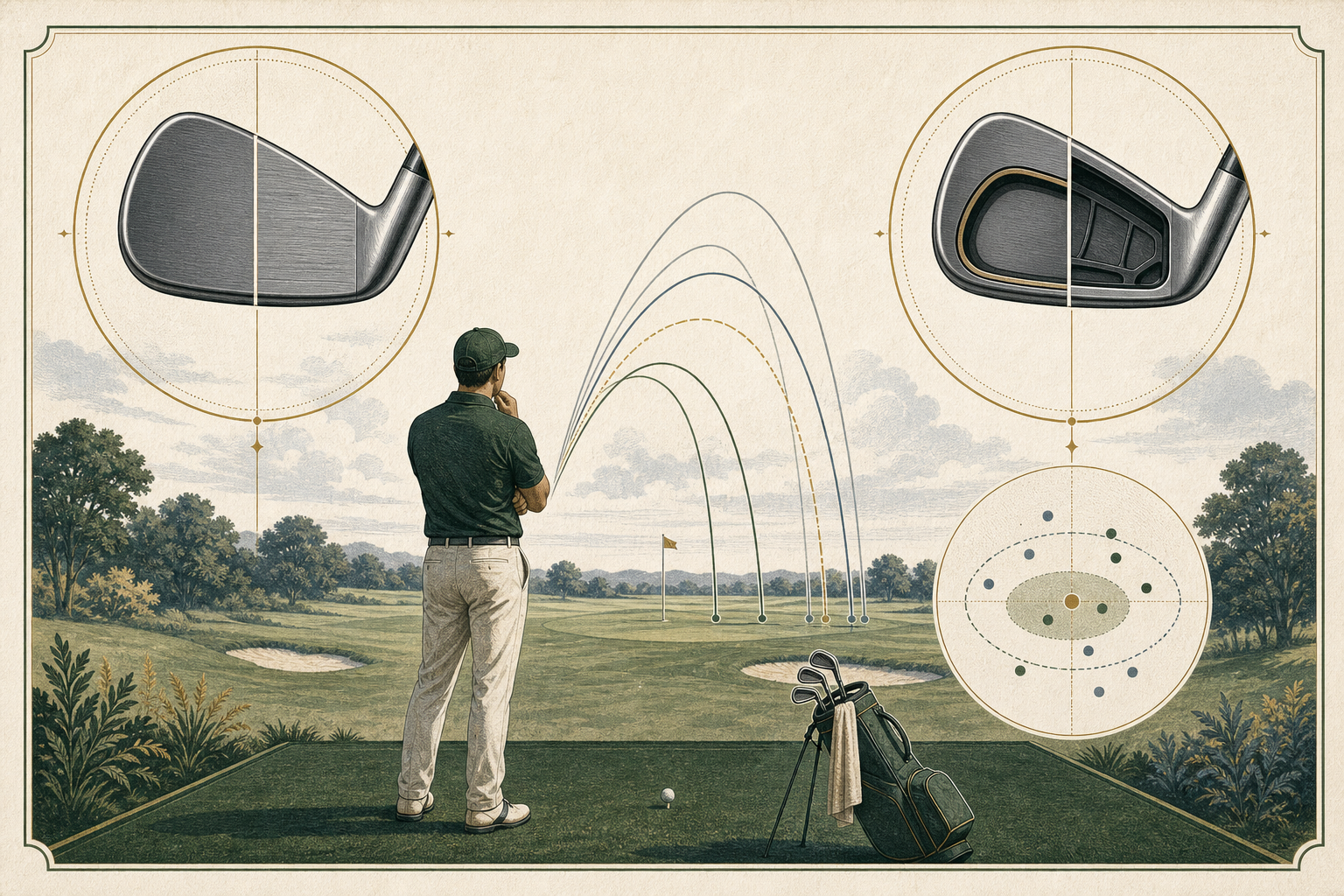
Built for: Golfers comparing iron constructions who want to separate manufacturing terms from on-course fit and performance.
When one iron looks inviting in the shop and another promises a different kind of feel, the useful question is not which label wins. It is which head, shaft, loft setup, and build produces the launch, distance pattern, and playable misses you can repeat.
The quick verdict
Forged and hollow-body are construction labels, not a substitute for a fitting result. Choose the option that gives you a repeatable distance pattern and a shot shape you can use on the course.
Best for Golfers willing to compare several builds with measured results and judge them against the shots that create trouble in their own rounds.
Skip it if Skip a label-first purchase if you cannot compare a consistent set of strikes or if a different loft, shaft, or build may be driving the result you think comes from the head.
The decision starts on the hole where your iron shot matters
Picture a par 3 where the front bunker is trouble and the green narrows from the left. A clean strike that flies farther than expected is not automatically a win if it leaves an awkward recovery; a slightly shorter shot that finishes pin-high on the safe side may be the better result. That is why forged versus hollow-body should begin as an on-course decision, not a manufacturing debate. Construction language can help you organize a search, but it cannot tell you whether a particular build gives you a playable pattern.
Guild recommendation: Write down one recurring iron problem before shopping, such as approaches finishing long, a common start-line miss, or unreliable gaps, and use that problem as your comparison standard.
Separate the label from the complete club
“Forged” and “hollow-body” are construction terms, but a golfer swings a complete club rather than a label. A comparison can also be affected by loft, shaft, length, lie, grip, and the way the set is arranged. If two irons do not match in the variables that matter to your delivery and intended distance, a difference in result is not a clean verdict on construction. The practical goal is simpler: find the complete build that turns ordinary strikes into outcomes you can manage.
Guild recommendation: When comparing candidates, ask for the complete build details and avoid declaring a construction winner from a comparison in which loft or shaft choices differ.
Feel is useful when you make it observable
Feel can be a valuable preference, especially when it helps you commit to a shot, but it is most useful when tied to something you can observe. Instead of stopping at “this one feels better,” ask what that response changes. Do you make a calmer swing? Can you identify face contact more clearly? Does the preferred sound or sensation coincide with a more repeatable finish pattern? If the answer is no, feel may still be a legitimate enjoyment preference, but it should not overrule a result you cannot live with on the course.
Guild recommendation: Use a simple note after each group of shots: confidence at address, perceived contact, start line, and finishing area, then look for agreement between preference and outcome.
Use fitting to test tradeoffs rather than confirm a hunch
The PGA of America advises that fit and measured results matter when comparing club options. That principle protects golfers from a familiar trap: hitting one excellent shot, deciding the head style caused it, and overlooking the less memorable shots that define scoring. Bring a target distance and a familiar miss to the conversation. Then compare candidates through a sufficient group of normal swings, asking how each option handles your useful strike, your ordinary strike, and the miss that usually costs you a shot.
Guild recommendation: A fitting is most productive when you arrive with a scoring question, such as finding a more dependable approach window or clarifying a troublesome distance gap, rather than asking which construction is inherently best.
Conformity and preference are different questions
A club’s marketing category or construction method does not replace the need to meet conforming-club requirements. The USGA Equipment Rules apply conforming requirements regardless of construction method or marketing category. For the golfer, that means two separate checks are sensible: confirm that the club is appropriate for the competitions you enter, then choose the build that best supports your measured and on-course needs.
Guild recommendation: If you play in events requiring conforming equipment, confirm conformity through the relevant event or governing-body process before treating a construction label as a deciding factor.
Try this · 25 minutes.
The 18-Ball Distance-Pattern Check
Use one iron you already trust, a clearly defined target, and a safe practice area with enough room to observe both start line and finish position. If you are comparing clubs, use the same target, tee height or turf condition, and ball type for each group.
- Hit three easy shots with your current iron to establish a comfortable tempo rather than chase maximum distance.
- Hit six shots with the first comparison iron and note only the start direction, the finish relative to the target, and whether each carry would leave a useful next shot on your usual hole.
- Hit six shots with the second comparison iron under the same conditions and record the same three observations.
- Finish with three more shots using your current iron, which helps you notice whether changing tempo or fatigue affected the comparison.
- Review the groups as patterns: look for the club that produces the most usable misses and the least confusing distance spread, not the single best strike.
What progress looks like: You can describe one observable reason for a preference, such as a tighter usable finish pattern or more predictable carry outcomes, instead of relying on the construction label alone.
Put the guide to work
These searches are a starting point—not a substitute for the fit and comparison criteria above.
Compare forged iron sets
After you have identified the loft range, shaft weight, and distance pattern you need, use this search to inspect available forged-labeled options with comparable set makeup.
Compare hollow body iron sets
Use this search only after setting the same comparison criteria, so a different construction label does not distract from lofts, shafts, and measured outcomes.
Find a club fitting session
A fitting creates a setting to compare options with measured results, which is more useful than treating either construction category as a universal answer.
If you buy through these links, Guild of Golf may earn a commission at no extra cost to you.
The practical takeaway
- Forged and hollow-body labels are starting points for a comparison, not performance conclusions.
- A complete iron build includes more than head construction, so control the variables before attributing a result to one label.
- Translate feel into an observable outcome, such as a calmer swing or a more usable shot pattern.
- Measured fitting results and the misses you face on the course provide a stronger decision basis than one memorable strike.
- Conforming requirements apply regardless of a club’s construction method or marketing category.
Frequently asked questions
Should I buy forged irons if I prefer their feel?
A feel preference is a valid part of the decision when it helps you commit to shots and it does not conflict with your measured and on-course results. Compare it alongside start line, distance pattern, and the usability of your common miss.
Does hollow-body construction automatically fit a certain handicap range?
A construction label alone cannot make that decision. Use your strike pattern, desired distance windows, set gaps, and fitting results to determine whether a particular complete build suits you.
What should I bring to an iron fitting?
Bring a clear target problem from your rounds, such as a difficult approach distance, inconsistent gaps, or a miss that creates penalty risk. The PGA of America notes that fit and measured results matter when comparing options.
Are forged and hollow-body irons both allowed in conforming play?
Conforming club requirements apply regardless of marketing category or construction method. Confirm the status required by your specific competition through the applicable process.
Sources used for this draft
- USGA Equipment Rules — Conforming club requirements apply regardless of marketing category or construction method.
- PGA of America: Club Fitting — Fit and measured results matter when comparing club options.
Guild of Golf may earn a commission from qualifying purchases made through shopping links, at no additional cost to you.