
comparison
Two-Piece vs Three-Piece Golf Balls: Choose by Your Priority
A practical comparison for golfers who need to weigh ball construction against the results they can actually observe in play.
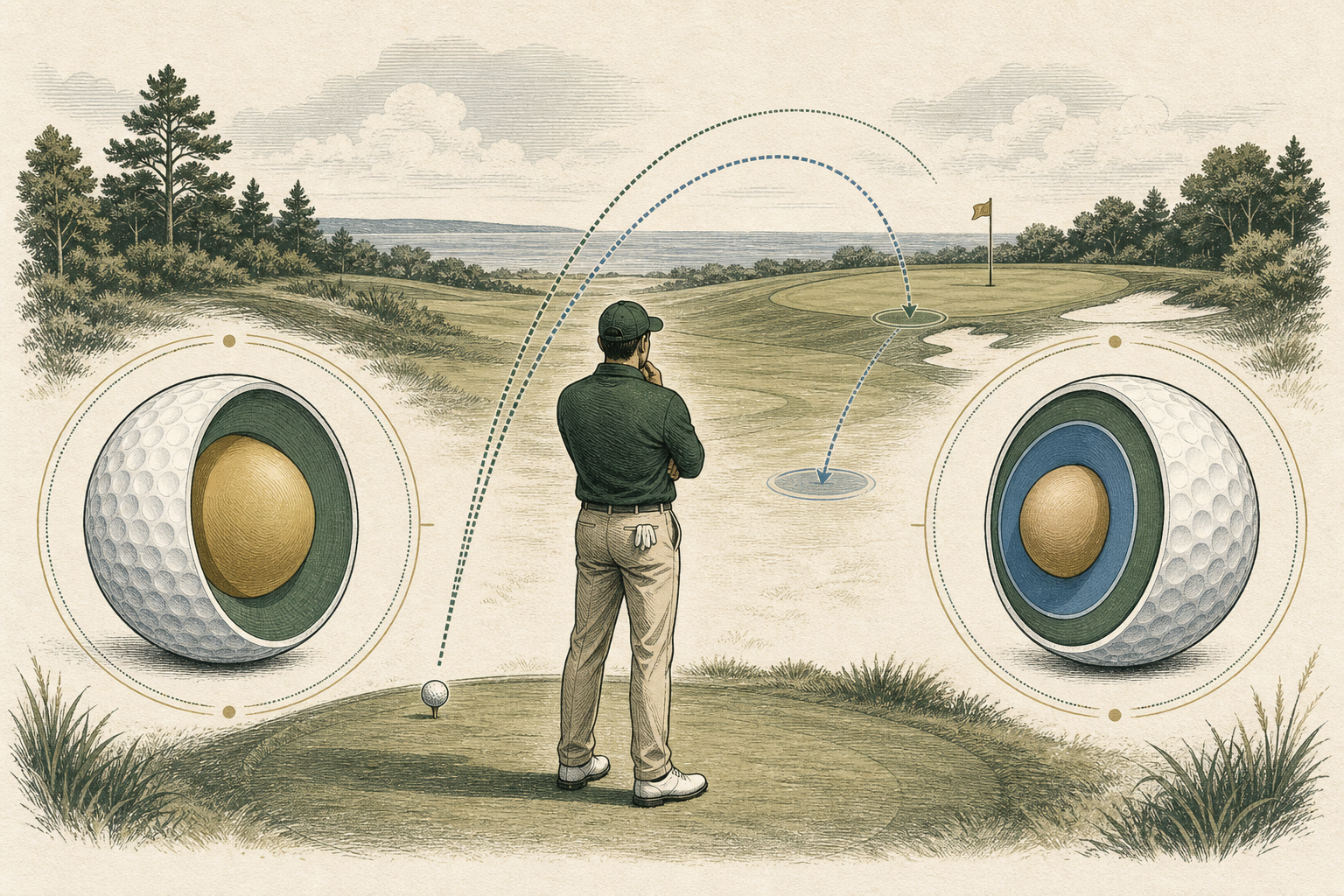
Built for: Golfers comparing golf-ball construction while balancing feel, durability, flight, and short-game control.
When one ball feels reassuring off the tee but another seems easier to judge around the green, the construction label can become an unhelpful shortcut. Start with the shot you need to trust, then compare candidates under the same conditions.
The quick verdict
Choose neither two-piece nor three-piece construction on the label alone; choose the conforming ball that produces the most dependable result on the shots that cost you the most strokes.
Best for Golfers who can name a clear priority, such as a consistent tee-shot window, confidence in the wind, a preferred impact sensation, resilience through a round, or predictable distance control near the green.
Skip it if Skip a construction-first decision if you have not compared candidate balls with the same club, target, and routine.
Start with the shot that creates the decision.
A golfer who loses confidence when a tee shot finishes outside a familiar window has a different problem from a golfer facing a delicate chip over a bunker. “Two-piece” and “three-piece” are useful labels for organizing a search, but they do not replace a priority. Before comparing balls, finish this sentence: “I need my ball to be easier to judge on __.” The blank might be full-shot flight, the sound and sensation at impact, how the cover looks after a round, or the distance a chip finishes from the hole.
Guild recommendation: Choose one primary shot category for your first comparison and keep the rest of the test simple.
Match the comparison to feel, durability, flight, or control.
Feel is personal, so treat it as feedback rather than a universal ranking. If one ball leaves you uncertain about how firmly you struck a putt or chip, that uncertainty is worth recording. Durability is also best judged in your own routine: inspect each candidate after equivalent use and note visible change without assuming that construction count predicts it. For flight and short-game control, define a target and a finish area before hitting. A ball that repeatedly produces the result you can recognize is more useful than one that wins a label-based argument.
Guild recommendation: Compare only two candidates at once, use the same club and target, and record outcomes rather than relying on a few memorable shots.
Keep the Rules check separate from the preference check.
Personal preference answers which ball helps you play with more reliable expectations. Rules eligibility is a separate question. The USGA Equipment Rules state that balls used under the Rules must meet applicable equipment requirements, and the USGA Conforming Ball List identifies balls submitted and evaluated for conformance. If you play in an event or simply want to verify a choice for Rules play, check the relevant list rather than inferring conformance from construction, packaging language, or appearance.
Guild recommendation: Verify the exact ball on the current applicable conforming list before using it in a setting governed by the Rules.
A sensible priority map.
Prioritize a repeatable full-shot result when the tee box or approach is where your round unravels. Prioritize chip and putt distance feedback when you routinely leave recovery shots outside a comfortable next-putt range. Prioritize visible condition after comparable use when replacing scuffed balls disrupts your routine. A golfer with several concerns should begin with the one that appears most often in scoring situations, then revisit the others after narrowing the field.
Guild recommendation: Let your most frequent on-course decision set the order of testing, not the number of layers named on the box.
Try this · Twenty-five minutes.
The Same-Target Ball Comparison.
Bring two conforming ball candidates, a wedge or short iron, a putter, and a practice area with a safe chipping target and a level putting target. Mark a single starting spot for each exercise and alternate balls so changing conditions do not favor one candidate.
- Hit three chips with the first ball to one landing area, then hit three chips with the second ball from the same lie and to the same landing area.
- Repeat that sequence once, paying attention to whether you can predict the first bounce, rollout, and finishing area before each shot.
- From one putting distance, alternate six putts between the two balls while keeping the same line and pace intention.
- Write down only observable results: the number of chips that finish in your chosen area, the number of putts that reach a defined finish zone, and which ball gives you the clearest sense of distance at impact.
- If flight is your main priority, repeat the comparison on a quiet day with the same club and target, recording whether each ball repeatedly finishes in the window you selected.
What progress looks like: One candidate earns a repeatable advantage in your chosen finish area or gives you a consistently clearer distance picture across both rounds of the drill.
Put the guide to work
These searches are a starting point—not a substitute for the fit and comparison criteria above.
Compare two-piece candidates.
Use this search after deciding which observable result matters most, then confirm that any ball you intend to use under the Rules appears on the applicable conforming list.
Compare three-piece candidates.
Use this search to build a small, like-for-like test group rather than assuming the construction label settles feel, flight, or control.
If you buy through these links, Guild of Golf may earn a commission at no extra cost to you.
The practical takeaway
- Two-piece and three-piece labels are starting points for comparison, not guarantees of a particular playing result.
- Choose a ball by testing one priority at a time with a fixed club, target, and finish area.
- Record feel as personal feedback and judge flight, condition, and short-game results by observable outcomes.
- For play under the Rules, verify that the exact ball meets applicable requirements and appears on the relevant conforming list.
Frequently asked questions
Is a three-piece ball automatically better for short-game control?
No supplied evidence establishes that conclusion, so treat construction count as a search filter and compare short shots to one landing area before deciding.
Is a two-piece ball automatically the more durable choice?
Do not assume durability from the construction label alone; inspect candidate balls after comparable use and choose the result that suits your routine.
How can I compare feel without guessing?
Alternate balls on the same chip and putt targets, then note which one gives you the clearest, most repeatable sense of distance at impact.
Do I need to check whether my golf ball conforms?
If you will use the ball under the Rules, check the applicable equipment requirements and the USGA Conforming Ball List for the exact ball.
Sources used for this draft
- USGA Equipment Rules — Golf balls used under the Rules must meet applicable equipment requirements.
- USGA Conforming Ball List — The list identifies balls submitted and evaluated for conformance.
Guild of Golf may earn a commission from qualifying purchases made through shopping links, at no extra cost to the reader.