
evergreen guide
Choose a Home Launch Monitor That Makes Practice More Useful
A practical framework for deciding whether a personal launch monitor gives a home golfer a repeatable, measurable practice task rather than another screen to watch.
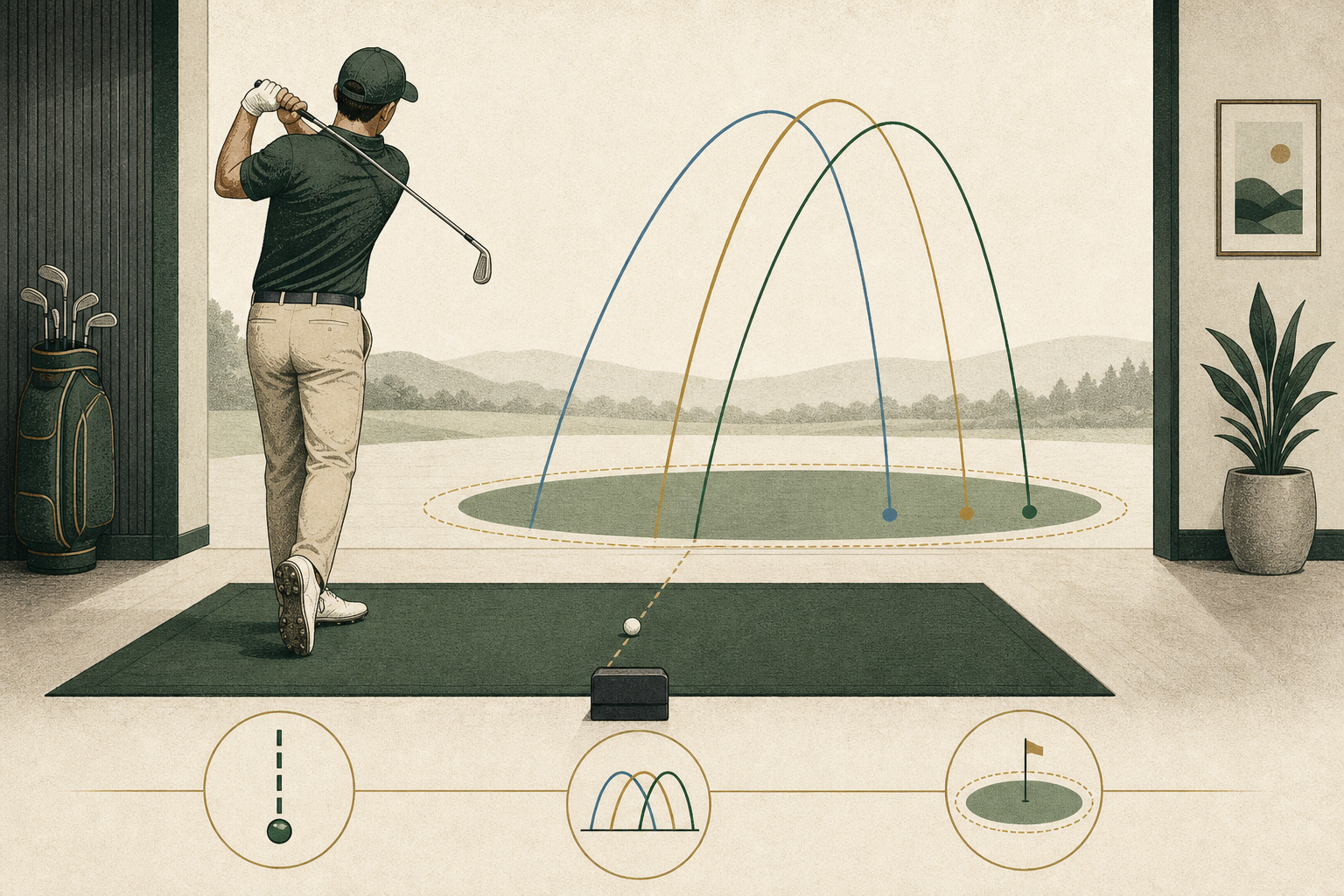
Built for: Golfers deciding whether a personal launch monitor provides the measurements and setup their practice actually needs.
The familiar home-practice trap is hitting forty balls, seeing forty different numbers, and finishing no clearer about what to work on next. A launch monitor earns its space when it lets you define one task, repeat the setup, and recognize a measurable result.
The quick verdict
Choose a launch monitor only after you can name the one or two measurements that will decide whether a practice shot met its task, and confirm that your available space allows a repeatable setup.
Best for It is best for golfers who can practice in one reasonably consistent location and want to organize sessions around a specific, observable target.
Skip it if Skip it if you do not have a reliable place to position the ball and device consistently, or if you expect a display of numbers to identify the cause of every poor shot.
Start with the practice decision, not the device.
A personal launch monitor can look compelling when you are frustrated by vague range sessions, but the better question is narrower: what decision will its information help you make? One golfer may need a consistent way to compare carry-distance results while changing clubs. Another may want a visible shot window for a short indoor session after work. If you cannot describe the task in one sentence, more measurements are likely to create more noise than direction. The PGA of America recommends practice with a defined purpose and measurable structure, which is a useful standard for this purchase as well.
Guild recommendation: Write down one recurring practice question before comparing monitors, such as whether a group of shots reached a chosen distance window or whether a particular club produced a more repeatable result.
Choose measurements you can act on during one session.
Do not begin by counting data fields. Begin with the smallest set of results that can settle your practice task. For example, a golfer working on distance control might prioritize a distance result and a clear target window. A golfer trying to make more disciplined contact practice may prefer one repeatable ball-result measure rather than several swing-related readouts. The constraint is attention: if you watch five figures after every swing, you may stop noticing whether the shot actually met the intended task. A measurement is useful when it changes the next shot, the next five-shot group, or the club selection you practice.
Guild recommendation: Limit an early session to one primary displayed measurement and one target outcome. Add another measurement only when you can explain the separate decision it will support.
Treat setup repeatability as part of the purchase.
Home practice rarely happens in a perfectly permanent studio. A garage bay may need to be cleared for a car, a garden mat may sit on uneven ground, and an indoor net may leave little room for repositioning. Those realities matter because your practice comparison is only as useful as your ability to recreate the ball position, device position, target line, and hitting area. Before buying, map the exact place where you expect to practice and decide whether you can preserve those reference points from session to session. A device that fits your routine is more useful than one whose setup makes you abandon the session after ten minutes.
Guild recommendation: Create a no-purchase floor plan with the ball location, intended device location, hitting direction, and safe target area. If that plan is awkward, solve the space problem before treating more data as the answer.
Ask for evidence behind any objective promise.
Golfers often encounter claims about what a monitor measures, how it performs in a given environment, or how it compares with another option. Treat those as objective claims that deserve a reasonable basis, not as reasons to suspend judgment. The FTC states that objective advertising claims should have a reasonable basis. For your decision, separate a seller’s promise from the practical question you can verify in your own routine: can you set the unit up consistently, understand the chosen output, and complete a purposeful practice session with it?
Guild recommendation: When comparing listings or marketing materials, keep a short claim checklist. Note the exact measurement or setup promise, then ask what evidence is provided and whether that promise addresses your own practice task.
Build sessions around groups, not one heroic swing.
A single excellent number can be entertaining, but it does not automatically make a practice session useful. A better home routine is a small, repeatable set of shots with the same club, target, and chosen measurement. This gives you a defined task and measurable structure without asking the monitor to diagnose a swing. It also makes a bad shot less disruptive: record it, keep the setup unchanged, and let the group show whether the task was met often enough to be useful. The goal is not to chase a perfect reading. It is to make a clear comparison you can repeat next time.
Guild recommendation: Use five-shot groups and a simple success count. After each group, decide whether to keep the task, change the target, or switch clubs, rather than making a major adjustment after every shot.
Try this · Twenty minutes.
The One-Task Repeatability Check.
Use the same club, the same ball position, and the same target for the entire session. Place the launch monitor in its intended position and avoid moving it after the first shot. Choose one displayed measurement that you expect to use in practice, plus one simple target outcome such as finishing within a chosen landing area.
- Write one task before hitting, such as producing a chosen shot window or sending the ball toward a defined target area.
- Hit five unhurried baseline shots and record only the selected measurement and whether each shot met the target outcome.
- Make one deliberate, comfort-level change that you can repeat without trying to diagnose your swing, such as choosing a different target or using a different club.
- Hit five more shots from the unchanged device and ball setup, again recording the same measurement and target outcome.
- Review the two groups as practice evidence: ask whether the display helped you distinguish a more successful group from a less successful group and whether the setup remained practical to repeat.
What progress looks like: The monitor is useful for your practice when you can state the task, preserve the setup, and use the selected measurement to tell which group better met the target outcome.
Put the guide to work
These searches are a starting point—not a substitute for the fit and comparison criteria above.
Search for a personal launch monitor after you have identified the measurement,.
Use this search if carry distance and club speed are the measurements you have already decided will organize your sessions.
Search for an indoor launch monitor after you have measured your available space
Use this search if your main constraint is creating a stable, repeatable home-practice layout.
Search for a launch monitor with shot data recording if review is your priority.
Use this search if you want to compare groups of shots after practice rather than react to each shot in isolation.
If you buy through these links, Guild of Golf may earn a commission at no extra cost to you.
The practical takeaway
- A home launch monitor is most valuable when it serves a clearly written practice task.
- The right measurement is the one that helps you judge a specific shot outcome, not necessarily the largest list of available data.
- A repeatable ball position, device position, and target line are purchase requirements, not afterthoughts.
- Use small groups of shots to create measurable structure and avoid overreacting to one result.
- Objective product claims deserve a reasonable basis, so compare evidence with the needs of your own setup.
Frequently asked questions
Do I need many measurements for home launch-monitor practice?
No. Start with the smallest set of measurements that helps you judge one defined practice task, then add information only when it supports another clear decision.
What is the most important home-setup consideration?
The most important consideration is whether you can reproduce the ball location, device location, hitting direction, and target arrangement often enough to make one session comparable with the next.
Can a launch monitor diagnose my swing?
Use it first as a way to observe selected shot results and organize purposeful practice, rather than assuming it can explain the cause of every result.
How can I judge whether a monitor will change my practice?
Run the One-Task Repeatability Check and see whether a stable setup and one chosen measurement help you distinguish a more successful five-shot group from a less successful one.
Sources used for this draft
- PGA of America: Practice With Purpose — This source supports the recommendation to give practice a defined purpose and measurable structure.
- FTC Advertising and Marketing Basics — This source supports the guidance that objective product claims should have a reasonable basis.
Guild of Golf may earn a commission from qualifying purchases made through shopping links, at no extra cost to the reader.