
comparison
Alignment Sticks vs. Tempo Trainers: Choose the Feedback You Need
A practical way to choose between an alignment stick and a swing tempo trainer by matching the aid to the mistake you can observe and the outcome you want to improve.
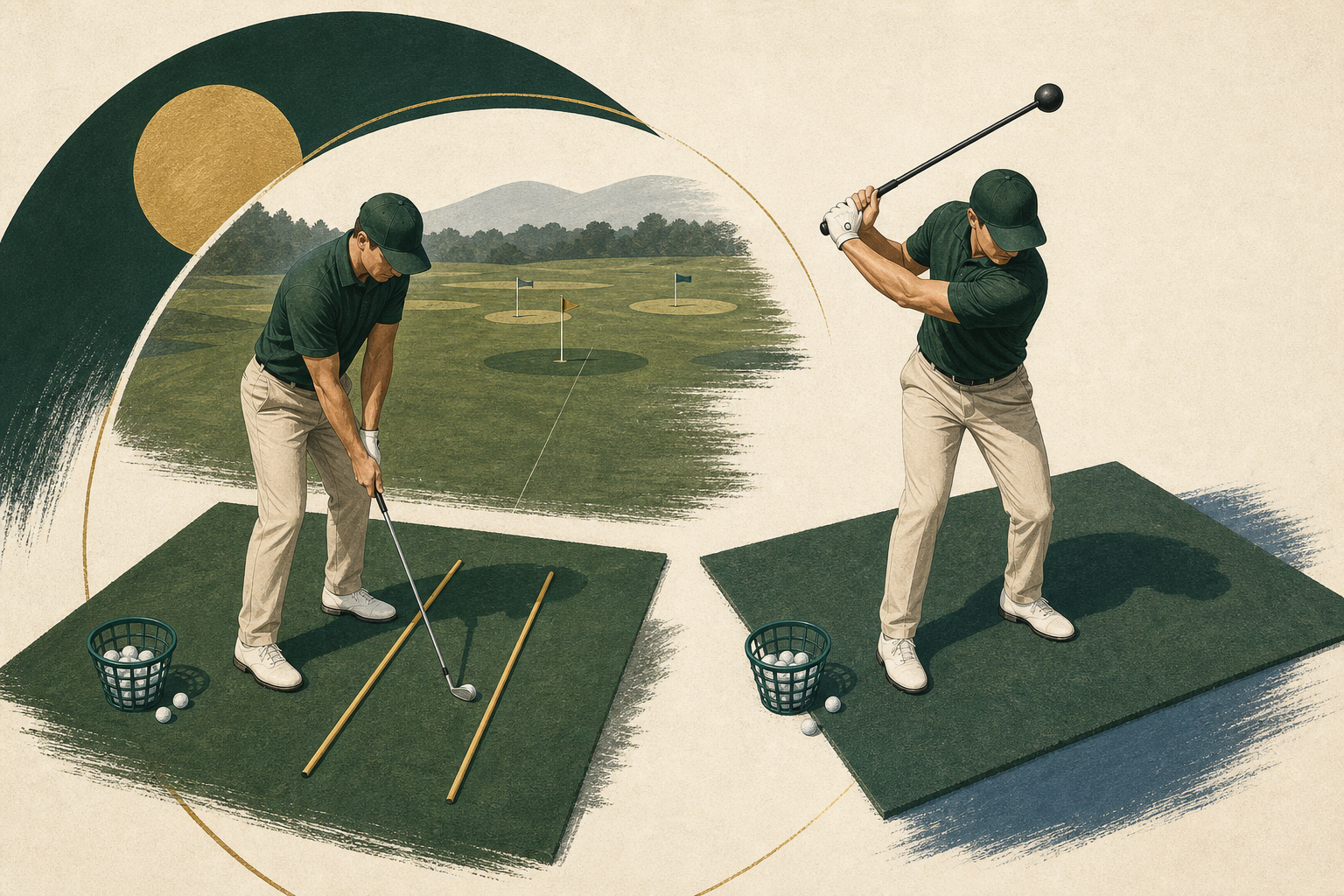
Built for: Golfers choosing between inexpensive practice aids for alignment, movement, rhythm, or speed awareness.
When a range session produces plenty of swings but no clear answer, another gadget is rarely the cure. Choose the aid that makes one visible part of your practice easier to judge: where you are aimed, how your body moves, or whether your motion stays organized from start to finish.
The quick verdict
Buy alignment sticks when your practice needs visible reference lines for aim, ball position, and movement space; choose a swing tempo trainer when your priority is repeating a calmer, more consistent motion. Neither aid fixes a swing by itself, so the useful choice is the one that gives feedback you can see or feel on the very next rep.
Best for Alignment sticks suit golfers who need a simple station for target alignment and setup checks. A tempo trainer suits golfers whose practice goal is rhythm and awareness of how their swing moves through the backswing and downswing.
Skip it if Skip both for now if you cannot name a practice goal or if you plan to use the aid during a stipulated round without first confirming what the applicable rules allow.
Start with the miss you can actually observe
Picture two golfers on the same range. One keeps aiming well left of the flag without realizing it, then makes compensations through the swing. The other sets up squarely enough but rushes the transition, finishing some practice swings off balance. Giving both golfers the same aid turns practice into guesswork. Purposeful practice begins by connecting the activity to a specific goal, not by collecting more drills. PGA of America: Practice With Purpose
Guild recommendation: Choose alignment sticks if your goal concerns a visible line at address. Choose a tempo trainer if your goal concerns the pace and balance of your motion.
What alignment sticks make easier to judge
An alignment stick is most valuable as a reference, not a verdict on your swing. Set one on the ground toward a selected target and use another to establish a repeatable ball-position reference. Now you have a station that can reveal whether your feet, ball position, and intended target line are changing from rep to rep. That is particularly helpful for the golfer who hits several different starting directions while feeling as though every setup was identical.
Guild recommendation: Buy the simplest pair if you will use them to make setup repeatable. Skip them if your only plan is to place them down once and then ignore the reference they provide.
What a tempo trainer can bring to a session
A swing tempo trainer changes the feel of a rehearsal. Its best role is to slow the urge to snatch the club away, rush from the top, or lash at the ball when the goal should be a balanced finish. It is not a substitute for identifying every technical cause of a poor shot. Instead, it gives the golfer a single movement constraint: complete a controlled motion that stays organized enough to finish in balance. For a player whose range swings become faster and less coordinated as the bucket goes on, that can be a useful reset.
Guild recommendation: Choose a tempo trainer if you can make deliberate rehearsals and then carry one simple rhythm cue into normal-club shots. Skip it if you are seeking a guaranteed speed gain or a diagnosis of your swing.
The tradeoff: line feedback versus motion feedback
Alignment sticks are usually the clearer choice when you need external feedback. The rods remain on the ground, so you can step into the station and see whether your setup matches your intention. A tempo trainer is more about internal awareness: you notice the weight, pace, and finish of your movement. Neither form of feedback is automatically better. A golfer preparing for a narrow tee shot may benefit more from a reliable target-line routine; a golfer who has begun swinging harder after a bad hole may benefit more from a few controlled rehearsals before returning to a normal club.
Guild recommendation: If your question is “Where am I aimed?” choose sticks. If your question is “Can I move through this swing without rushing?” choose the tempo trainer.
Keep range tools separate from on-course assumptions
Practice aids belong in a practice plan, not in an assumption about what is permitted during play. Equipment and its use during a stipulated round are governed by the applicable rules, so check the relevant rules before relying on any aid on the course. USGA Equipment Rules
Guild recommendation: Use the aid at the range or in a practice area unless you have confirmed that its use is permitted for your particular round and competition conditions.
Try this · 15 minutes.
The One-Question Alternating Station
Choose one target at the range. Place two alignment sticks on the ground only: one aimed at the target and one perpendicular to it to mark a consistent ball position. Keep a swing tempo trainer nearby, and use a normal club for any shots you hit.
- Write one observable goal before starting, such as starting the ball nearer the intended target line or completing every practice swing in a balanced finish.
- Make five slow address rehearsals with your normal club, checking only whether your feet and clubface are set consistently relative to the ground reference.
- Make five unhurried practice swings with the tempo trainer, finishing each swing in balance. Do not chase speed or try to change several positions at once.
- Alternate for two more rounds: five setup rehearsals with the sticks, then five balanced tempo-trainer swings.
- Finish with five normal shots using your regular club. Before each shot, choose either the alignment check or the rhythm cue, not both.
What progress looks like: The session is working when you can complete five consecutive repetitions with the same chosen setup reference or a controlled, balanced finish, and can state which cue helped without guessing.
Put the guide to work
These searches are a starting point—not a substitute for the fit and comparison criteria above.
Basic alignment-stick pair
Compare length, visibility, and whether the pair can lie flat and stay in place for the simple ground-reference station described above.
Weighted tempo practice club
Compare grip comfort, overall feel, and whether the trainer encourages a controlled rehearsal rather than a rushed, strength-focused motion.
Alignment-stick carry tube
Consider a carry option only if transporting loose rods is the reason you would otherwise leave the alignment station at home.
If you buy through these links, Guild of Golf may earn a commission at no extra cost to you.
The practical takeaway
- An alignment stick gives an external reference for a repeatable setup, target line, and ball position.
- A tempo trainer is most useful when your goal is a controlled rehearsal, steadier rhythm, and a balanced finish.
- Name one observable outcome before buying or practicing, because purposeful practice connects the activity to a specific goal.
- Use one cue at a time when you return to normal shots, so you can tell what changed.
- Confirm applicable rules before using any practice aid during a stipulated round.
Frequently asked questions
Should a beginner buy alignment sticks or a tempo trainer first?
Start with alignment sticks if the beginner needs a repeatable way to aim and set the ball in the same place. Start with a tempo trainer if setup is reasonably consistent but practice swings are regularly hurried or unbalanced.
Can alignment sticks improve swing tempo?
They can support a structured practice station, but their direct feedback is visual and positional. If rhythm and pace are the central goal, a tempo trainer is the more direct choice.
Can a tempo trainer correct my alignment?
It can help organize a rehearsal, but it does not provide a target-line reference on the ground. Use alignment sticks when you need to see and repeat your intended line at address.
Can I use these aids on the golf course?
Do not assume so. Equipment and use during a stipulated round are governed by applicable rules, so consult the relevant rules and any competition conditions before using an aid during play.
Sources used for this draft
- PGA of America: Practice With Purpose — The principle that purposeful practice should connect an activity to a specific goal.
- USGA Equipment Rules — The statement that equipment and its use during a stipulated round are governed by applicable rules.
Guild of Golf may earn a commission from qualifying purchases made through shopping links, at no additional cost to the reader.