
evergreen guide
Draw-Bias Drivers: When a Right Miss Is the Right Fit
A practical way to decide whether a draw-bias driver suits your recurring right miss, or merely hides the wrong question.
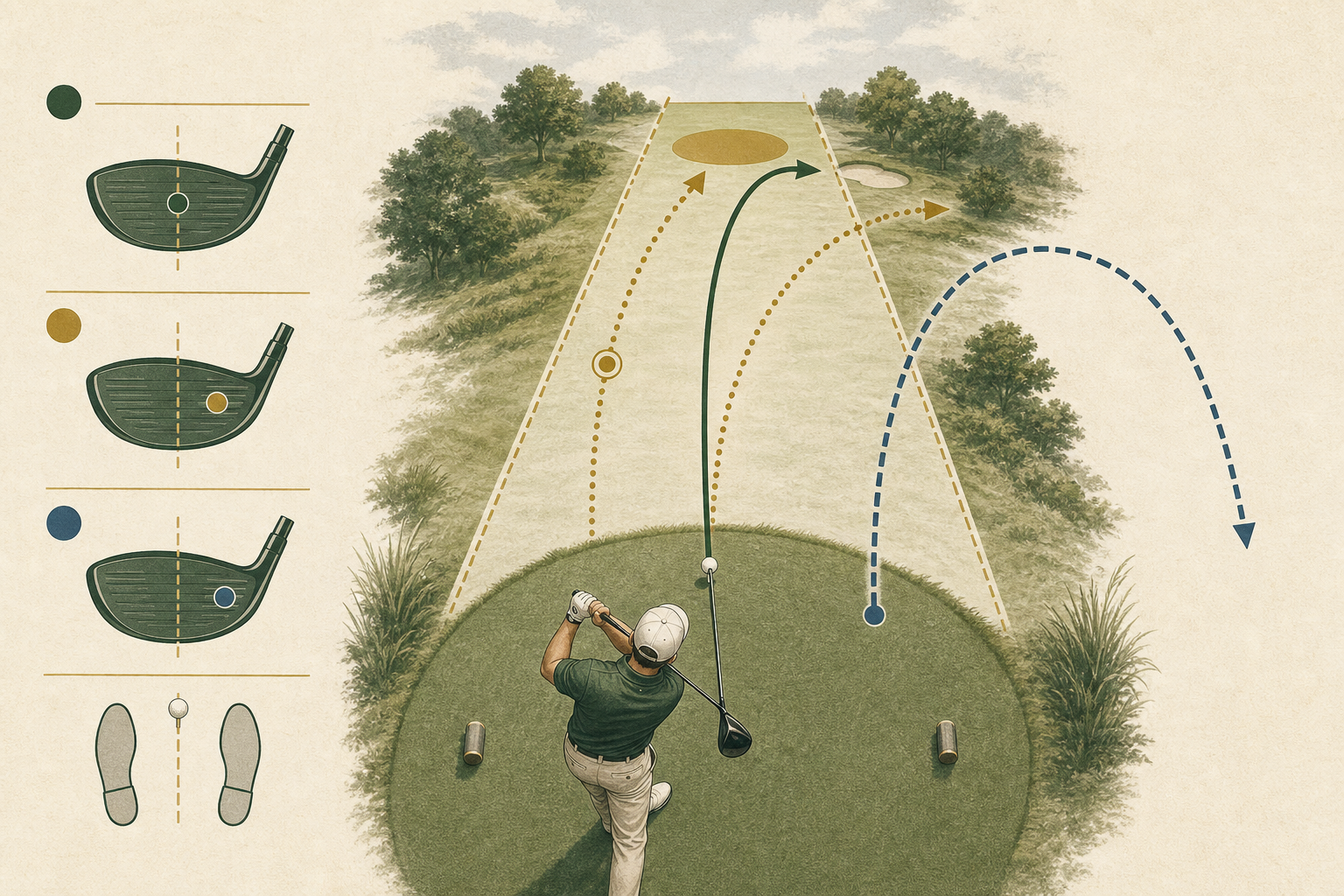
Built for: Right-handed golfers considering draw bias for a recurring right miss who need to separate face, path, strike, and setup effects.
A drive that finishes right can begin right, curve right, arrive there after heel contact, or simply follow a poor setup. Before choosing a draw-bias driver, make the miss specific enough that the club choice has a job to do.
The quick verdict
A draw-bias driver is most sensible for the right-handed golfer whose typical tee shot starts near the intended line and repeatedly leaks or finishes right, especially when that pattern remains after a consistent setup and centered-contact check.
Best for Golfers with a repeatable rightward shape who want to compare a draw-oriented head during a fitting based on measured ball flight.
Skip it if Skip the purchase decision for now if your right miss changes from ball to ball, begins far right because of alignment or aim, or is routinely tied to very high or low face contact.
First, describe the ball flight rather than the miss.
“I slice it” is often too broad to guide a driver decision. Stand behind the tee after several ordinary swings and separate where the ball starts from what it does afterward. A ball that starts close to the target and bends right is a different pattern from a ball that starts immediately right and stays there. They may finish in the same trees, but they do not present the same question for a draw-bias head.
Guild recommendation: Write down start direction and curvature for at least six normal tee shots before narrowing the search.
Face, path, strike, and setup deserve separate checks.
Use these as observation categories, not labels for a flawed swing. Start direction gives you one visible clue from the initial flight. Curvature gives you another. Strike location can be checked with an impact marker, while setup can be checked by seeing whether your feet, shoulders, and clubface are repeatedly aimed as intended. When all four observations point in different directions from shot to shot, a driver change is unlikely to be a clean first answer.
Guild recommendation: Do not choose a head based only on the final landing area; note the starting line, shape, impact location, and address picture.
The golfer a draw-bias driver may actually suit.
The strongest candidate is a right-handed golfer with a recurring, recognizable rightward result: a drive that commonly begins near the intended line and then works right, with contact that is not wildly scattered. This golfer has a specific flight to compare in a fitting. The goal is not to buy a promise of a draw; it is to see whether a draw-oriented configuration produces a measurably more useful pattern without creating a new left miss.
Guild recommendation: Bring your usual driver and a short record of your repeated flight pattern to a fitting, because fitting should account for the individual golfer and measured ball flight.
When the draw label is likely solving the wrong problem.
A draw-bias driver is a weaker fit when the recurring ball begins far right because the player is not consistently aimed at the intended target. It is also a weak shortcut when heel-side, toe-side, high, and low strikes rotate from shot to shot. In those cases, the practical constraint is inconsistency: there is no single stable outcome by which to judge whether a head helps. Establish a repeatable setup and a clearer strike pattern first, then compare equipment.
Guild recommendation: If your notes show different starts, different curves, and different impact locations each session, postpone the purchase and work with a qualified instructor or fitter on a more stable baseline.
Make the fitting comparison honest.
A fitting is not a contest between labels. Ask to hit your current driver and a draw-oriented alternative under similar conditions, using your normal swing and the same target. Compare the repeated start line, curvature, strike pattern, and dispersion rather than chasing one unusually long ball. PGA of America guidance notes that fitting should account for the individual golfer and measured ball flight. Any driver design considered should also conform to the applicable equipment rules.
Guild recommendation: Choose the option only if its repeated ball flight improves the result you care about while keeping your playable misses in view.
A practical decision rule for the course.
Suppose your usual hole asks for a tee shot that can start at the center of the fairway and tolerate a gentle movement left, but right-side trouble is severe. A golfer whose normal ball leaks right may have a useful reason to test draw bias. On another hole, where left trouble is the real penalty or the player’s misses already turn over left, the same label becomes a poor match. The club should serve the common hole and common miss, not one remembered drive.
Guild recommendation: Base the decision on your usual miss and the trouble it creates, not on whether a draw sounds preferable in theory.
Try this · 20 minutes.
The Three-Flight Tee Shot Check
Use a level practice tee, one target in the distance, eight to 12 balls, and a removable face-impact marker such as impact tape or foot spray used according to its label. Set an alignment club on the ground outside the ball-to-target line where it cannot interfere with your swing, and remove it before hitting if its position feels unsafe.
- Choose one distant target and make your normal address each time; do not attempt to manufacture a draw or fade.
- For each shot, record only three observations: where the ball started relative to the target, whether it curved left or right in flight, and whether the impact mark was broadly centered, heel-side, toe-side, high, or low.
- After six shots, group the results by the most repeated pattern rather than giving extra weight to one dramatic miss.
- If the same near-target start followed by a rightward curve appears repeatedly with broadly similar impact marks, bring that observation to a qualified fitter and compare ball flight with and without a draw-oriented option.
- If start direction, curve, and strike location all vary widely, repeat the check on another day before treating the pattern as an equipment problem.
What progress looks like: The useful result is a simple repeatable description, such as “starts near target and leaks right with mostly centered contact,” rather than a diagnosis of your swing.
Put the guide to work
These searches are a starting point—not a substitute for the fit and comparison criteria above.
Compare adjustable draw-oriented models.
Look for an adjustable option only if you want to compare more than one setup during a fitting, while confirming that the specific club conforms to the applicable rules.
Compare fixed draw-oriented models.
A fixed design can be a cleaner comparison when your ball flight is already measured and your fitter has identified a consistent use case.
Check strike location before changing clubs.
Impact feedback helps distinguish a repeated contact location from a vague memory of where the ball finished.
If you buy through these links, Guild of Golf may earn a commission at no extra cost to you.
The practical takeaway
- A right finish is an outcome, not a complete equipment diagnosis.
- Separate start direction, curvature, strike location, and setup before assigning a driver a corrective role.
- Draw bias is best treated as a measured fitting comparison for a repeatable rightward pattern.
- A head that improves one shot but introduces a repeated left miss has not necessarily improved your scoring option.
- Conforming equipment and an individual, ball-flight-based fitting provide a sound basis for the final choice.
Frequently asked questions
Will a draw-bias driver fix every slice?
No. A rightward finish can reflect different observable patterns, including a rightward start, rightward curvature, inconsistent impact location, or inconsistent setup. Identify the repeated pattern before deciding whether the club category deserves a fitting comparison.
What should I bring to a driver fitting?
Bring your current driver, a concise record of your usual tee-shot pattern, and a clear description of the hole trouble you are trying to avoid. PGA of America guidance says fitting should account for the individual golfer and measured ball flight.
Should I choose an adjustable or fixed draw-oriented driver?
Choose based on the comparison you need during fitting. An adjustable model may offer more configurations to evaluate, while a fixed model may be sufficient when the desired ball-flight result is already clear. In either case, the driver must conform to the applicable equipment rules.
How many shots should I judge?
Use enough normal shots to see a pattern rather than deciding from one exceptional drive. Six to 12 recorded tee shots can give you a more useful starting description, and a second session is sensible if the results are highly mixed.
Sources used for this draft
- USGA Equipment Rules — The point that adjustable and non-adjustable driver designs must conform to applicable equipment rules.
- PGA of America: Club Fitting — The recommendation that fitting account for the individual golfer and measured ball flight.
Guild of Golf may earn a commission from qualifying purchases made through certain shopping links, at no extra cost to you.