
evergreen guide
Choose a Game-Improvement Driver by Your Strike Pattern, Not the Label
A practical framework for choosing a more playable driver by comparing where you strike the face, how your misses finish, and which option gives you repeatable confidence.
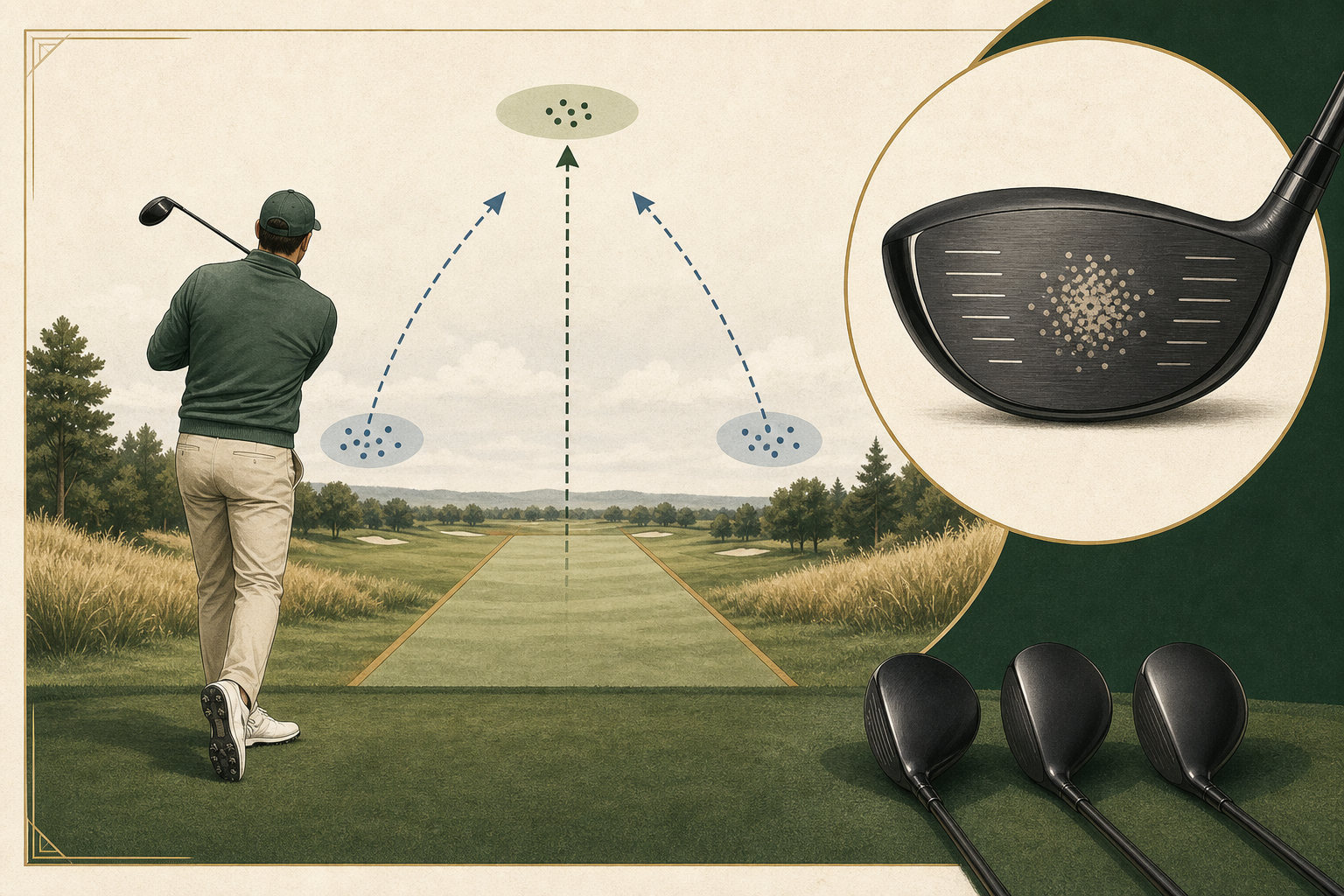
Built for: Golfers seeking a more playable driver who want to evaluate strike consistency, dispersion, launch, and confidence without relying on a vague game-improvement label.
The driver that helps is not necessarily the one carrying the most reassuring category label. It is the one that turns your common tee-shot pattern into a more manageable next shot often enough to matter.
The quick verdict
Treat “game-improvement” as a starting point, not a verdict. Compare drivers by the strike pattern you can repeat, the miss that remains playable, measured launch and dispersion when available, and whether the club gives you a committed swing on the tee.
Best for Golfers whose usual driver miss is identifiable and who can compare several options with the same target, ball, and swing intention.
Skip it if Skip a driver decision based only on a category label, a single exceptional drive, or a few swings hit without noting where the ball started and finished.
The first tee problem is rarely “I need more forgiveness.”
You stand on a tight par 4 with trouble right, aim down the middle, and still feel compelled to guide the club through impact. Or you hit two long drives during a demo, then lose three balls with the same club when you try to play a normal shot. Those experiences are not solved by a broad label. The decision is whether a driver makes your recurring strike and ball-flight pattern easier to live with. Start by naming the pattern: contact scattered across the face, a ball that begins in an unwanted direction, a curve that carries into trouble, a launch window that is hard to repeat, or a swing that feels tentative because you do not trust the outcome.
Guild recommendation: Write down your most common poor tee shot in one sentence before comparing clubs, such as, “My normal miss starts right and finishes too far right,” or, “My contact moves around the face and my distance varies.”
Separate strike pattern from ball-flight pattern.
A strike pattern is the cluster of contact locations you produce over a group of ordinary swings. A ball-flight pattern is where those shots begin and where they finish. They are related observations, but they answer different questions. A golfer may see a consistent ball start with changing contact, or see similar contact with a wide variety of finishes. During a comparison, record both rather than assigning a cause from one shot. This keeps the process useful without pretending a range session can diagnose a swing.
Guild recommendation: Use a simple scorecard for each club: eight strike locations when visible, eight starting directions, eight finishing zones, and the number of shots that would require recovery on your home course.
Define a playable miss before you look for a better driver.
A playable miss is specific to the hole you usually face. On a course with trees close to the fairway, a shot that finishes only a few yards into the first cut may be acceptable, while one that crosses into a blocked angle is not. On an open course, a wider finish may still leave a clear approach. The important comparison is not whether every ball is perfect; it is which driver leaves your normal miss in a place from which you can sensibly continue the hole. A drive that is occasionally spectacular but regularly creates a penalty or a forced punch-out may be less useful than one with a narrower range of ordinary outcomes.
Guild recommendation: For each shot, mark it as “green” for a straightforward next shot, “yellow” for a compromised but playable next shot, or “red” for a likely recovery or penalty. Compare those totals across options.
Use launch and dispersion as measured context, not decoration.
If a fitter or launch monitor is available, measured results can add context to what you see outdoors. PGA of America guidance emphasizes that fit and measured results matter when comparing club options. Keep the comparison controlled: same ball type, same target, similar number of shots, and the same normal swing intention. Look for a repeatable group, not the largest single number on a screen. If the measured result points one way but your shot pattern and confidence point another, ask to repeat the comparison rather than forcing a conclusion from too few swings.
Guild recommendation: Ask for side-by-side results from multiple ordinary shots and match them to your green, yellow, and red outcome notes before deciding.
Confidence is evidence only when it survives a fair comparison.
Confidence matters when it changes what you can actually do over the ball. A driver that allows you to make your normal committed swing may produce a more honest comparison than one that makes you steer or rush. But confidence should be tested, not merely declared after a flushed shot. Alternate clubs after an initial block of swings, return to the same target, and see whether the preferred option still produces a recognizable pattern. The club you choose should help you make the swing you intend while keeping its ordinary miss within your version of playable.
Guild recommendation: After the eight-ball comparison, alternate four more shots between the two finalists. If your preferred result disappears when the order changes, collect more swings before purchasing.
Make the final decision within the rules and with a fitter’s help.
A club’s marketing category does not determine whether it conforms. USGA Equipment Rules set conforming club requirements regardless of how a club is marketed. Once you have identified the strike and miss pattern you want to improve, take that information to a fitting conversation. Tell the fitter which shots are red outcomes, show the launch and dispersion notes if you have them, and ask to compare options against the same target. That gives the fitting process a practical goal: not an abstract promise of improvement, but fewer tee shots that turn a normal hole into a recovery exercise.
Guild recommendation: Before putting a driver in play for competition, confirm that the specific club configuration meets the applicable equipment rules and retain your comparison notes for a follow-up fitting session.
Try this · 30 to 45 minutes.
The Eight-Ball Playable-Miss Comparison
Bring two driver options, use the same model of golf ball when possible, and choose a target with a clearly defined fairway-width corridor or range target. If you have access to a launch monitor, use it for both clubs under the same settings. Hit only when the area ahead is clear.
- Warm up with a few unrecorded swings, then choose one target and one normal on-course tee-shot intention.
- Hit eight shots with the first driver. After each shot, note strike location if it is visible, starting direction, finish relative to your intended corridor, and whether the result would leave a straightforward next shot or a recovery.
- Repeat the same eight-shot sequence with the second driver. Do not change targets or try to manufacture a different swing for either club.
- Compare the two groups rather than their single longest shots. If launch information is available, write down the displayed launch results alongside the dispersion notes.
- Choose the option whose ordinary shots occupy the most repeatable area and whose common miss creates the fewest obvious recovery situations.
What progress looks like: One driver produces a noticeably tighter cluster of strikes and finishes, or turns your frequent miss into a result you would be willing to play from on a normal hole.
Put the guide to work
These searches are a starting point—not a substitute for the fit and comparison criteria above.
Compare adjustable driver options after defining your pattern
Use this search only after you know whether you are trying to reduce a particular start line, widen your acceptable landing area, or improve strike consistency during a like-for-like comparison.
Find simple impact-location feedback tools
Impact-location feedback can help you record a strike pattern instead of judging a club from ball flight alone.
Prepare for a measured fitting session
A measured comparison gives you a way to pair your on-course observations with launch and dispersion results.
If you buy through these links, Guild of Golf may earn a commission at no extra cost to you.
The practical takeaway
- A game-improvement label cannot replace evidence from your own repeated strike and shot pattern.
- The best driver comparison counts playable outcomes and recovery situations, not only peak distance.
- Record strike location, starting direction, finish, and launch information when it is available.
- A measured fitting is most useful when you arrive with a clear description of the miss you want to make more playable.
- Choose the driver that supports a committed normal swing and produces an ordinary miss you can manage.
Frequently asked questions
What is the most useful way to compare two drivers at the range?
Hit the same number of ordinary shots toward the same target with each club, then compare strike clustering, starting direction, finishing zone, and how often each result would create a recovery on the course.
Should I choose the driver that produces my longest drive?
Not from one or two shots alone. A more useful choice is the driver that produces a repeatable group of shots and leaves your usual miss in a manageable place.
Can launch-monitor numbers settle the decision?
They can provide valuable measured context, especially when the comparison is controlled, but they should be considered alongside your observed dispersion, strike pattern, and on-course confidence.
Does a game-improvement driver automatically conform to the rules?
Conformity is governed by applicable equipment rules rather than a marketing category, so confirm the specific club configuration before using it in competition.
Sources used for this draft
- USGA Equipment Rules — Conforming club requirements apply regardless of marketing category.
- PGA of America: Club Fitting — Fit and measured results matter when comparing club options.
Guild of Golf may earn a commission from qualifying purchases made through affiliated shopping links, at no additional cost to the buyer.