
evergreen guide
Choose a Home Launch Monitor by the Practice Decision It Improves
A practical framework for deciding whether a personal launch monitor will create clearer, more measurable home practice rather than simply produce more numbers.
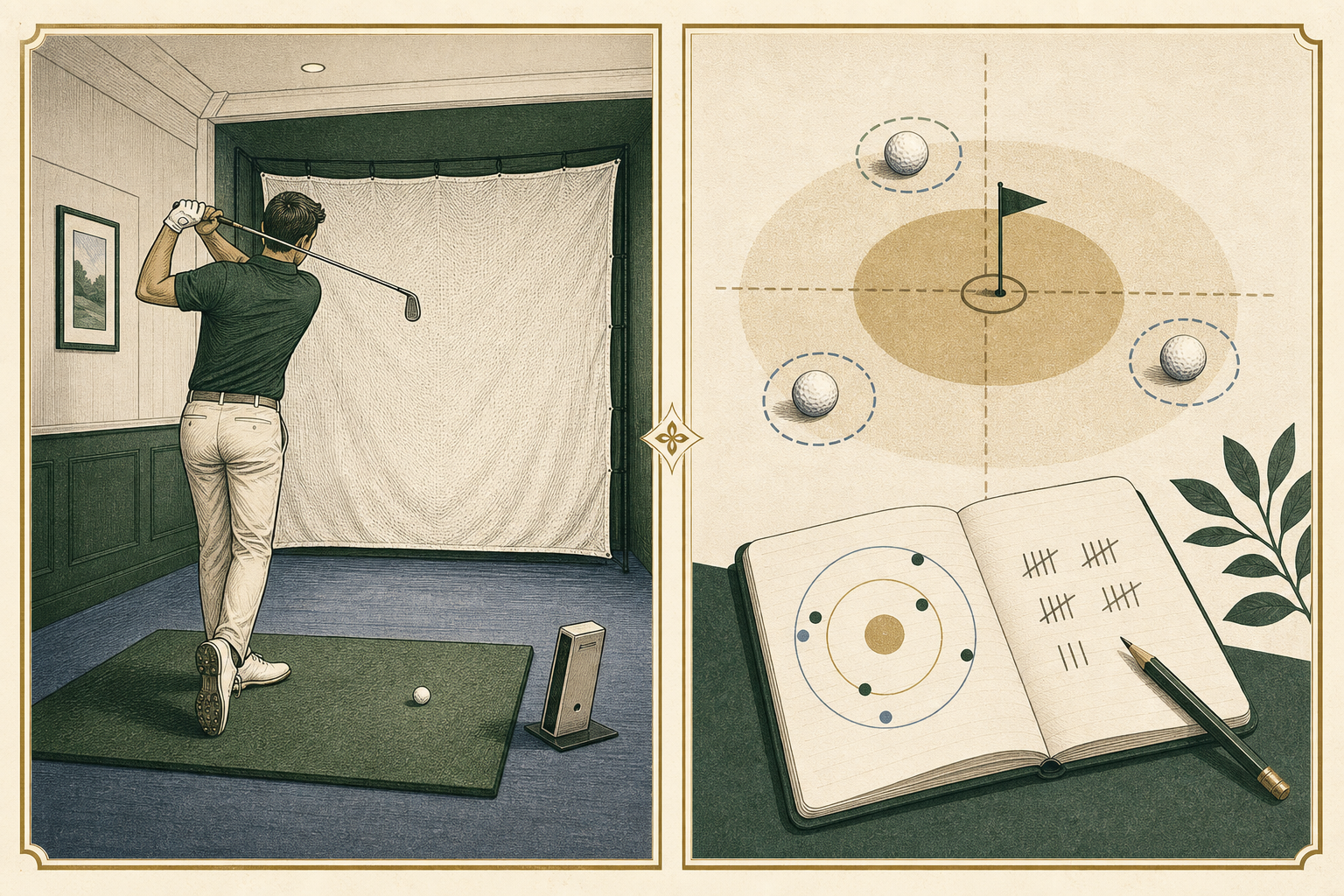
Built for: Golfers deciding whether a personal launch monitor provides the measurements and setup their practice actually needs.
Before comparing screens, subscriptions, or headline measurements, decide which shot decision you want help making and whether your practice space can support a repeatable session.
The quick verdict
A home launch monitor is worth evaluating when it can give you one or two repeatable measurements that change how you practice a specific shot. Start with the practice decision, then verify the required space, ball and club compatibility, displayed results, saved-session workflow, and any ongoing access requirements from the manufacturer’s current documentation.
Best for Golfers with a consistent home practice area who will use measured targets for a defined task, such as building a tighter carry-distance pattern with one club or recording a repeatable baseline over several sessions.
Skip it if Skip it, or wait, if you do not yet have a safe repeatable hitting setup, cannot identify a useful question the data would answer, or would be discouraged by numbers without a plan for acting on them.
The familiar trap: buying numbers before choosing a question
A golfer may hit a dozen balls into a net, glance at a screen after each one, and still leave without knowing what improved. That is the central decision tension. More feedback is not automatically more useful feedback if it does not change the next shot, the next drill, or the next practice session.
Begin with a shot question that can be answered at home. “What is my usual carry pattern with this club?” is workable. “Can I start more shots near my intended line?” may be workable if the device reports a relevant direction result. “Why did that shot curve?” is a different and more demanding question; do not assume every device or setup can answer it.
The PGA of America recommends practice with a defined purpose and measurable structure. Apply that principle before shopping: name one outcome, choose a measurement that relates to it, and decide what result would count as progress. That makes the launch monitor a feedback tool rather than a scoreboard.
Guild recommendation: Write down one home-practice question and the single measurement you would use to track it. If you cannot do that yet, prioritize a structured practice routine before buying a monitor.
Match the displayed measurement to a real practice decision
Treat every listed metric as a question: What will I do differently after seeing it? If the answer is “nothing,” it is not essential for your first home setup.
For a golfer working on distance control, a carry-style result may be useful if it lets the golfer define a target window and count successful shots. For someone trying to make a more repeatable starting pattern, a direction-related result may matter more, provided it is presented in a way the golfer can understand and revisit. A golfer who wants to compare sessions needs a clear way to retain or manually record results.
Ask the seller or manufacturer to show precisely what appears after a shot, what can be reviewed after a session, and which measurements require particular modes, equipment, or conditions. Avoid translating a feature name into a promise about your game. Objective product claims should have a reasonable basis, a standard the FTC describes in its advertising guidance.
Guild recommendation: Make a two-column list: “measurement displayed” and “practice decision it changes.” Keep only the measurements with a specific action beside them.
Your room and routine are part of the product decision
A launch monitor cannot be separated from the practice bay around it. Before comparing models, measure the available area and consider where the ball, device, target, and golfer would sit during a normal swing. Confirm the manufacturer’s current instructions for required placement, intended indoor or outdoor use, compatible balls and clubs, and any stated safety guidance.
Then consider repeatability. Can you place the ball in the same spot each session? Can you keep the unit in its instructed position? Is the target arrangement stable enough that you can focus on the shot rather than constantly rebuilding the bay? A compact device is not automatically the better fit if its instructions demand a setup your room cannot reproduce.
This check also protects practice time. If setup takes so long that you avoid using the system, the measurements you paid for will not create much feedback.
Guild recommendation: Sketch your hitting area to scale and compare it against each manufacturer’s current setup instructions before narrowing your shortlist.
Compare the workflow, not just the device
A useful session has a beginning, a target, a record, and a review. Examine the whole workflow: how you start a session, how quickly you see the selected result, whether results are stored or must be logged by hand, and how easily you can compare one session with another.
Also ask what continues to work without optional services and what access, applications, accounts, or updates may be needed for the features you care about. These are not minor details for a home golfer who practices in short windows after work. A setup that produces one reliable measurement in five minutes can be more valuable than a richer system that remains unused.
Do not rely on broad performance language alone. Read the current documentation, identify the exact feature being described, and look for the conditions attached to that claim. The FTC’s advertising guidance is a useful reminder to separate supported, specific claims from assumptions built around them.
Guild recommendation: For each finalist, run a paper rehearsal: write the steps from entering the room to reviewing 20 shots. Choose the workflow you are realistically willing to repeat.
Set a sensible first-session standard
The first goal is not to create a perfect swing diagnosis. It is to establish a repeatable reference point. Pick one club, one target, one displayed measurement, and a broad success window that suits your present game. Record enough shots to see a pattern, then repeat the session another day under similar conditions.
This approach gives the data a job. A tighter pattern, more shots in your window, or a more consistent session record can guide the next practice plan. If the result is scattered, that is still useful information: simplify the target, check that the setup follows the manufacturer’s instructions, and avoid drawing technical conclusions from a single session.
Purposeful practice is more durable than screen-watching. The monitor should help you notice a trend you can measure, not pressure you to chase an isolated best number.
Guild recommendation: Use the One-Club Baseline Session twice before changing clubs, targets, or settings. Compare the count inside your target window, not only your single best shot.
Try this · 25 minutes.
The One-Club Baseline Session
Use a safe, repeatable hitting area and one club you can strike comfortably. Choose one target line and one measurable outcome your device actually displays, such as carry distance or a direction result. Set a broad target window before you begin, and keep the same ball type and setup throughout the session when practical.
- Hit five comfortable warm-up shots without recording a verdict on them.
- Write one simple session goal, such as producing 10 shots within your chosen carry window or observing how tightly a direction result groups around your target line.
- Hit 10 shots with the same club and normal pre-shot routine. Record only the selected measurement and whether each shot met your target window.
- Take a short break, then hit a second set of 10 shots under the same conditions.
- Compare the two sets: note the number of shots that met the window and whether the pattern was broadly similar, tighter, or wider. Do not try to explain the cause from the numbers alone.
What progress looks like: The session is useful when you finish with a repeatable baseline, such as a count of shots inside your chosen window, and a clear next-session target rather than a vague impression of whether you hit it well.
Put the guide to work
These searches are a starting point—not a substitute for the fit and comparison criteria above.
Compare general home-practice monitor options
Use product pages and current manuals to compare the exact measurements shown, the space requirements, and how a session is saved or reviewed.
Compare indoor-practice setups
Evaluate the monitor as part of the whole hitting environment, including a safe target, stable hitting location, and enough room for your normal motion.
Find a simple practice-recording tool
A notebook or scorecard-style log can keep the session centered on one observable target instead of chasing every available number.
If you buy through these links, Guild of Golf may earn a commission at no extra cost to you.
The practical takeaway
- Choose a launch monitor by the practice decision it helps you make, not by the longest metric list.
- Confirm that your room, target arrangement, and normal routine can reproduce the manufacturer’s required setup.
- Prioritize measurements you can turn into a defined target and record across sessions.
- Review current documentation for feature conditions, access requirements, and setup instructions before purchase.
- Use a simple one-club baseline to turn feedback into measurable practice.
Frequently asked questions
What is the first feature I should evaluate on a home launch monitor?
Evaluate the one displayed measurement that directly supports your most common practice goal. For example, a golfer working on distance control should first determine whether the device presents a usable distance result and whether it can be recorded consistently across sessions.
Do I need every available measurement for productive home practice?
No. Purposeful practice starts with a defined outcome and a measurable structure. A smaller set of results is often more useful when each one informs a specific target or next-session decision.
How can I tell whether a monitor will fit my space?
Measure your intended hitting area, map the ball, device, target, and golfer positions, and compare that plan with the manufacturer’s current setup and safety instructions. Do this before treating portability or compact size as proof of fit.
How should I judge accuracy claims?
Read the exact claim, its stated conditions, and the manufacturer’s supporting documentation. Do not expand a feature description into a promise that it will solve a particular ball-flight or swing problem. The FTC advises that objective advertising claims should have a reasonable basis.
Sources used for this draft
- PGA of America: Practice With Purpose — The recommendation to use a defined purpose and measurable structure for practice.
- FTC Advertising and Marketing Basics — The guidance to scrutinize objective product claims and look for a reasonable basis.
Guild of Golf may earn a commission from qualifying purchases made through affiliate links. Shopping searches are provided to help you compare options after defining your practice needs.