
comparison
Putting Mirror vs. Putting Mat: Choose the Feedback Your Stroke Needs
A putting mirror and a putting mat solve different home-practice problems. Choose a mirror when your priority is repeatable setup feedback, and choose a mat when you need a clear ball-roll task and a target.
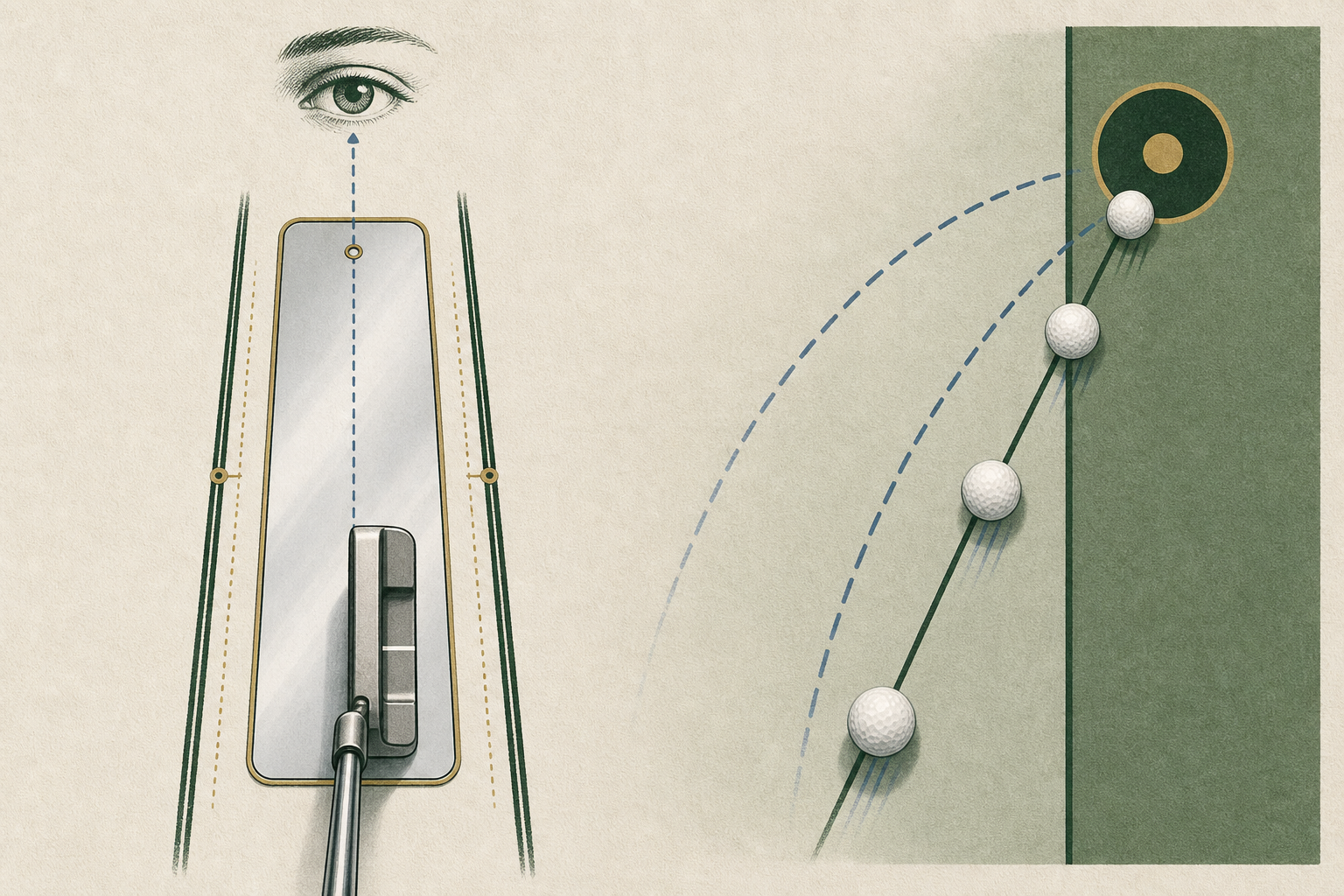
Built for: Golfers choosing one practice aid and deciding whether they need setup feedback or ball-roll feedback.
When a short putt misses at home, the useful question is not which aid looks more serious. It is whether you need to see your address position before the stroke or give the ball a defined rolling task after it leaves the face.
The quick verdict
Buy a putting mirror if your home sessions need a consistent address checkpoint; buy a putting mat if you are more likely to practice when you can roll balls toward a defined target. If you can choose only one, select the aid that makes your next practice session measurable rather than merely busy.
Best for A mirror is best for golfers who want setup feedback before each stroke. A mat is best for golfers who need a repeatable start line, distance, or target task to hold their attention.
Skip it if Skip a mirror if looking down at alignment references makes you rehearse positions without rolling enough putts. Skip a mat if its target task encourages you to ignore how you set the putter and ball down at address.
Start with the miss you are trying to understand
Picture a familiar living-room session: you roll twenty putts, make several, miss several, and finish with no better idea of what to repeat tomorrow. A mirror and a mat can both make practice more organized, but they organize different parts of the putting task. The mirror asks you to inspect address before the ball moves. The mat asks you to send the ball somewhere and observe the result. Practice has greater value when it has a defined purpose and structure, so choosing between them begins with identifying the feedback you will use rather than the accessory you expect to own.
Guild recommendation: Choose one question for a session. If it is “Did I set up the same way?” favor a mirror. If it is “Did the ball start and finish at my intended target?” favor a mat or a simple target.
A putting mirror makes the pre-stroke moment visible
A mirror is primarily a setup-feedback tool. Before a short putt, it gives the golfer a repeatable opportunity to check the relationship among the eyes, ball, putter face, and intended line. That is valuable for the player whose practice tends to drift: the ball moves, but the address position changes from one attempt to the next. Its limitation is equally important. Seeing a reference is not the same as learning a motion, and a golfer can spend too long arranging the picture instead of rolling putts. Use the mirror for a short check, then make the stroke and judge the ball’s start.
Guild recommendation: Buy a mirror when you want a brief, consistent address routine. Skip it when visual references make you freeze over the ball or reduce the number of purposeful putts you roll.
A putting mat gives the ball a job to do
A mat is most useful when it turns a vague indoor roll into a defined task. A target, a marked finishing area, or a chosen distance lets you judge each attempt by an observable outcome: did the ball begin where intended, finish near the target, or arrive with the pace you selected? This makes a mat a practical choice for the golfer who will practice more often with a ready-made lane than with a bare floor and an improvised objective. The tradeoff is that ball-roll feedback can be incomplete if you never pause to establish a repeatable address position.
Guild recommendation: Buy a mat when a visible target will get you rolling focused sets of putts. Skip it if you tend to chase makes and misses without any repeatable pre-stroke checkpoint.
Do not confuse a home target with the putting green
Home practice is a place to rehearse a chosen task, not to recreate every condition found on a golf course. Rule 13 supplies the rules context for putting greens and lines of play, while your indoor station is simply a controlled practice environment. That distinction is helpful: a home target can teach you to commit to a start line or a finishing area, but it cannot answer every question that arises from changing slopes, surfaces, and on-course circumstances. Keep the goal narrow and carry only the useful cue to the course.
Guild recommendation: Use home practice to build a repeatable routine and a clear starting task. On the course, apply the Rules of Golf and respond to the actual putting-green situation in front of you.
If you can own only one, choose the aid that removes your biggest excuse
For the golfer who says, “I do not know whether I am aimed or set up consistently,” the mirror is the more direct purchase. For the golfer who says, “I never practice unless there is a hole or target in front of me,” the mat is more likely to earn regular use. Neither choice needs to be permanent. A mirror can be paired later with a basic target, and a mat can be improved by adding one short setup check before each putt. The stronger decision is the one that turns twelve idle minutes into a small, repeatable practice block.
Guild recommendation: Prioritize setup feedback when uncertainty begins before the stroke. Prioritize ball-roll feedback when the missing ingredient is a target, a routine, and a measurable outcome.
Try this · 12 minutes.
The Setup-Then-Roll Home Putting Check
Create a clear indoor putting lane on a level, unobstructed surface. Use a mirror or another repeatable visual reference for the first half, then use a cup, small target, or marked finishing area for the second half. Start from a short distance at which you can make a smooth, unhurried stroke.
- Roll five putts with no aid in view and note only whether each ball starts where you intended and finishes at the target or in the marked area.
- For the next five balls, use the mirror or visual reference before each stroke. Take one brief look at your eye position, ball position, and putter-face aim, then look away from the reference and make the stroke.
- Remove the visual reference and roll five more balls to the same target. Keep the same starting distance and do not change your target after a miss.
- Finish with five putts in which you choose one simple task: either begin the ball on your intended line or finish it inside the marked area. Record how many satisfy that one task.
What progress looks like: The session is useful when the final five-ball set produces a clearer, repeatable result on your chosen task than the first five, or when it identifies one setup checkpoint worth carrying into the next session.
Put the guide to work
These searches are a starting point—not a substitute for the fit and comparison criteria above.
Compare putting mirrors
Compare the clarity and simplicity of the address references. The best choice is one you can check briefly before a stroke without turning every putt into a long pre-shot routine.
Compare putting mats
Compare whether the mat gives you a target or finishing task you will actually use. A defined task matters more than extra visual detail when your goal is purposeful ball-roll practice.
Compare simple home targets
A simple target can complement either aid by giving each ball a clear destination and helping you measure a small set of putts consistently.
If you buy through these links, Guild of Golf may earn a commission at no extra cost to you.
The practical takeaway
- A putting mirror is a setup-feedback aid, while a putting mat is chiefly a ball-roll and target-task aid.
- Purposeful practice starts with one observable question, not with a large number of untracked putts.
- Use a mirror briefly, then judge whether the ball starts on the intended line.
- Use a mat to create a repeatable target task, but retain one simple address checkpoint.
- Choose the single aid that is most likely to make your next home session structured and repeatable.
Frequently asked questions
Is a putting mirror better than a putting mat for beginners?
Neither is automatically better. A beginner who needs a repeatable way to place the ball and aim the putter may benefit more from a mirror, while a beginner who needs a simple target and a reason to practice may benefit more from a mat.
Can a putting mat replace a putting mirror?
It can replace the ball-roll task, but it does not automatically provide the same pre-stroke visual feedback. Add a brief, repeatable setup check if address consistency is the main concern.
Can a putting mirror replace a putting mat?
It can provide a setup reference, but it does not create a target task by itself. Pair it with a cup, marked area, or other simple target so each putt has an observable outcome.
How should I measure a productive home putting session?
Use one task for a short set, such as starting the ball on your intended line or finishing inside a marked area, and record the result. A defined purpose and structure make the session more useful than rolling putts without a clear measure.
Sources used for this draft
- PGA of America: Practice With Purpose — The recommendation to give practice a defined purpose and structure.
- USGA Rule 13: Putting Greens — The rules context for putting greens and lines of play.
Guild of Golf may earn a commission from qualifying purchases made through affiliated shopping links, at no extra cost to you.