
evergreen guide
Build Sensible Wedge Loft Gaps Before You Buy Another Wedge
A practical way to map the scoring clubs you already own, identify a real distance problem, and choose the next wedge only when it solves it.
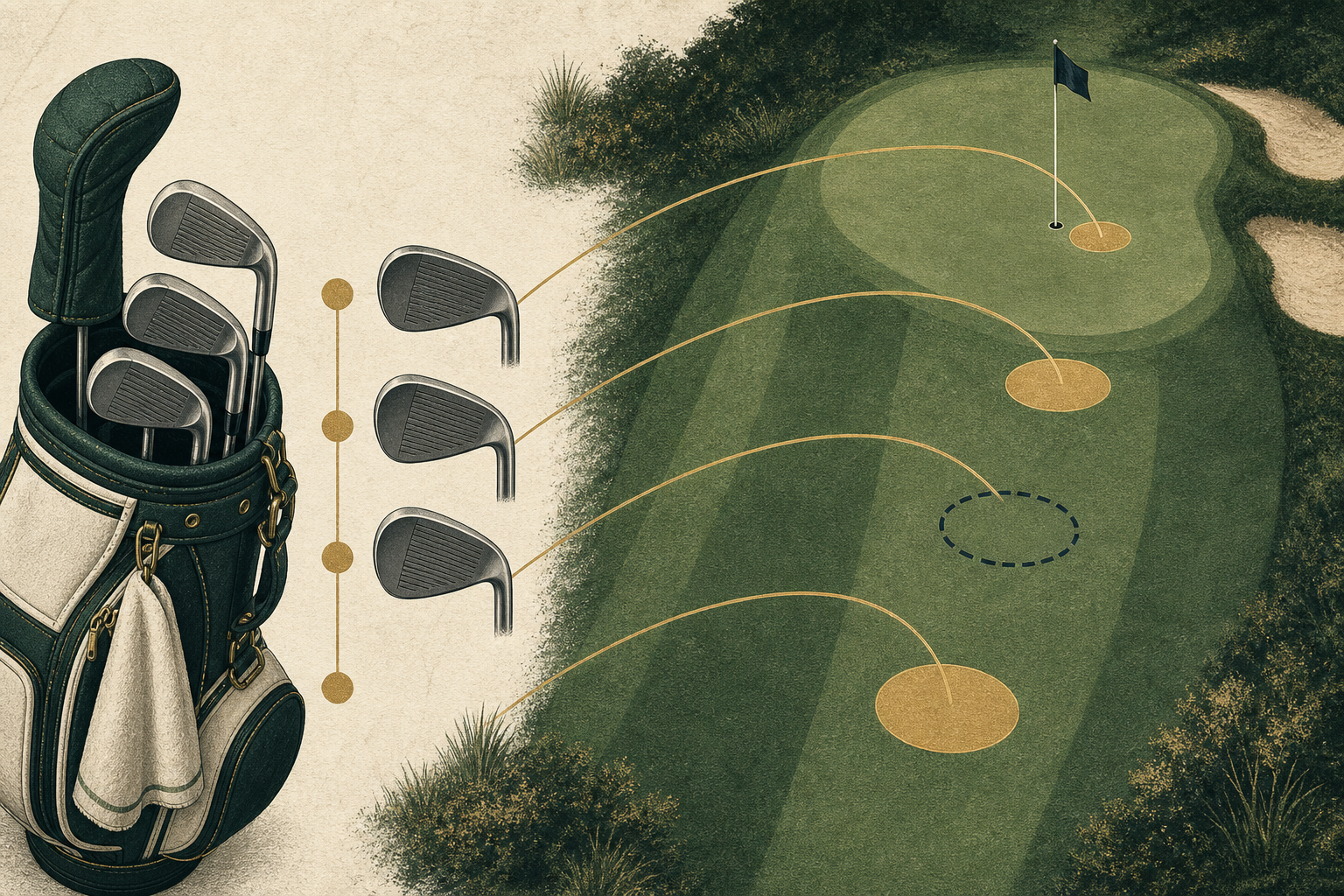
Built for: Golfers who have an awkward distance gap near the green and are considering a gap, sand, or lob wedge.
Before adding a wedge for one frustrating yardage, establish what your current set actually covers. The most sensible purchase is the club that creates a repeatable option, not simply the highest-lofted club on the rack.
The quick verdict
Start with your current wedges and your pitching wedge, record the carry windows you can produce with a normal swing, and buy only if a usable yardage window is missing.
Best for Golfers whose approach shots routinely leave one uncomfortable carry or whose existing wedges have overlapping jobs.
Skip it if Skip a new wedge for now if the problem is mainly inconsistent strike, uncertain carry distance, or choosing a shot before checking the lie and landing area.
The familiar mistake: buying for one bad hole
You come up short from a familiar approach distance, or fly the green after trying to ease off a wedge, and the obvious conclusion is that you need another club. Sometimes you do. Just as often, the bag already contains the answer, but its job has never been defined. A new wedge cannot make a distance gap sensible if it merely duplicates a club you already hit to the same area.
Begin with the scoring end of the set: your pitching wedge and every wedge below it. Read the loft stamped on each club, but treat the number as a starting point for organizing the bag, not a promise of a particular distance. What matters on the course is the carry window you can repeat with a normal, balanced swing. A golfer who can cover a useful sequence of approach windows has a better decision on a tight pin than a golfer carrying several wedges with vague, overlapping purposes.
Guild recommendation: Do not choose a wedge from a single frustrating shot. First establish whether that shot sits inside an uncovered carry window or simply asks for a more controlled version of a club you own.
Build gaps around carry windows, not wishful full swings
A sensible wedge setup gives neighboring clubs distinct jobs. One may be the reliable fuller approach club. The next may cover a shorter normal carry or a controlled approach. The highest-lofted wedge may be reserved for shots that need a shorter carry, a higher launch, or more room to stop before trouble. Those are useful distinctions because they describe observable outcomes, not labels on the sole.
On the course, carry is the first number to solve. A front bunker, water short of the green, or a false front does not care how far the ball rolls after landing. Pick a safe landing area, estimate the carry required, and then ask which current wedge delivers that carry with the least forced swing. If your answer is repeatedly “none of them,” you may have found a legitimate gap. If the answer is “my lower-lofted wedge with a shorter, controlled motion,” practice that option before buying a replacement.
Guild recommendation: Define the missing job in plain language, such as “a normal carry over the front bunker without a hard swing,” before comparing lofts.
Separate a loft problem from a shot-selection problem
Not every awkward yardage calls for another wedge. A shot can feel impossible because the lie is poor, the green has little room in front of the flag, the ball must clear trouble, or the player is trying to hit one club at an unfamiliar effort level. Those are different problems, and a loft change addresses only one of them.
Use your coverage map to create a simple test. If two existing clubs can bracket the required carry and one produces it predictably with a measured change in swing length, the bag may already be adequate. If neither club reaches the landing area without a forced swing, or both routinely produce the same result despite different loft markings, further comparison is justified. This is why a complete setup matters: PGA of America guidance describes club fitting as an evaluation of both the golfer and the complete equipment setup, rather than an isolated club choice.
Guild recommendation: Bring your complete scoring-club picture to a fitter or teaching professional, especially when a prospective wedge would alter the relationship among several existing clubs.
Choose the wedge job before comparing the wedge
A gap wedge is most useful when it fills the space between your pitching wedge and your next wedge. A sand wedge may be the better answer when the missing job includes ordinary bunker play as well as a fuller scoring shot. A lob wedge makes sense when the actual missing job is a short-carry, higher-flight shot, not merely because a golfer wants another option around the green.
That distinction keeps the purchase tied to your course reality. A player who often has a full approach from the missing window should prioritize a club that makes that normal shot easier to repeat. A player who mainly faces raised greens, short-sided misses, or carries over hazards may need a different job from the added wedge. Avoid assuming the highest-lofted option is automatically more useful; it can leave a new overlap lower in the bag while failing to improve the shot that prompted the purchase.
Guild recommendation: When you compare options, write down the one sentence the new wedge must satisfy and reject choices that cannot clearly earn that role.
Confirm the finished setup and keep it conforming
After any purchase, repeat the coverage map with the entire scoring group. The new wedge should make one decision easier: a particular carry, landing area, or common recovery shot should now have a clear club-and-swing choice. If it creates two clubs that compete for the same normal shot, the setup still needs attention.
For golfers playing under the Rules, equipment design and conformance are governed by the USGA Equipment Rules. When eligibility matters for your competitions, confirm that the specific club you intend to use meets the applicable requirements. This check belongs at the end of the buying process, after you have first established that the club fills a useful job in your bag.
Guild recommendation: Re-map the bag after adding a wedge, and verify conformance when you play in events where equipment rules apply.
Try this · 35 to 45 minutes.
The Wedge Coverage Map
Use a driving range or practice area with clear, safe distance markers. Bring your pitching wedge and every wedge you carry, plus 20 to 30 balls, a notebook, and a rangefinder if one is permitted. Choose a target line with enough room to observe carry and finish positions.
- Write down each club’s stamped loft, then list the clubs from the lowest-lofted scoring club to the highest-lofted one.
- Hit five normal, balanced shots with the first club. Do not try to manufacture extra speed or a specialty trajectory.
- Record the carry area of the three most representative shots, ignoring obvious mishits. Repeat for every scoring club.
- Circle any two neighboring clubs that repeatedly reach nearly the same carry area, then mark any carry area between clubs that you cannot approach comfortably with either one.
- For the suspected missing window, hit five controlled shots with the two clubs on either side of it. Note whether a modest length-of-swing change gives you a predictable option without forcing a delicate or overly hard motion.
What progress looks like: The map succeeds when you can name each scoring club’s normal job and can identify either one repeatable uncovered carry window or no purchase-worthy gap at all.
Put the guide to work
These searches are a starting point—not a substitute for the fit and comparison criteria above.
Compare loft-marked gap wedges
Use this only after your coverage map shows a missing middle window between your pitching wedge and the next wedge.
Compare loft-marked sand wedges
Compare these when the uncovered job is a fuller shot or a greenside shot from ordinary sand rather than simply a desire for more loft.
Compare loft-marked lob wedges
Consider these only if your map and typical course situations show a genuine need for a higher, shorter-carry option.
If you buy through these links, Guild of Golf may earn a commission at no extra cost to you.
The practical takeaway
- The right wedge purchase begins with a missing carry window, not a club category.
- Record representative normal-shot carries for your pitching wedge and every wedge before comparing new options.
- A useful new wedge has one distinct job that neighboring clubs cannot perform comfortably.
- If a controlled swing with an existing club covers the shot predictably, practice that option before adding another wedge.
- A complete-set fitting can help assess how one added club changes the rest of the scoring setup.
Frequently asked questions
Should I buy a gap wedge, sand wedge, or lob wedge first?
Choose the category only after mapping your current carry windows and defining the missing job. The best first addition is the one that solves the most frequent uncovered shot in your own setup.
Is the loft stamped on a wedge enough to determine my gaps?
No. The stamped loft helps you organize the clubs, but the useful evidence is the carry window you can repeat with each club. Record normal shots before deciding that a numerical loft difference creates a practical distance difference.
What if two wedges go nearly the same distance for me?
Treat that as an overlap worth investigating before buying another wedge. Repeat the coverage-map session with representative strikes; if the overlap remains, a fitting that considers the complete setup can help clarify the next move.
Can I solve an awkward wedge distance without buying a club?
Often, a controlled, balanced swing with an existing wedge may cover the needed carry. Test that option in practice and judge it by whether it produces a predictable carry area rather than by whether it feels like a perfect full swing.
Sources used for this draft
- USGA Equipment Rules — Club design and conformance are governed by the equipment rules.
- PGA of America: Club Fitting — A fitting evaluates the golfer and the complete equipment setup.
Guild of Golf may earn a commission from qualifying purchases made through shopping links, at no extra cost to you.