
evergreen guide
How to Choose Driver Loft Using Launch, Strike, and Ball Flight
A repeatable way to compare driver lofts by watching what your ball does, isolating changes, and using a fitting to turn those observations into a confident decision.
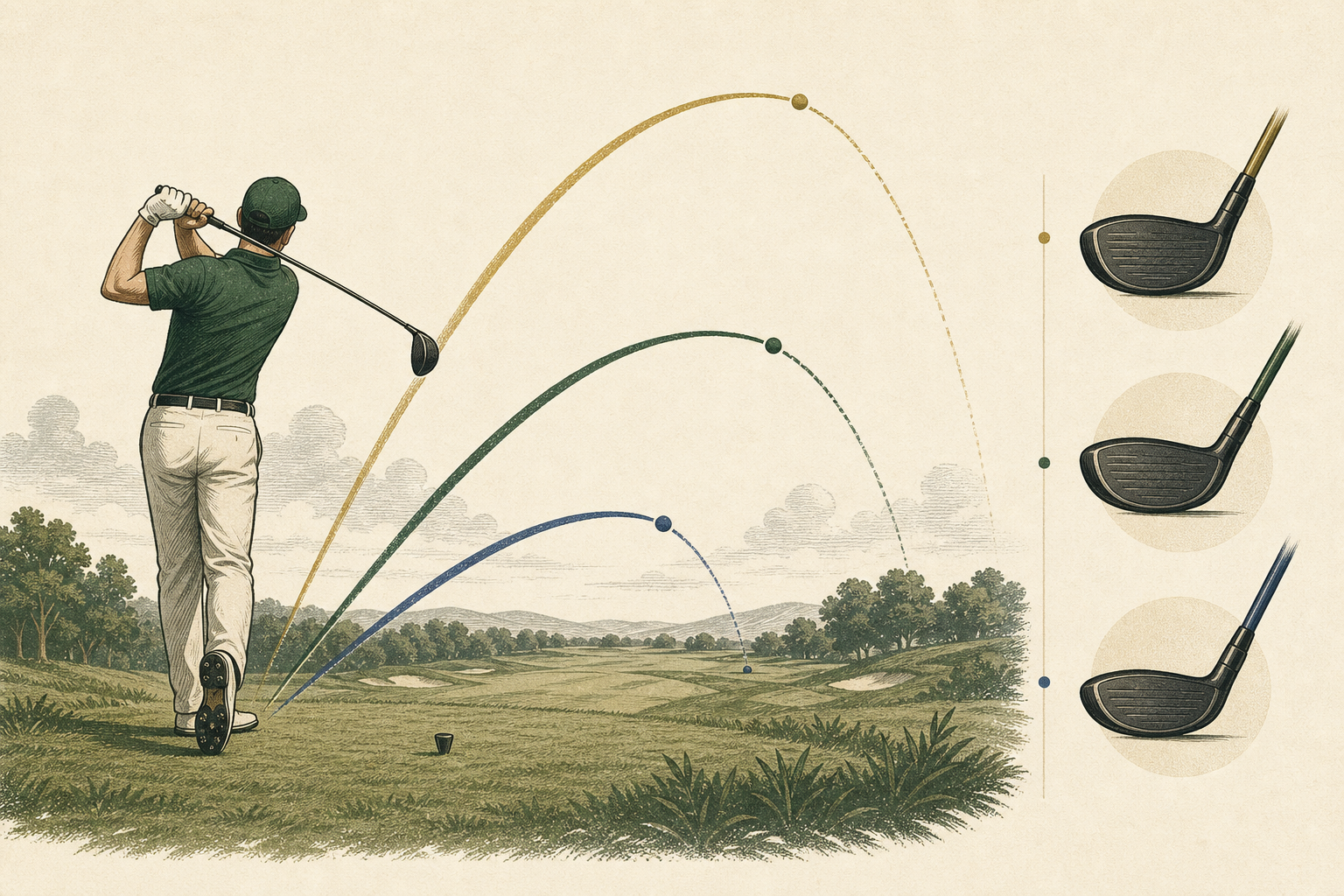
Built for: Golfers comparing driver lofts who want a repeatable decision process instead of a universal loft recommendation.
The right driver loft is not a number to borrow from a friend. It is the setting that gives your own swing a useful, repeatable ball flight when strike quality varies—as it inevitably does on the course.
The quick verdict
Begin with the loft you can launch and strike consistently, then compare alternatives one at a time against the same target and the same ball. Treat the resulting launch, strike pattern, and ball flight as a decision record—not as a search for a universally “correct” loft.
Best for Golfers who want to replace assumptions about swing speed, handicap, or what stronger players use with a structured comparison and an individual fitting.
Skip it if Your contact changes so widely that each loft produces a different strike pattern. Establish a usable baseline—or work with a qualified fitter—before blaming loft for every poor flight.
Start with the decision, not a loft label
Driver loft is often discussed as though it identifies the golfer: lower for one kind of player, higher for another. That shortcut ignores the question that matters on the tee: which loft helps you produce a playable flight often enough to trust it?
Make the comparison personal. Use your current driver as the baseline and describe its ordinary shot—not the best one you remember. Does the ball appear to climb quickly, stay low for most of its flight, start on a useful line but finish unpredictably, or change dramatically when contact moves around the face? Those observations establish what needs attention.
Avoid changing several things at once. A new shaft, a different ball, a new tee height, and a loft adjustment may all be reasonable experiments, but they do not make a clean loft comparison when combined. Hold the ball, target, and normal setup as steady as practical. Change the loft option, hit a meaningful group of shots, then record what you saw.
Guild recommendation: Write down a baseline in three plain-language notes: typical starting height, usual curvature, and the part of the face where you tend to strike it.
Read launch as a pattern over several swings
Launch is the ball’s initial climb after impact. For this decision, you do not need to assign a perfect number to it. You do need a repeatable description that distinguishes the shot you can produce regularly from the outlier.
Watch a series of normal drives toward one target. Mark whether the initial flight is consistently lower, roughly middle-height, or higher relative to your own usual flight. Then note whether that appearance holds when the strike is merely acceptable, not perfect. A loft option that looks ideal only on the center-most strike has given you less useful information than one that produces a dependable flight across your ordinary strike pattern.
If you use a launch monitor, let it organize the session rather than replace your eyes. Record each setting separately and keep notes on contact and visible flight. The goal is a comparison you can revisit, not a single headline measurement.
Guild recommendation: Choose the setting whose launch pattern is most repeatable across ordinary swings before giving extra weight to one exceptional drive.
Let strike location qualify every ball-flight conclusion
A driver can produce very different shots when contact shifts around the face. That is why a ball-flight verdict without a strike record can mislead. Before deciding that a loft is wrong, ask whether the shots behind that impression came from a similar place on the face.
Use face-impact spray or impact tape during a comparison if you have it. After each small group, identify the general strike pattern: centered, toward the heel, toward the toe, high, low, or widely scattered. You are not chasing a laboratory-perfect pattern. You are separating a loft question from a contact question.
For example, if one setting seems to create a preferred flight but only when contact is centered, record that honestly. If another setting gives a more useful flight while your strikes remain in their normal area, it may be the more practical course choice. Conversely, if every setting produces contact scattered across the face, improve the quality of the comparison before treating loft as the answer.
Guild recommendation: Do not select a loft from shots with visibly different strike locations. Compare like with like, and treat inconsistent impact as its own fitting issue.
Use ball flight to define what “better” means for your game
Ball flight is the outcome you can observe most directly, but “better” must be tied to the course problem you are trying to solve. A player who routinely flies the ball into trouble needs a different outcome from one whose common drive struggles to carry a hazard. Neither golfer is served by a universal loft recommendation.
Build a simple scorecard for each setting. Note start line, height, curvature, and where the ball would likely finish relative to your intended corridor. Add a consistency note: how many shots would you willingly play on a tight driving hole? This shifts the comparison away from one impressive trajectory and toward usable tee shots.
Keep the session honest by using your normal effort. Trying to create a different swing for each setting obscures the decision. The better candidate is the one that supports a flight you recognize and can repeat while aiming at a real target.
Guild recommendation: Judge loft by the shot pattern you would take to the course: a predictable start, a usable height, and a finish that fits your normal target corridor.
Move from comparison to fitting
Once you have a baseline and notes from a controlled comparison, take them to a club fitter. The PGA of America advises that equipment choices should be evaluated for the individual golfer through fitting. Your notes make that conversation more precise: they show the fitter what you were trying to change, what happened to strike quality, and which ball flights were most playable.
A fitting does not require you to arrive with a predetermined loft. It gives you a way to test your observations against an individual evaluation. Bring your current driver, describe your normal ball flight rather than your ideal one, and explain any conditions that shape the decision—regularly windy rounds, narrow targets, a preference for a certain visual look at address, or a need for a straightforward adjustable setting.
If you play in competitions, equipment used must conform to the applicable club rules under the USGA Equipment Rules. Confirm conformance for the club configuration you intend to use, particularly when making equipment changes.
Guild recommendation: Use your comparison notes as the starting brief for an individual fitting, then verify that the final club configuration conforms to applicable competition rules.
Try this · 15 minutes
Build your three-window launch test
Use one ball model, one target corridor, your normal tee height, and face spray or impact tape. The objective is not to discover a magic loft in one session; it is to create a clean comparison worth taking to a fitting.
- Hit five normal drives at your current setting. Record strike location, starting height, curve, and whether the finish stayed inside your target corridor.
- Change only the stated loft. Reset your target and repeat the same five-shot routine without trying to manufacture a different swing.
- Compare the ordinary shots—not the single longest drive—and circle the setting that produced the most playable pattern across imperfect strikes.
What progress looks like: You can describe why one setting creates a more useful pattern, and you have strike-and-flight notes a fitter can verify.
Put the guide to work
These searches are a starting point—not a substitute for the fit and comparison criteria above.
Compare adjustable-loft drivers
An adjustable head can make a controlled comparison more practical because you can examine several stated loft settings without replacing the entire club. Compare adjustability, shaft options, and return terms before buying.
Find a launch monitor for practice feedback
A launch monitor can give structure to an outdoor or indoor comparison. Prioritize the measurements you will actually use, adequate space requirements, and a setup you can repeat consistently.
If you buy through these links, Guild of Golf may earn a commission at no extra cost to you.
The practical takeaway
- There is no universal driver-loft recommendation; the useful choice is the one that supports your repeatable shot pattern.
- Evaluate launch over a group of ordinary swings, not a single flushed drive.
- Record strike location alongside ball flight so contact variability does not masquerade as a loft result.
- Change one meaningful variable at a time and keep the ball, target, and normal setup consistent.
- Use an individual fitting to evaluate the final choice, and confirm conformance when competition rules apply.
Frequently asked questions
Should I choose driver loft based on handicap or swing speed alone?
No single category provides a complete answer. Start with your own repeated launch, strike pattern, and ball flight, then use an individual fitting to evaluate equipment choices for your game.
How many shots should I hit when comparing lofts?
Hit enough normal shots at each setting to see a pattern rather than relying on one memorable result. Keep the target, ball, and setup as consistent as practical, and record strike location with the visible flight.
What should I write down during a driver-loft comparison?
For each setting, record general launch height, start line, curvature, likely finish relative to your target corridor, and general strike location on the face. Add whether the result appeared across ordinary swings.
Can an adjustable driver make this process easier?
It can make a one-variable comparison more convenient because you can examine different stated loft settings in one head. Still, evaluate each setting over repeated shots and confirm the configuration is appropriate for any competition in which you use it.
Do I need a fitting after comparing lofts myself?
A self-comparison can clarify your priorities and give you useful notes, but the PGA of America recommends evaluating equipment choices for the individual golfer through fitting.
Sources used for this draft
- PGA of America: Club Fitting — The recommendation that equipment choices be evaluated for the individual golfer through fitting.
- USGA Equipment Rules — The reminder that equipment used in competition must conform to applicable club rules.
Guild of Golf may earn a commission from qualifying purchases made through Amazon links in this guide. This does not change the editorial framework: compare launch, strike, and ball flight for your own game, then seek an individual fitting.