
comparison
Putting Mirror vs. Putting Mat: Choose the Feedback You Need
A purposeful comparison for golfers choosing between setup feedback from a putting mirror and ball-roll feedback from a putting mat at home.
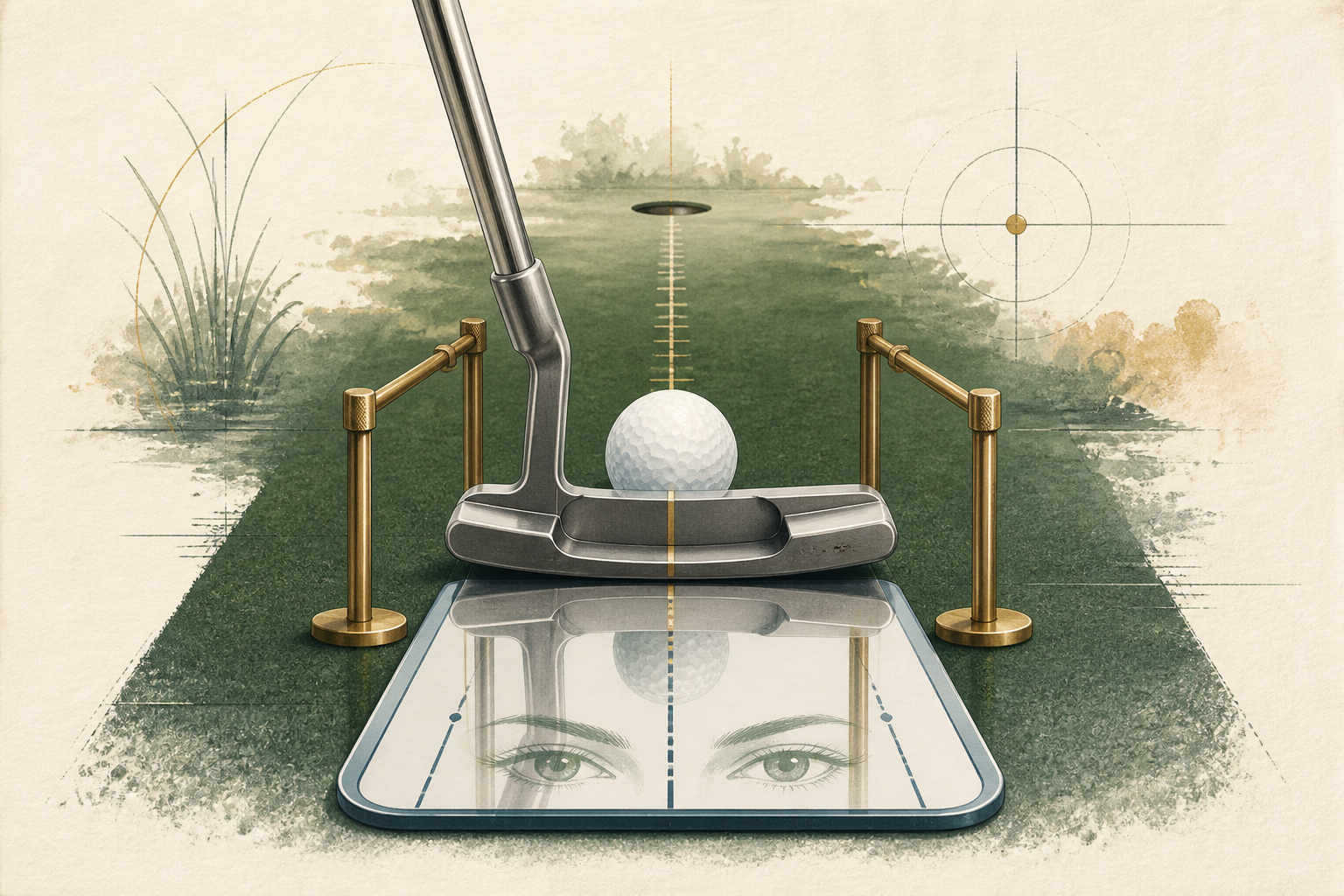
Built for: Golfers choosing one practice aid and deciding whether they need setup feedback or ball-roll feedback.
When short putts start missing left, right, or with uncertain pace, buying more practice time is not the same as buying better feedback. A mirror helps make the address position repeatable; a mat gives each stroke a destination and a roll to observe. Choose the tool that exposes the question you can actually answer in your available space.
The quick verdict
Choose a putting mirror when your main uncertainty is how you are aimed and set up at address; choose a putting mat when you need to rehearse a repeatable start line and pace to a target.
Best for A mirror is best for golfers who can practice on a reasonably flat surface and want a simple visual check before the stroke. A mat is best for golfers with enough clear floor space who will benefit from a consistent target and repeated ball-roll tasks.
Skip it if Skip a mirror if visual setup checks make you more concerned with positions than hitting putts. Skip a mat if its length will not let you practice the putt distances you intend to work on or if you have no room to leave it out or unroll it consistently.
Begin with the miss that keeps showing up.
Picture the common living-room routine: ten putts at a mug, a few go in, and the session ends without explaining why the others missed. A mirror and a mat can both make that session more deliberate, but they focus attention at different moments. The mirror is primarily an address checkpoint before the putter moves. The mat is primarily a place to observe the ball after impact as it travels toward a defined target. Purposeful practice is more useful when it has a defined purpose and structure, so the first decision is not which aid looks more complete; it is which question your next practice session needs to answer.
Guild recommendation: Write down one recurring problem before shopping: “I cannot settle into the same address,” or “I cannot repeatedly start and pace the ball to a target.” Buy for that problem rather than for a longer feature list.
What a putting mirror is for.
A putting mirror suits the golfer whose uncertainty begins before the stroke. If you stand over a four-footer and wonder whether the ball position, putter face, or body alignment looks the same as it did on the previous putt, a reflective reference gives you a consistent pre-stroke check. Its strength is constraint: it slows the session down and asks you to build the same address picture repeatedly. That can be especially useful in a small home area because the work happens in a compact space. Its limitation is equally important. The mirror does not replace the need to hit putts to a target, so it can become a dead end for a golfer who spends the whole session arranging the setup and too little time observing the result.
Guild recommendation: Choose a mirror if your best practice objective is to create the same address picture before each putt. Look for a size that fits your stance and a clear reflective surface, then use it for a few deliberate checks rather than every second of the session.
What a putting mat is for.
A putting mat suits the golfer who needs a repeatable home lane, a target, and a visible outcome. It gives a short-putt session a beginning and an end: select a line, roll the ball, and observe whether it reaches the target as intended. That structure is valuable for a player who otherwise scatters putts across carpet or changes targets every few strokes. The tradeoff is that a mat cannot tell you whether a particular setup position is right for you, and a marked or highly prescribed surface can tempt a golfer to chase markings instead of paying attention to the start and finish of each putt. The most useful mat is therefore the one that fits the space and invites frequent, simple target practice.
Guild recommendation: Choose a mat if your best practice objective is to rehearse a consistent task, such as starting short putts toward one target with controlled pace. Prioritize usable length and a target you can see clearly over decorative extras.
Use the room and routine as tiebreakers.
A mirror wins when storage is tight, your practice surface is already usable, and you will reliably take a few minutes to check address. A mat wins when an open strip of floor lets you create the same target task several times a week. The less glamorous question matters most: will the aid be easy enough to use on an ordinary Tuesday night? An aid that remains in a closet does not create the structured practice that makes feedback useful. If you can leave a mat in place, it may make repetition easier. If every session requires moving furniture, a compact mirror may be the more realistic first purchase.
Guild recommendation: Measure the clear floor area and decide how often you can set up a station before choosing. If the answer is “briefly and in a small area,” favor the mirror; if it is “often, with a defined lane,” favor the mat.
Neither tool changes the rules of the green.
Home practice is rehearsal, not a substitute for reading an outdoor putt. On the course, putting-green conditions and the line of play exist within the rules context set out in Rule 13. A mirror can help you arrive at the ball with a repeatable routine, and a mat can help you commit to a target and pace, but neither recreates every on-course decision. Treat the home station as a place to make one part of the routine more dependable, then carry that simple intention to the green.
Guild recommendation: Before an on-course round, reduce the home lesson to one cue you can use without an aid, such as setting the putter behind the ball calmly or choosing a target before starting the stroke.
Try this · 12 minutes.
The Setup-or-Roll Decision Session.
Use a level-looking section of floor, one golf ball, a putter, and a small target such as an upturned cup or coin. If you own a mirror, place it under the ball and putter at address. If you own a mat, place the target at a comfortable short-putt distance on the mat. If you own both, begin with the mirror and then move to the mat.
- Hit three unhurried putts to the target without changing anything, and simply note whether the ball begins near the intended line and reaches the target with a repeatable finish.
- For the next six putts, use the mirror only before each stroke to check that you can return the ball and putter to the same address picture. Remove your eyes from the mirror before making the stroke.
- For the final six putts, use the mat or floor target only. Keep the same intended starting line and try to finish each ball at or just beyond the target rather than changing your motion after every miss.
- Record one observation: whether a repeated address picture was difficult to create, or whether the address felt repeatable but the starting line and pace still varied. Let that observation determine which aid deserves your practice time.
What progress looks like: The useful result is a clear choice: repeated setup uncertainty points toward a mirror, while repeatable setup paired with inconsistent starts or pace points toward a mat.
Put the guide to work
These searches are a starting point—not a substitute for the fit and comparison criteria above.
Compare putting mirrors.
Compare the size of the reflective area, whether the surface gives a clear view at address, and whether the format fits the floor space where you will actually practice.
Compare indoor putting mats.
Compare usable putting length, the target format, and whether the mat can be set up often enough to support a regular routine.
If you buy through these links, Guild of Golf may earn a commission at no extra cost to you.
The practical takeaway
- A putting mirror is a setup-feedback tool, while a putting mat is a ball-roll and target-practice tool.
- Choose the aid that addresses an observable practice problem, not the one that appears to offer the most features.
- A compact mirror is often the practical choice for limited space; a mat is more useful when it can be deployed frequently with a clear target.
- Use a brief, structured session to decide whether your main uncertainty occurs at address or after the ball starts rolling.
Frequently asked questions
Can a beginner use a putting mirror or putting mat?
Yes. A beginner should keep the task narrow: use a mirror to create the same address picture several times, or use a mat to roll several balls to one target. The goal is a repeatable observation, not a perfect-looking stroke.
Should I buy both a putting mirror and a putting mat?
Buy both only if you will use them for separate jobs. A mirror can organize a short setup-check block, while a mat can provide a target-based block afterward. If you are choosing one, start with the feedback gap identified by the practice plan.
Does a putting mat replace practice on a real putting green?
No. A home mat can organize target and pace rehearsal, but it does not replace the on-course context of putting greens and lines of play addressed by Rule 13. Use it to make one part of your routine more repeatable, then practice reading and adapting on real greens.
Sources used for this draft
- PGA of America: Practice With Purpose — The recommendation to use a defined, structured objective for practice.
- USGA Rule 13: Putting Greens — The rules context for putting greens and lines of play.
Guild of Golf may earn a commission from qualifying purchases made through its shopping links, at no extra cost to the buyer.