
comparison
Alignment Sticks vs. Tempo Trainers: Buy for the Feedback You Need
Choose the inexpensive practice aid that makes your actual practice problem visible instead of adding another vague swing thought.
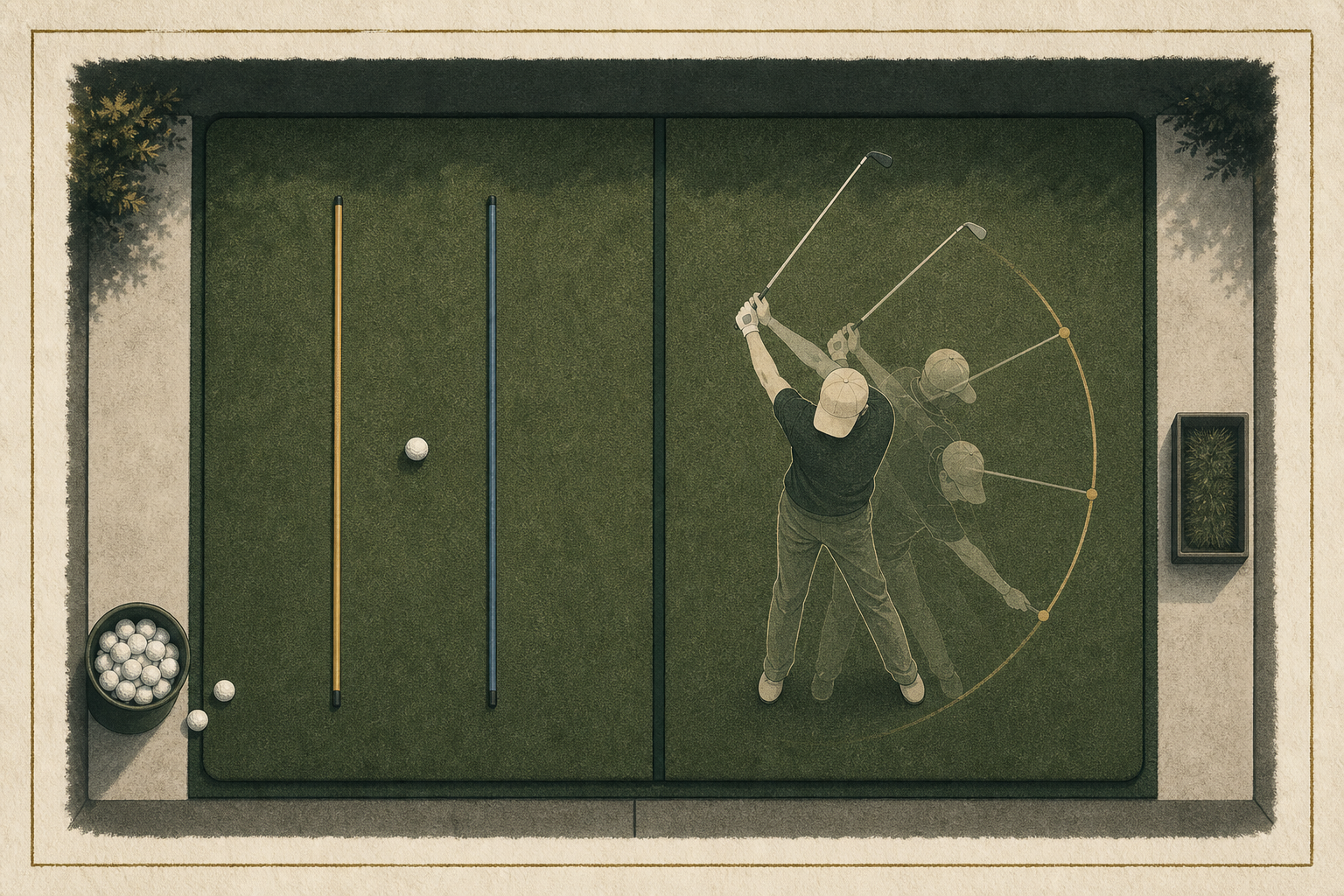
Built for: Golfers choosing between inexpensive practice aids for alignment, movement, rhythm, or speed awareness.
If a shot starts nowhere near where you aimed, select a reference for setup. If setup looks settled but your motion changes from swing to swing, select a tempo cue. The useful choice is the one that gives feedback on an observable problem.
The quick verdict
Buy alignment sticks when you need to see where your body, club, or intended start line is set; buy a swing tempo trainer when your repeatable task is making the same-paced motion. Neither is a cure-all, and one clear target beats a bag full of aids.
Best for Alignment sticks suit golfers whose practice problem can be expressed as a position or direction, such as inconsistent setup orientation. A tempo trainer suits golfers who can identify an inconsistent cadence or effort level during practice.
Skip it if Skip either purchase if you cannot name the feedback you will check after each repetition. For golfers whose concern is a painful movement or a persistent ball-flight issue they cannot connect to an observable practice task, an aid alone is an incomplete answer.
Start with the miss you can observe at the range
Picture two common practice sessions. In the first, a golfer feels as though every shot is a different swing, but the club is repeatedly aimed without a dependable ground reference. In the second, the golfer sets up in a familiar way, then alternates between a rushed lash and a slow steer. Those sessions do not call for the same purchase.
Purposeful practice connects an activity to a specific goal, according to the PGA of America. That makes the first question more useful than “Which gadget helps more?” Ask, “What can I observe and check on the very next repetition?” If the answer concerns direction, spacing, or setup position, choose a visual reference. If it concerns the pace of the motion, choose a rhythm cue.
Guild recommendation: Name one visible or repeatable behavior before buying. If you cannot describe the behavior in a short sentence, spend a session observing it before adding an aid.
Choose alignment sticks when the feedback must sit on the ground
Alignment sticks are most useful when the practice task needs a fixed reference. A golfer working on a consistent address can use rods on the ground to make a target-line reference and a parallel foot-line reference. The point is not to create a perfect-looking pose; it is to stop guessing where the references are.
This is a strong choice for the player who steps behind the ball, picks a target, and then wonders whether that intention survived the walk into address. It also works well for a low-drama drill: set the reference, build the stance, step out, and reset. The outcome is visible before the club moves.
The tradeoff is that rods do not supply a rhythm. A player who already sets up consistently but repeatedly changes pace may turn an alignment drill into an avoidance exercise. Rods are also a practice-space tool, not something to scatter thoughtlessly during play.
Guild recommendation: Choose sticks if your success measure is positional: for example, repeatedly building the same relationship between your stance and a ground reference.
Choose a tempo trainer when your target is repeatable pace
A swing tempo trainer makes more sense when your useful observation is movement timing. The golfer who takes one calm rehearsal, then hurries the ball swing has a cadence problem to explore, not necessarily an alignment problem. A trainer can provide a cue that makes an intentionally even rehearsal easier to repeat.
Keep the task modest. Use one club, one comfortable effort, and one chosen count or pace for a short set. The outcome to look for is not a promised swing rebuild or a particular ball flight. It is whether the golfer can reproduce the same pace through several rehearsals and shots.
The limitation is equally important: tempo feedback does not tell you whether your setup is pointed where you intended. It can also become unhelpful if a golfer uses it to chase force, speed, or a mechanically prescribed motion rather than a steady, personally repeatable cadence.
Guild recommendation: Choose a tempo trainer if your success measure is temporal: for example, completing a series of swings with the same deliberate pace rather than one rushed swing followed by one guarded swing.
Use one aid, one question, and a short scorecard
The value of either choice is the feedback loop. Before a practice set, write the question. During the set, make the observation. After the set, record a plain result. “Four of five setups matched my ground reference” is useful. “The trainer felt good” is too vague to guide the next session.
This approach protects golfers from treating every poor shot as evidence that they need more equipment. If the alignment reference improves the consistency of setup but the ball result remains mixed, that is still information: the setup task may be becoming more repeatable, while another question remains for a later practice block. If the tempo cue is easy to repeat only without a ball, begin there and introduce short shots gradually.
Equipment and its use during a stipulated round are governed by applicable rules, as the USGA notes. Treat these aids as practice tools, and check the applicable rules before using any aid during a round.
Guild recommendation: Do not alternate aids every few swings. Give one feedback question a complete, short practice block, then decide whether it earned another session.
Try this · 15 minutes.
The Two-Feedback Range Test
At a quiet practice area, place one ball at a time and choose a short, comfortable target. Use two plain practice rods only for the alignment portion. For the tempo portion, use no ball at first, then hit a few short shots with the same club. Do not place rods where a swing could strike them.
- Write one observable question before starting: either “Is my setup aimed consistently relative to my chosen target?” or “Can I make the same unhurried motion repeatedly?” Do not try to answer both in the same set.
- For the alignment set, lay one rod on the ground parallel to your intended target line and a second rod along your toe line. Step into five setups, pause, look down, then step away. Reset after every setup rather than hitting immediately.
- For the tempo set, make five rehearsal swings with a deliberately even count from start to finish. Then hit five short shots while retaining the same count. Judge the pace of the motion, not the result of a single shot.
- Repeat only the set that gave you a clear answer. Record a simple result, such as five setups that looked consistent or five swings completed with the same count. End when attention fades rather than adding random swings.
What progress looks like: The right aid produces a checkable result: you can repeatedly see the same setup reference or repeatedly complete the same chosen swing count without rushing.
Put the guide to work
These searches are a starting point—not a substitute for the fit and comparison criteria above.
Compare alignment sticks after defining a setup-reference task.
Compare portability and visibility only after deciding where the rods will sit in your setup drill. The useful option is one you will place consistently and safely on the ground.
Compare swing tempo trainers after defining a cadence task.
Compare the kind of cue the trainer provides and whether it lets you rehearse a repeatable pace. Avoid buying resistance or complexity when your only goal is a clear rhythm reminder.
If you buy through these links, Guild of Golf may earn a commission at no extra cost to you.
The practical takeaway
- Alignment sticks are the better purchase when you need to see a direction, line, or setup relationship.
- A tempo trainer is the better purchase when you need a repeatable cue for the pace of your motion.
- A useful aid produces an observable result that you can record after a small number of repetitions.
- Purposeful practice begins with a specific goal, not with the most features on a product page.
- Check applicable rules before using any practice aid during a stipulated round.
Frequently asked questions
Can alignment sticks help if my problem feels like a slice or pull?
They can help you check whether your intended setup reference is consistent, which is a concrete practice task. They do not by themselves explain every ball-flight pattern, so keep the drill focused on the setup observation rather than assuming a full diagnosis.
Should I buy both an alignment-stick set and a tempo trainer?
Only if you have two separate, observable practice questions and will work on them in separate blocks. Start with the aid that addresses the problem you can see most clearly, then add the other only if it serves a distinct goal.
How long should I use a practice aid in one session?
Use a short, attentive set with a defined result, such as five deliberate setups or five evenly paced swings. Stop or reset when you can no longer make an honest observation from each repetition.
May I use these aids during a round?
Equipment and its use during a stipulated round are governed by applicable rules. Check the applicable rules before using an aid during a round.
Sources used for this draft
- PGA of America: Practice With Purpose — The principle that purposeful practice connects an activity to a specific goal.
- USGA Equipment Rules — The note that equipment and its use during a stipulated round are governed by applicable rules.
Guild of Golf may earn a commission from qualifying purchases made through shopping links, at no additional cost to the reader.