
comparison
Two-Piece vs. Three-Piece Golf Balls: Choose by the Shot You Can See
A practical decision guide for golfers choosing between two-piece and three-piece golf balls by starting with an observable on-course problem, then comparing only the construction detail that may address it.
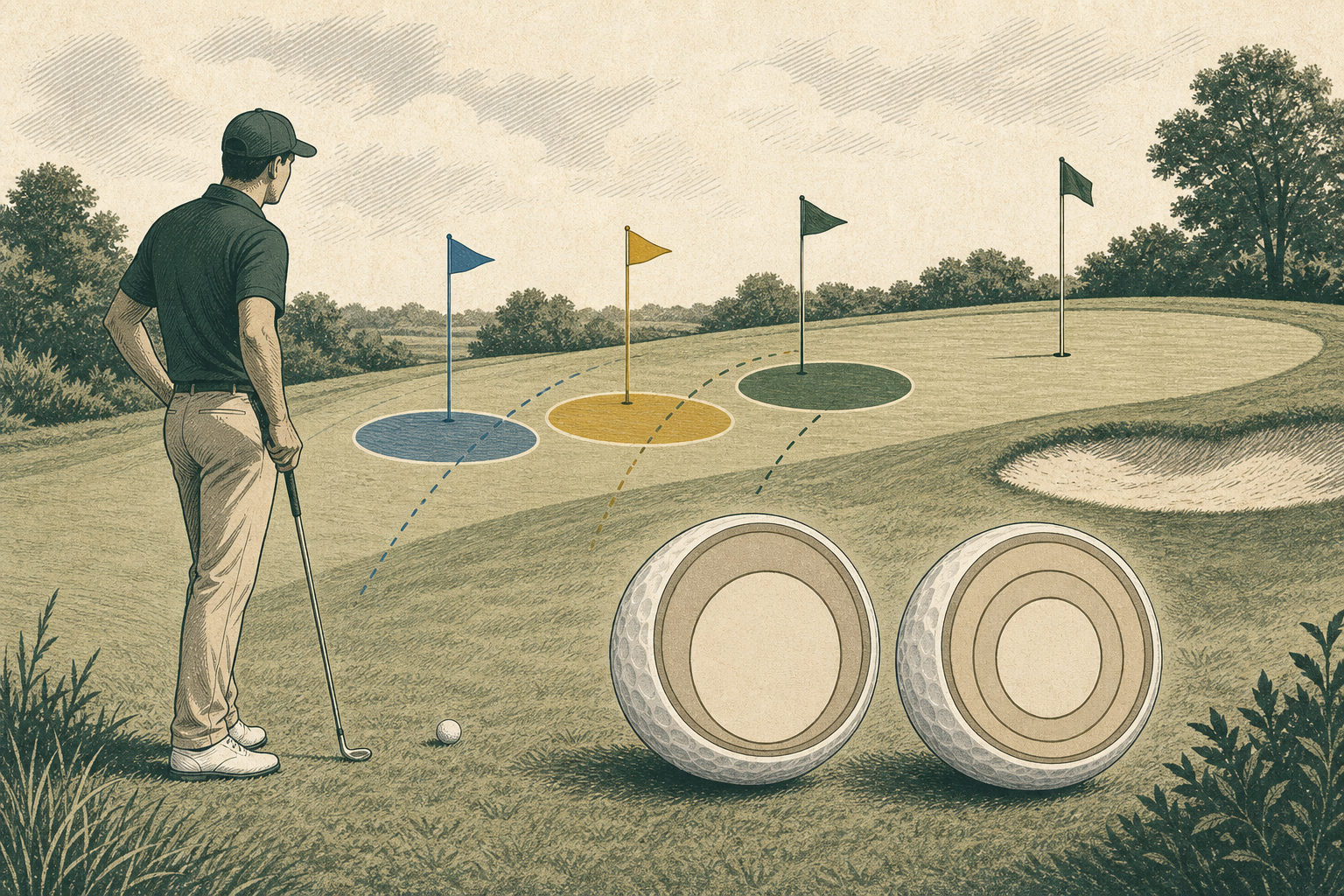
Built for: Golfers comparing golf-ball construction while balancing feel, durability, flight, and short-game control.
When one ball runs through the back of the green and another scuffs after a cart-path glance, construction labels can seem like the answer. Start instead with the shot result you want to change, test one priority at a time, and keep the ball that makes your scoring decisions simpler.
The quick verdict
Choose a two-piece or three-piece ball only after naming the result you want to improve, such as more predictable greenside rollout, a preferred impact sensation, or better resistance to visible cover wear.
Best for Golfers willing to play one ball model through several rounds or practice sessions and judge it by repeatable, observable outcomes rather than the number of layers alone.
Skip it if Skip a construction-led purchase if you have not identified a ball-flight, short-game, feel, or durability priority; a label by itself cannot tell you which result you will see.
Begin with the shot that is costing you confidence.
The decision usually arrives after a recognizable moment: a chip lands where you intended but releases farther than you expected, a ball feels distractingly firm off the putter, or a ball you otherwise like develops visible marks sooner than you want. Those are different problems. Do not ask whether three pieces are automatically better than two; ask which single outcome you would notice improving on the next round.
Guild recommendation: Write down one priority before you shop: predictable greenside finish, preferred feel, visible cover condition, or a flight result you want to observe.
Layer count is a starting label, not a performance promise.
A two-piece ball has two construction layers, while a three-piece ball has three. That difference is useful for sorting products, but it does not replace the rest of the product information or your own results. If short-game control is the concern, compare the stated cover material and then measure landing and rollout with one club. If durability is the concern, inspect the cover after the same number of shots and normal on-course use. If feel is the concern, use the same putter and a short, familiar putt rather than forming an opinion from one full swing.
Guild recommendation: Compare one feature tied to your problem, then test the resulting shot instead of treating construction as a shortcut to a verdict.
Match the comparison to your priority.
For the golfer who loses shots by misjudging a chip’s finish, the useful comparison is not distance on a range. It is whether two candidate balls repeatedly finish in a manageable area after landing near the same marker. For the golfer annoyed by a marked cover, the practical outcome is whether one candidate remains in acceptable condition through a similar amount of play. For a player whose putting confidence changes with sound or sensation, the right question is simply which ball permits a relaxed, repeatable stroke on short putts. Flight belongs in the same framework: use a familiar tee shot or approach and watch start line, height, and finishing position over multiple swings rather than relying on one unusually good strike.
Guild recommendation: Give each candidate a single job during testing, because a ball that solves your most frequent scoring problem is more useful than one that merely sounds impressive in a description.
Make the choice stable enough to learn from.
Changing ball models every few holes makes it harder to separate a ball difference from changing lies, wind, contact, and decision-making. Once a candidate meets your chosen priority, play it consistently for several rounds or practice sessions. That gives you a usable reference for club selection and greenside planning. If its observed result does not suit you, change one variable—the ball—and repeat the same simple check. This is a selection process, not a swing diagnosis.
Guild recommendation: Commit to one model long enough to observe patterns, then reconsider only when the chosen priority is still not being met.
Confirm that the ball is permitted for the golf you play.
For play conducted under the Rules of Golf, the USGA states that golf balls must meet the applicable equipment requirements. The USGA Conforming Ball List identifies balls that have been submitted and evaluated for conformance. Construction is only one shopping detail; conformity matters when the competition or course policy requires it.
Guild recommendation: Before competition play, check the current Conforming Ball List and any event-specific conditions of competition.
Try this · Twenty minutes.
The one-variable greenside rollout check.
Use a practice green with a clear landing area and a level-to-gently-sloping target zone. Bring two sleeves or several balls from each construction category, place a small towel or headcover as a landing marker, and choose one hole or target roughly 10 to 15 paces beyond it.
- Hit five short pitch shots with the first ball, aiming to land each shot on or near the marker with the same club and a comfortable, repeatable motion.
- Note only what you can see: whether each ball finishes short, at, or beyond the target, plus whether the cover shows noticeable new marks after the set.
- Repeat with the second ball from the same location, using the same club, landing marker, and intended shot.
- If neither group lands consistently near the marker, move closer or choose a larger target area rather than changing your motion to force a result.
- Finish by hitting three ordinary chip shots with the ball whose rollout pattern and feel you prefer, then use that ball for a full practice session before making a purchase decision.
What progress looks like: One ball gives you a more repeatable finish pattern at your chosen target, or it clearly meets your personal preference for impact feel or visible cover condition.
Put the guide to work
These searches are a starting point—not a substitute for the fit and comparison criteria above.
Compare two-piece golf balls.
After identifying a priority, compare the maker’s stated cover material, durability language, and intended use rather than assuming every two-piece ball will produce the same result.
Compare three-piece golf balls.
Use this search to compare construction disclosures alongside stated cover material and performance intent, then verify the choice with the same on-green test.
Compare golf ball variety packs.
A mixed pack can help you run a controlled comparison before committing to a larger quantity, provided you keep the club, target, and shot task the same.
If you buy through these links, Guild of Golf may earn a commission at no extra cost to you.
The practical takeaway
- Start with one visible problem, such as unpredictable chip finish, an unwanted feel, or cover wear.
- A two-piece or three-piece label narrows the search, but it does not guarantee a particular result for every golfer.
- Use the same club, landing marker, and target when comparing balls, then judge finish pattern and cover condition.
- Once a ball fits your priority, play it consistently so your on-course observations become meaningful.
- For rules-governed play, confirm that the selected ball meets applicable equipment requirements.
Frequently asked questions
Is a three-piece golf ball automatically better than a two-piece golf ball?
No. More layers describe construction, not a universal ranking. The better choice is the ball that produces the observable result you value most when you test it under the same conditions.
How should I compare feel without guessing?
Use the same putter and hit several short putts to one target with each candidate. Choose the sensation and sound that help you make a calm, repeatable stroke, while recognizing that feel is a personal preference.
What is the simplest way to compare short-game control?
Use one wedge or short-game club, one landing marker, and one target. Hit equal sets with each ball and compare where the balls finish, not just where they land.
Do I need to check whether my golf ball conforms?
If you are playing under conditions that require a conforming ball, check the USGA Conforming Ball List and the event’s conditions of competition. The USGA states that balls used under the Rules must meet applicable equipment requirements.
Sources used for this draft
- USGA Equipment Rules. — The requirement that golf balls used under the Rules meet applicable equipment requirements.
- USGA Conforming Ball List. — The description of the list as identifying balls submitted and evaluated for conformance.
Guild of Golf may earn a commission from qualifying purchases made through shopping links, at no extra cost to the buyer.