
comparison
Two-Piece or Three-Piece Golf Balls? Choose by the Shot You Can Measure
A practical way to compare two-piece and three-piece golf balls without assuming that piece count alone will solve a scoring problem.
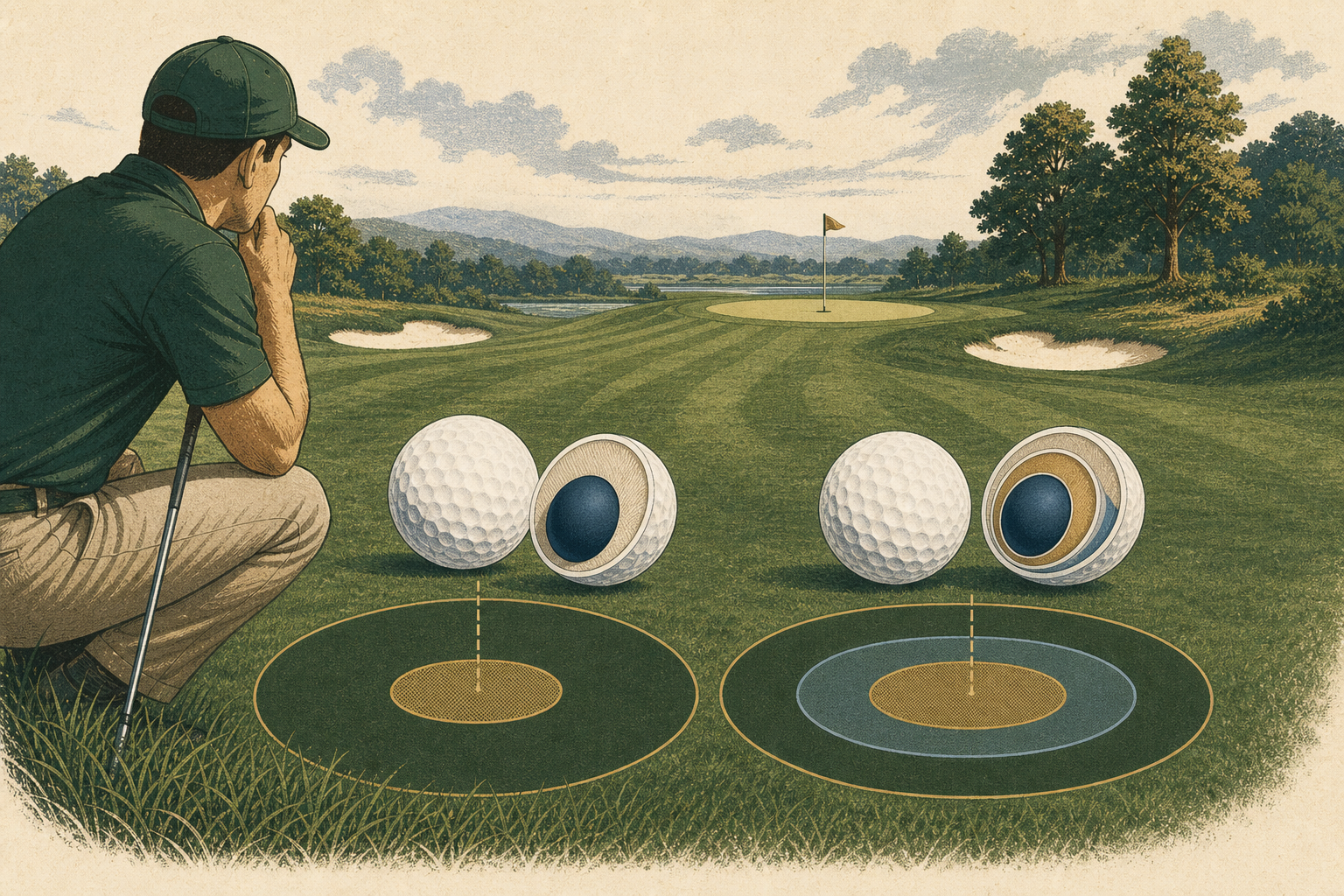
Built for: Golfers comparing golf-ball construction while balancing feel, durability, flight, and short-game control.
When one ball feels pleasant off the putter but another seems easier to keep in play, the useful question is not which construction is superior. It is which ball produces the result you can repeatedly observe on the shots that cost you strokes.
The quick verdict
Choose between two-piece and three-piece balls by testing one priority at a time: predictable full-shot outcome, cover condition after a round, or repeatable touch on short shots. Piece count is a starting filter, not a promise of a particular result.
Best for Golfers willing to play the same two candidate balls through a short, structured comparison and select the one that improves their most common on-course decision.
Skip it if Skip construction-led shopping if you have not identified an observable problem yet, or if you change ball models from hole to hole and cannot compare like with like.
Begin with the stroke that keeps showing up on your scorecard
A golfer who loses a ball on the right side twice a round has a different buying problem from the golfer who repeatedly leaves pitch shots outside a comfortable putting range. Likewise, a player whose ball looks badly worn after a round is weighing a different constraint from a player who simply dislikes the response at impact. Put one problem at the top of the list before looking at “two-piece” or “three-piece” on a package.
Make the problem observable. “I want better feel” becomes “I want my five- to ten-foot putts to arrive with more predictable pace.” “I need more control” becomes “I want more pitches to finish inside a pace of my landing target.” That translation prevents a construction label from doing more decision-making than it can support.
Guild recommendation: Name one shot, one outcome, and one condition you want to improve before comparing any ball models.
Use construction as a filter, not as a conclusion
Two-piece and three-piece describe different ball constructions, but the number of pieces is not, by itself, a scorecard outcome. A sensible comparison asks what the individual model does for your priority under your normal conditions. Do not assume that every ball with the same piece count will fly, feel, wear, or respond alike.
For the golfer focused on durability, the relevant check is simple: play or practice with a candidate long enough to see whether its cover condition remains acceptable to you. For the golfer focused on flight, compare starting line, height, and finishing position on a group of similar full shots. For the golfer focused on short-game control, compare landing area and finish position rather than trying to judge a ball from one impressive spinner or one poorly struck pitch.
Guild recommendation: Keep candidates within the same construction category only if that makes shopping easier, then let repeatable on-course or practice outcomes make the final choice.
Match the comparison to your real constraint
If your priority is keeping a ball in play, test full shots where a poor finish actually creates trouble: a range target framed by hazards, a wide practice fairway, or a familiar driving hole played with the same ball for several rounds. Watch the pattern, not the best drive. A ball choice is useful when it gives you a more manageable next shot often enough to notice.
If your priority is scoring from inside 50 yards, choose a fixed landing spot and assess where the ball finishes. This is more helpful than relying on the sound at impact, because the finish dictates the next putt. If touch is the issue, use short putts and ask whether pace becomes easier to repeat. If cover condition matters, inspect the ball after the same kind of use and decide what amount of visible wear you will accept.
These tests do not diagnose a swing, and they do not prove that one ball is best for every golfer. They help you select the feature that addresses your own recurring problem.
Guild recommendation: Give each candidate enough similar shots to reveal a pattern, and avoid switching balls every hole while making the comparison.
Check conformance when your rounds require it
Golf balls used under the Rules of Golf must meet the applicable equipment requirements. The USGA Conforming Golf Ball List identifies balls that have been submitted and evaluated for conformance. If you play competitions or any round where conformance matters, verify the exact ball rather than relying on a construction description or a familiar product name.
That check belongs at the end of the process. First identify the result you need, then compare candidates, and finally confirm that the exact ball fits the conditions of play you expect.
Guild recommendation: Consult the current USGA list for the exact ball model before using it in a setting that requires a conforming ball.
Try this · 30 to 40 minutes.
The One-Variable Ball Comparison
Bring two sleeves or a sufficient supply of two candidate ball models, a marker, and one wedge or short iron. Mark the balls discreetly as A and B. Use one practice green or a quiet short-game area, choose one landing area, and avoid changing clubs, target, or shot type during a set.
- Hit six similar shots with Ball A toward the same landing area, then note how many finish inside a pace of your chosen target area.
- Hit six similar shots with Ball B from the same area and record the same result.
- Repeat the sequence from one different lie or with one different short-game shot, but keep the target and club unchanged within that set.
- Finish by rolling five short putts with each ball from the same distance, recording only whether each putt reaches the hole area or is left noticeably short.
- Inspect both covers afterward and note any visible change that matters to you, without treating a single mark as a verdict.
What progress looks like: One ball produces a clearer, repeatable advantage in the outcome you selected, such as more shots finishing near the target, more reliable pace, or a cover condition you are comfortable accepting.
Put the guide to work
These searches are a starting point—not a substitute for the fit and comparison criteria above.
Compare two-piece golf balls
Use this search after deciding that consistent full-shot outcomes or cover condition are the first results you want to evaluate.
Compare three-piece golf balls
Use this search after deciding that your primary comparison will be greenside landing, rollout, and putting pace.
Compare conforming golf balls
Use this search if you play under the Rules of Golf and want to verify that a candidate appears on the USGA Conforming Golf Ball List.
If you buy through these links, Guild of Golf may earn a commission at no extra cost to you.
The practical takeaway
- A two-piece or three-piece label does not replace a comparison based on your own observable shot outcome.
- Choose one priority first: full-shot finishing position, short-game finish, putting pace, or acceptable cover condition.
- Test candidates with the same club, target, and shot type before deciding.
- If play under the Rules requires it, confirm the exact ball on the USGA Conforming Golf Ball List.
Frequently asked questions
Should I automatically choose a three-piece ball for short-game control?
No. Construction alone does not establish the result you will see. Compare candidate balls on the same pitch or chip and select the one that gives you the more repeatable landing and finishing pattern.
Is a two-piece ball always the durable option?
Do not make that assumption from piece count alone. If durability is your priority, inspect two candidates after comparable use and decide which cover condition meets your standard.
How many shots should I hit before choosing a ball?
Use enough similar shots to see a pattern rather than reacting to one strike. The practice plan uses two sets of six short shots, then a second set from a different lie or with a different short-game shot.
How do I know whether a golf ball is allowed in a competition?
Check the exact model against the USGA Conforming Golf Ball List when the competition or course conditions require a conforming ball.
Sources used for this draft
- USGA Equipment Rules — Golf balls used under the Rules of Golf must meet applicable equipment requirements.
- USGA Conforming Ball List — The list identifies balls submitted and evaluated for conformance.
Guild of Golf may earn a commission from qualifying purchases made through associated shopping links.