
comparison
Forged vs. Hollow-Body Irons: Buy for the Miss You Can See.
A performance-first guide to separating forged and hollow-body labels from the on-course result that should drive an iron fitting.
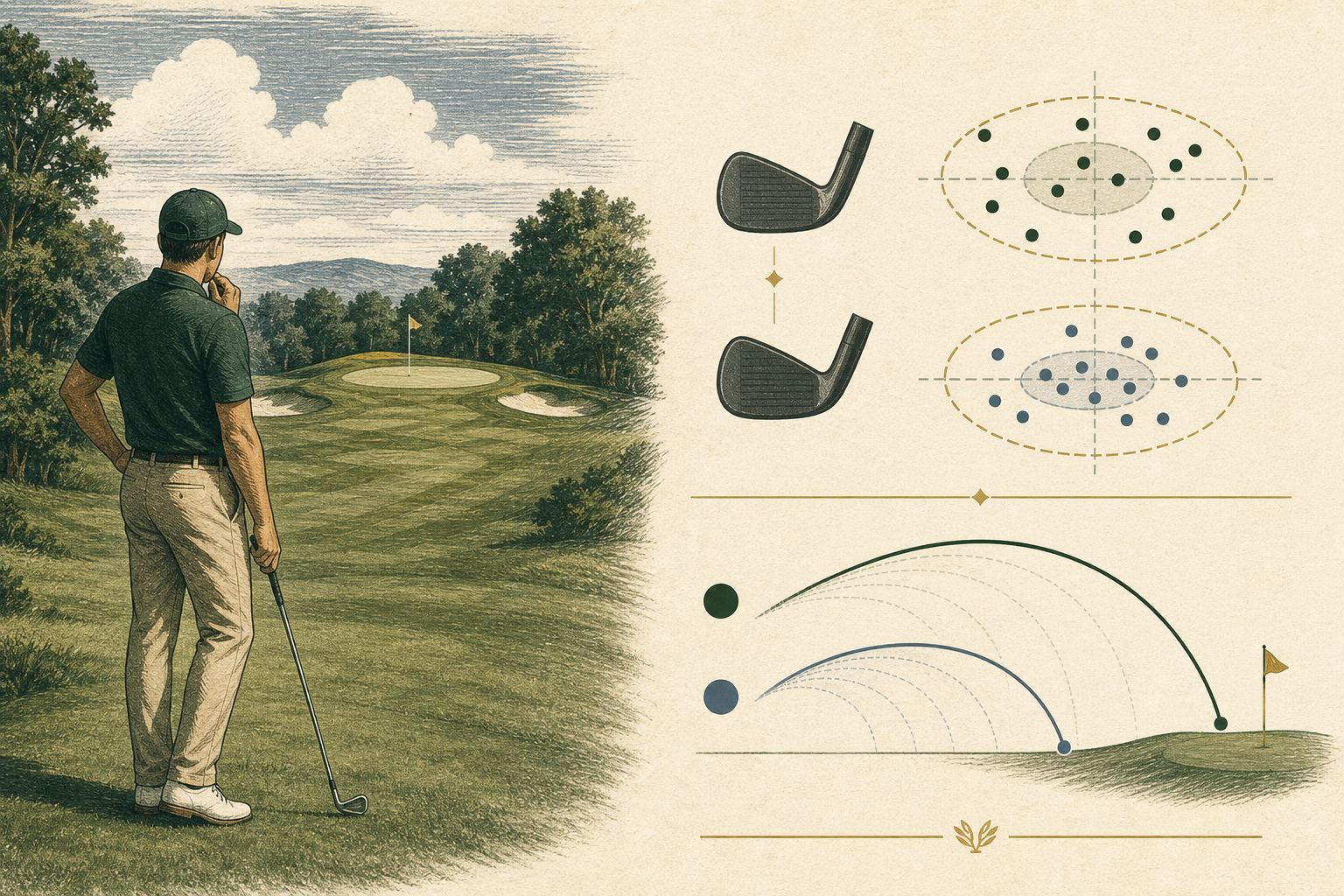
Built for: Golfers comparing iron constructions who want to separate manufacturing terms from on-course fit and performance.
The iron that feels best on a center strike is not automatically the iron that makes the next approach easier. Start with the pattern you can observe—contact, start line, carry spacing, or confidence from a specific lie—then use a fitting to see whether either construction serves that need.
The quick verdict
Forged and hollow-body are construction labels, not universal answers for feel, control, distance, or forgiveness. Choose neither label first; choose the head and shaft combination that produces the most useful measured result for the shot pattern you are trying to improve.
Best for A golfer who can name a repeatable problem, such as unreliable strike location or uneven carry gaps, and is willing to compare candidates in a measured fitting.
Skip it if Skip a construction-led purchase if you have not identified a shot problem or cannot compare results. A category name alone cannot establish that an iron is the right fit.
Start with the approach shot that keeps costing you.
On a 155-yard approach, a golfer may remember that one iron felt unusually solid in the shop. On the course, the more valuable question is whether the usual miss still finishes short, starts offline, or creates an awkward next shot. Construction is a possible part of the fitting conversation, but the observable miss gives that conversation a job to do. Write down one recurring issue before comparing irons: scattered carry distances, inconsistent contact, a predictable start direction, or discomfort looking down at the club. Do not combine all four into a vague search for a “better” iron.
Guild recommendation: Bring one defined on-course problem to the comparison, along with the iron and typical distance where it appears most often.
Treat the labels as descriptions, not promises.
“Forged” and “hollow-body” identify construction ideas, while golfers often use them as shorthand for anticipated feel or performance. That shortcut is where a purchase can go wrong. Neither label, by itself, tells you whether a particular club will solve your start-line pattern, tighten useful carry spacing, or make centered contact more repeatable. It also does not settle whether the club conforms: the USGA’s conforming-club requirements apply regardless of marketing category or construction method. A forged model can be a candidate for your test, and a hollow-body model can be a candidate for the same test; the comparison should remain about outcomes.
Guild recommendation: Do not rank an iron before hitting it because of its label. Ask what specific result would make either candidate worth choosing.
Match one feature question to one measurable outcome.
Suppose your seven-iron approaches regularly finish at noticeably different depths despite similar strikes. Your fitting question is not “Which construction is longer?” It is “Which tested configuration gives me the carry pattern and spacing I can use?” Another golfer may strike the ball toward the toe and want to know whether a candidate improves the result of that familiar miss. That is a different question, and it deserves its own comparison. PGA of America fitting guidance emphasizes fit and measured results when comparing club options. Record the same outcome for each candidate: carry pattern, landing pattern, contact location, or start direction. Keep the club number and target consistent enough that the comparison means something.
Guild recommendation: Ask the fitter to compare candidates against the same target and to show the measurement that relates to your stated problem.
Do not let feel overrule the scorecard question.
Feel matters because it affects confidence, attention, and whether you will commit to a shot. It is still one input, not a verdict. A golfer deciding between two irons can use a simple order: first, eliminate the option that fails the chosen measurable need; second, check whether loft, lie, shaft, and set makeup support the rest of the bag; third, use look and feel to break a close result. This keeps a satisfying center strike from masking a pattern that does not serve your typical approach. It also gives a golfer who values feel a fair place for that preference without presenting it as proof of on-course fit.
Guild recommendation: If two options produce similarly useful measured results, choose the one whose appearance and feel help you make a committed swing.
Turn the fitting result into a set decision.
An iron is not purchased as a single isolated answer. Once a preferred candidate emerges, check how its loft and lie specifications, shaft selection, and set composition fit around the clubs you already carry. The useful result is an iron setup that gives you understandable decisions on the course, not a label to defend in the parking lot. Before ordering, confirm the stated specifications and the seller’s return terms. If you intend to play in competitions, confirm that the specific club conforms under the applicable equipment rules rather than assuming construction settles the issue.
Guild recommendation: Keep the fitting notes, including the tested configuration and the result you preferred, so that any purchase matches the club you actually compared.
Try this · 20 minutes.
The One-Target Contact and Start-Line Check.
Use one mid-iron, a level practice area, one target, and 10 to 12 balls. Pick a target that gives you a clear start-line reference, such as a flag, post, or distinct point on the range.
- Hit six shots with your normal routine, without attempting a swing change. After each shot, note only two observations: whether contact felt centered, heel-side, toe-side, thin, or heavy, and whether the ball started left, near, or right of the target.
- Hit another six shots to the same target with the same club. Keep the goal the same: normal swings and honest observation, rather than trying to manufacture a preferred ball flight.
- Review the two groups together. Identify the one pattern that appeared most often, such as repeated toe-side contact or a repeated start direction. Take that single observation to a fitter as the performance question to investigate.
What progress looks like: The session is useful when you can state one repeatable, observable pattern in a sentence, rather than concluding that you need a particular construction.
Put the guide to work
These searches are a starting point—not a substitute for the fit and comparison criteria above.
Compare forged iron sets.
Use this search after deciding which measured outcome you need to verify, then compare stated loft, lie, shaft, set makeup, and return terms with a fitting result.
Compare hollow body iron sets.
Use this search to find candidates for the same fitting comparison, not to assume that the hollow-body label predicts your result.
Compare iron fitting tools.
Impact-location feedback can help you describe a contact pattern, but it does not replace a full fitting or measured comparison.
If you buy through these links, Guild of Golf may earn a commission at no extra cost to you.
The practical takeaway
- Choose an iron construction only after identifying the observable shot problem you want it to address.
- Forged and hollow-body labels do not independently predict the result a golfer will get.
- Compare candidates using the same target and one relevant measured outcome.
- Use feel as a meaningful tie-breaker when the performance result is already close.
- Conforming-club requirements apply regardless of construction or marketing category.
Frequently asked questions
Are forged irons automatically better for feel?
No construction label alone can establish the feel or fit you will prefer. Use feel as part of a comparison, then weigh it alongside the measured result that matters for your on-course problem.
Are hollow-body irons automatically the right choice for a golfer seeking help?
No. A hollow-body label does not establish that a particular club will improve your contact, carry pattern, or start direction. Compare the specific candidate against the outcome you need.
What should I ask for in an iron fitting?
State one observable issue, then ask to compare options against the same target while recording a relevant result such as carry pattern, contact location, or start direction. PGA of America guidance notes that fit and measured results matter when comparing club options.
Does construction determine whether an iron conforms?
No. The USGA states that conforming-club requirements apply regardless of marketing category or construction method. Confirm the specific club under the applicable rules when conformity matters.
Sources used for this draft
- USGA Equipment Rules — The point that conforming-club requirements apply regardless of marketing category or construction method.
- PGA of America: Club Fitting — The recommendation to prioritize fit and measured results when comparing club options.
Guild of Golf may earn a commission from qualifying purchases made through shopping links, at no additional cost to the reader.