
comparison
Forged vs. Hollow-Body Irons: Choose for the Miss You Actually Hit
A practical guide to separating forged and hollow-body labels, then choosing an iron through the ball-flight or strike result you can observe.
Built for: Golfers comparing iron constructions who want to separate manufacturing terms from on-course fit and performance.
The useful question is not whether forged or hollow-body irons are better. It is whether a candidate iron improves the shot you routinely face without creating a new distance, launch, or control problem elsewhere in the set.
The quick verdict
Forged and hollow-body are not opposite performance promises: forged identifies a manufacturing route, while hollow-body identifies a head architecture. Start with a repeatable, observable problem—such as inconsistent carry, an unwanted launch pattern, or unreliable strike feedback—and use a fitting session to compare measured results before assigning value to either label.
Best for Golfers willing to bring a clear test question to a fitter, such as which option produces the most usable carry pattern on their ordinary on-course iron shot.
Skip it if Skip a construction-led purchase if you have not identified a specific shot result to improve or cannot compare candidates with measured results.
Begin with the shot that costs you strokes
A golfer who catches a few thin shots late in a round has a different buying problem from the player whose solid shots repeatedly finish through a front pin. Calling either player a forged or hollow-body golfer skips the useful part of the decision. First name the result: unreliable carry, a launch window that does not hold the green, a starting line you do not trust, or distance gaps that make club selection uncertain. That problem becomes the test for every iron you consider.
Guild recommendation: Write down one primary outcome to improve and one outcome you must preserve before looking at head labels.
The labels describe different things
Forged is a manufacturing term. Hollow-body is a construction term for an iron head built around an internal space. Because the terms answer different questions, they should not be treated as a clean either-or scale of feel, skill level, or shot quality. A forged iron can take more than one head shape, and a hollow-body iron should be judged by the complete club and the ball flight it produces for you. Neither label, by itself, tells you what your carry pattern will be.
Guild recommendation: Ask the fitter or retailer to identify the full head design, loft, shaft, and build details, then compare completed clubs rather than labels in isolation.
Treat feel as feedback, not a verdict
Feel matters when it helps you recognize a strike you can repeat. It becomes less useful when it persuades you to ignore the ball finishing in an unusable place. Imagine two irons: one sounds and feels preferable on a centered strike, while the other gives you a more dependable carry pattern across ordinary swings. For the golfer choosing an approach club into a guarded green, the second observation may be the more valuable one. The right choice depends on which result matters most in your game.
Guild recommendation: During a comparison, record your impression of strike feel separately from carry, starting direction, and landing pattern. Do not let one pleasing shot settle the decision.
Use fitting to settle the performance question
The PGA of America advises golfers to focus on fit and measured results when comparing club options. That matters especially here, because a head category cannot account for the complete build or your delivery. Compare more than a best ball. Look for a usable group of shots, the distance relationship to the neighboring irons, and a pattern you can live with when your contact is merely normal. A fitter can help turn your stated on-course problem into a controlled comparison.
Guild recommendation: Bring a current iron and a specific question, such as whether another option gives a more dependable carry range without disrupting the spacing of the rest of the set.
Do not confuse conformity with suitability
Conforming club requirements apply regardless of marketing category or construction method under the USGA Equipment Rules. Conformity is therefore not a shortcut to fit. A conforming forged iron and a conforming hollow-body iron may both be eligible under the rules, while only one may make your recurring approach-shot decision easier. Rules status and player suitability are separate checks.
Guild recommendation: Verify conformity when competition requires it, then make the purchase decision from your own measured comparison and set makeup.
Try this · 15 minutes.
The Eight-Ball Carry-and-Start-Line Check
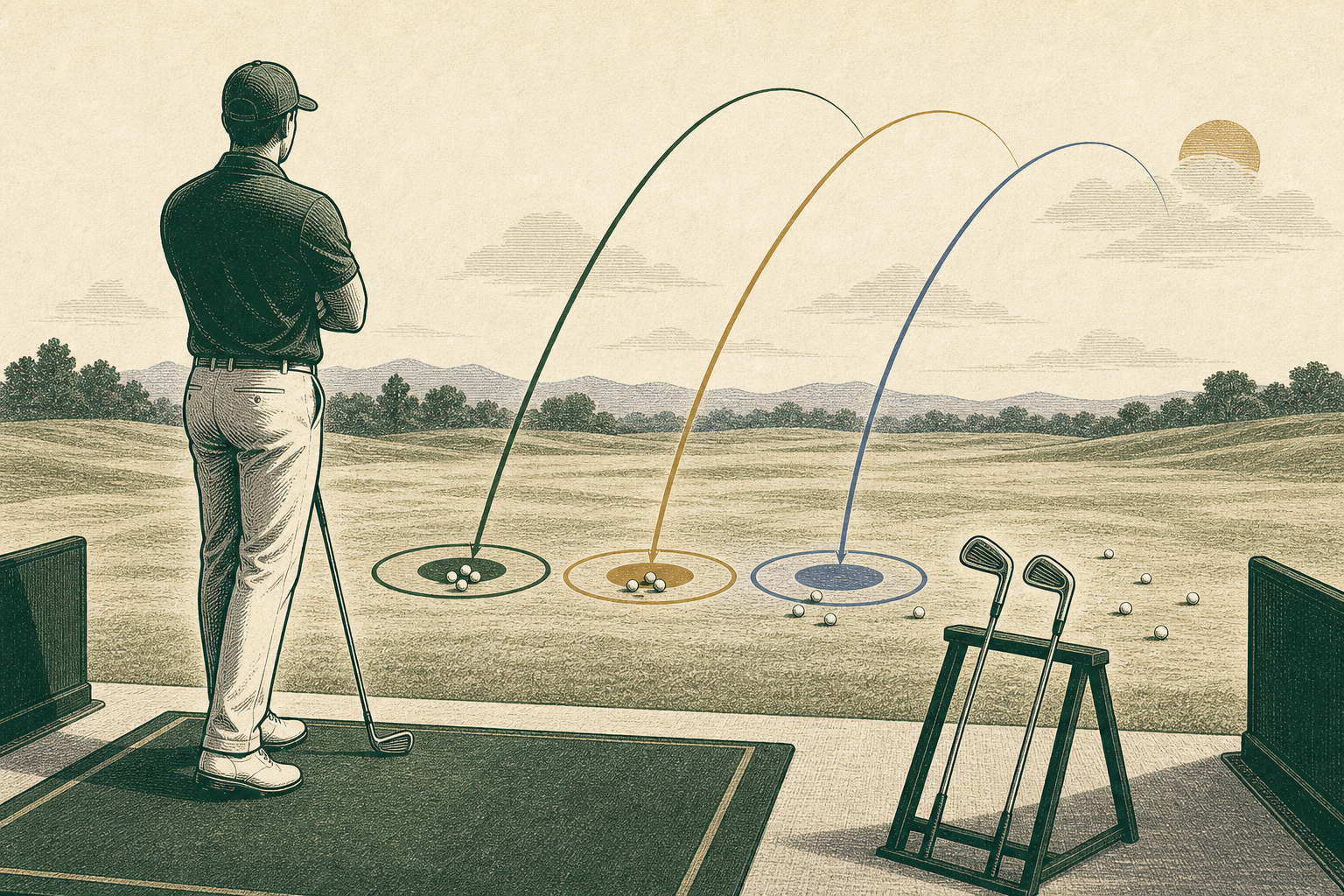
Use one familiar mid-iron, one target, and eight balls on a level practice range. If the range has marked targets, choose one that suits a comfortable full swing. If a launch monitor is available, record carry and starting direction; otherwise, use the target and landing area as visual references.
- Hit two easy warm-up shots that do not count.
- Hit six normal shots with the same target and usual pre-shot routine. After each ball, note only whether it started near the intended line and whether it finished short, near, or beyond the target area.
- Repeat the six-shot set with the comparison iron, keeping the target and effort level unchanged.
- Compare the two groups rather than the single best strike. Look for the club that gives you a more usable pattern for your normal shot, not simply the longest isolated ball.
- Take your notes to a fitter and ask for measured comparison of the result you are trying to improve, along with the club’s place in your full-set distance spacing.
What progress looks like: A useful outcome is a clear, repeatable observation—such as one candidate producing a tighter usable landing area or a more predictable carry window—rather than a conclusion drawn from one flushed shot.
Put the guide to work
These searches are a starting point—not a substitute for the fit and comparison criteria above.
Compare forged iron sets
Use this search after deciding which measured outcome you want to compare, then check that the listed specifications and fit options support a proper evaluation.
Compare hollow body iron sets
Use this search to find candidates with the architecture you want to trial, while treating the label as a starting point rather than proof of a result.
Find an iron fitting appointment
A fitting gives you a chance to compare candidates through measured results and full-set spacing rather than appearance alone.
If you buy through these links, Guild of Golf may earn a commission at no extra cost to you.
The practical takeaway
- Forged and hollow-body labels describe different aspects of an iron, so they do not create a simple better-versus-worse choice.
- Choose a candidate to address one observable performance problem, not to buy a category identity.
- Separate preferred feel from the shot pattern that actually helps you score.
- Use a fitting and measured results to compare complete clubs and protect distance spacing across the set.
- Check conformity separately from fit, because eligible equipment is not automatically suitable equipment.
Frequently asked questions
Are forged irons always better for feel?
No universal conclusion follows from the forged label alone. Feel is a personal response to the complete club and strike, so use it as one part of a comparison alongside the ball-flight result you can observe.
Are hollow-body irons automatically the right choice for golfers who need help?
No. A hollow-body label identifies a construction approach, not a guaranteed on-course outcome. Choose only if a comparison shows it improves the particular result you are trying to improve without harming your set spacing or control.
What should I ask for in an iron fitting?
Ask to compare your current iron and candidate clubs against one clear problem, then review measured results, carry pattern, starting direction, and the distance relationship to neighboring irons. The PGA of America emphasizes fit and measured results when comparing club options.
Do forged and hollow-body irons follow different conformity rules?
Conforming club requirements apply regardless of marketing category or construction method, according to the USGA Equipment Rules. Verify the individual club when your event requires conformity.
Sources used for this draft
- PGA of America: Club Fitting — The recommendation to prioritize fit and measured results when comparing iron options.
- USGA Equipment Rules — The distinction that conformity requirements apply regardless of construction method or marketing category.
Guild of Golf may earn a commission from qualifying purchases made through its shopping links, at no additional cost to the buyer.