
evergreen guide
Choose a Home Launch Monitor by the Shot Problem You Can Observe
A practical framework for matching a personal launch monitor’s measurements and home setup to one observable practice problem at a time.
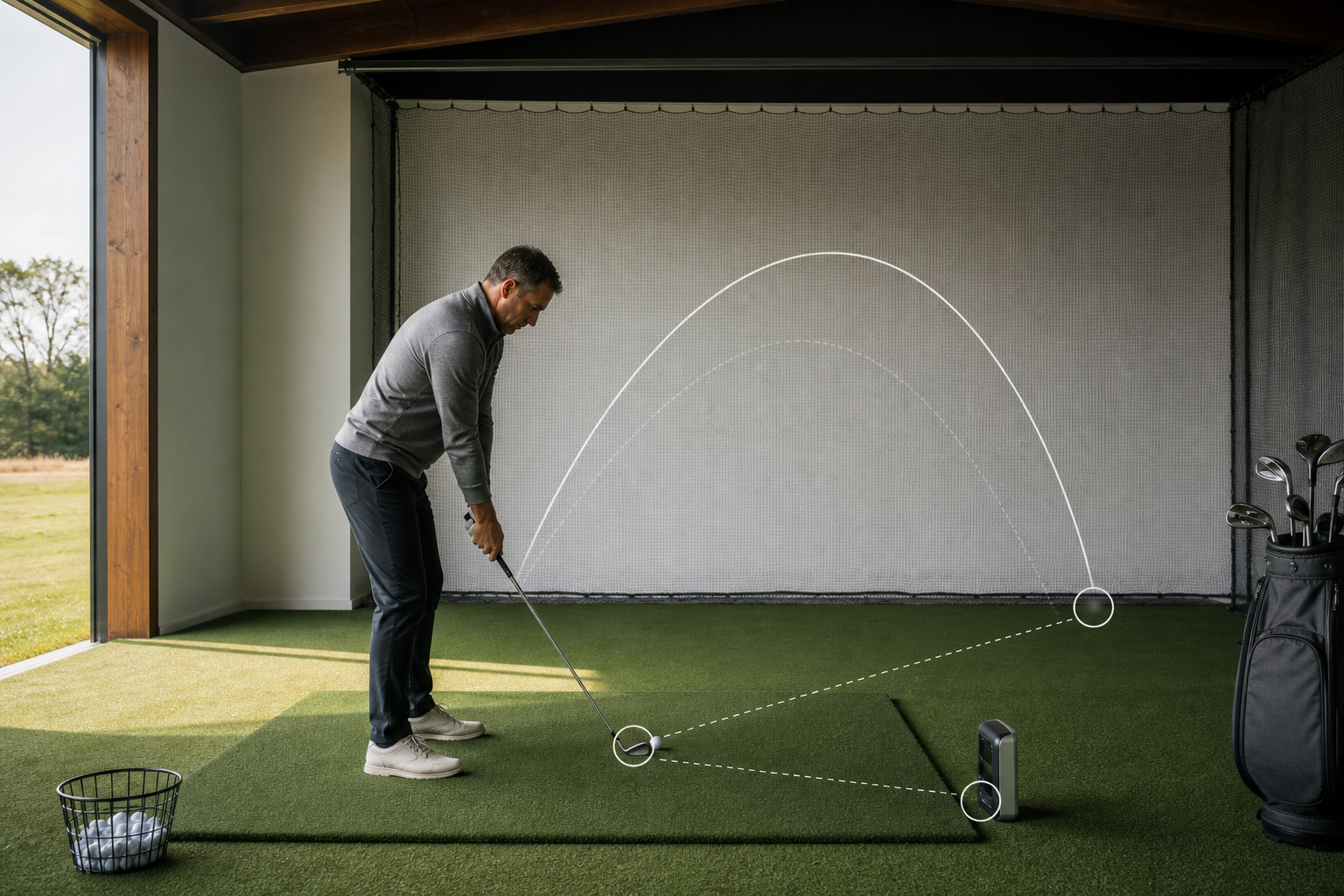
Built for: Golfers deciding whether a personal launch monitor provides the measurements and setup their practice actually needs.
Before buying a screen full of numbers, identify the ball-flight question you can see on the course. Then choose the monitor, space, and practice routine that can turn that question into a repeatable measurement.
The quick verdict
A useful home launch monitor is not the one that reports the most data; it is the one that consistently captures the one or two measurements tied to a shot problem you can observe and lets you repeat the same practice task safely.
Best for Golfers who can name a recurring outcome, such as approaches finishing short, drives starting unpredictably, or distance control varying with one club, and who have a stable place to practice.
Skip it if Skip the purchase for now if you cannot create a safe, repeatable hitting setup or if you mainly want the device to tell you why a swing is happening without a clear practice question.
Begin with the shot that costs you strokes
The familiar trap is buying a launch monitor after one frustrating range session and then scrolling through numbers with no decision attached. A better starting point is an outcome you can observe: a 7-iron that repeatedly finishes short of the green, a driver that starts in different directions, or a wedge distance that varies enough to make a layup uncomfortable. That outcome gives the practice a defined purpose and a measurable structure, which the PGA of America identifies as central to productive practice. The monitor’s job is to make that one outcome easier to compare from shot to shot, not to replace judgment with a larger data list.
Guild recommendation: Write one sentence that describes the result, the club, and the situation before comparing models. If you cannot write that sentence, delay the purchase and clarify the practice problem first.
Match the measurement to the observable question
For a distance-control problem, prioritize a repeatable distance result from the club you intend to practice. For a trajectory question, prioritize the ball-flight information that lets you compare a lower and higher outcome under the same target and effort. For a start-line question, look for output that helps you compare where shots begin relative to your chosen target line. The important distinction is practical: a measurement earns its place only if a change in that measurement would alter what you practice next. A number that cannot lead to a clear next task is merely interesting.
Guild recommendation: Make a two-column list before shopping: “What I can see” and “What I need to compare.” Select a monitor only if its documented outputs cover the second column without requiring you to infer the rest.
Treat repeatability as a feature, not a footnote
Home practice can become misleading when the hitting position moves, the target changes, balls differ, or the device is repeatedly repositioned. In that situation, changing numbers may reflect changing conditions rather than a useful shot comparison. Assess the full routine: where the ball sits, where the device sits, how quickly it is ready for the next shot, what it needs to display results, and whether you can recreate that arrangement next week. A simpler unit that you will place identically for twenty shots can be more useful than a more elaborate system that turns every session into a setup project.
Guild recommendation: Before buying, map the practice area with a ball position, target line, device location, and safe strike area. If the manufacturer’s setup requirements do not fit that map, choose a different approach rather than forcing the station.
Separate feedback from explanation
A personal monitor can give feedback on shot results, but feedback is not a diagnosis of why those results occurred. A low carry reading, for example, is a prompt to compare contact, effort, target, ball, and setup conditions across several shots; it is not proof of a particular swing fault. This boundary keeps practice safer and more useful. It also prevents a golfer from making a large technical change because of one outlying reading. Claims about what a product measures or can do should rest on a reasonable basis, a standard reflected in FTC advertising guidance; read the maker’s stated capabilities and setup instructions closely rather than assuming every model answers every question.
Guild recommendation: Use the monitor to identify patterns in ball results across a small, controlled set. For instruction about swing causes or physical limitations, work with a qualified teaching professional.
Buy the station, not only the device
The device is only one part of useful home practice. Consider the safe strike zone, a stable surface, a clear target reference, lighting or weather exposure where relevant, ball collection, and the interruption caused by retrieving balls or adjusting equipment. A golfer practicing a half-hour after work may value a setup that starts quickly and records a clean five-shot comparison. A golfer with a dedicated bay may reasonably value a more involved display and review process. Neither is automatically better; the better choice is the one that preserves attention for the defined task.
Guild recommendation: Time a mock session without a monitor: set up, hit ten balls safely, record a simple result, and pack away. Let that real routine determine how much device complexity your practice can support.
Try this · 20 minutes.
The One-Club Baseline Check
Use one club, the same type of ball for every shot, and a safe hitting area with enough room for the launch monitor and its required ball-to-device placement. Choose one visible target line, set the device in the same position for the full session, and use only measurements the device displays consistently.
- Write one observable question before hitting, such as, “Which shots with this club finish noticeably shorter than my usual solid shots?”
- Hit five comfortable shots toward the same target without changing the setup. Record only the carry result, or another single ball-result measurement your device reports, plus a simple note of solid, thin, or heavy contact based on what you felt and saw.
- Pause, keep the club and target unchanged, and make one modest task change that does not attempt to diagnose your swing. For example, make five more swings with the sole of the club brushing the ground after the ball, or make five swings at a deliberately calmer effort.
- Compare the two groups by their average-like cluster and spread, not by chasing the single longest shot. If the device also reports a second relevant ball-flight result consistently, note it without trying to explain its cause.
- Finish by writing the setup condition that produced the tighter group or the more useful target result. Repeat that same question on another day before drawing a conclusion.
What progress looks like: The session succeeds when you can say whether one repeatable practice condition produced a more consistent group of measured shot results, rather than when you produce one exceptional number.
Put the guide to work
These searches are a starting point—not a substitute for the fit and comparison criteria above.
Portable launch monitors for carry-distance practice
Use this search after deciding that your practice question is whether a specific club produces repeatable distance. Compare the stated measured outputs, placement requirements, and whether the setup fits your available hitting space.
Home golf launch monitors for ball-flight feedback
Use this search when your visible question concerns trajectory or speed-related outcomes. Compare only the listed measurements you will use, plus the device’s setup guidance and app or display workflow.
Golf launch monitor hitting net setup
Use this search if the limiting factor is building a repeatable station. Compare safe net and mat arrangements with the monitor’s required placement, rather than treating the device as a stand-alone purchase.
If you buy through these links, Guild of Golf may earn a commission at no extra cost to you.
The practical takeaway
- Choose a launch monitor from an observable shot problem, not from the length of its feature list.
- A measurement is useful only when it helps you compare a repeatable practice condition and choose a next step.
- A stable ball position, target line, device location, and ball type make home data more interpretable.
- Do not treat a ball-result reading as a diagnosis of your swing.
- Evaluate setup requirements and safe use as carefully as reported measurements.
Frequently asked questions
What is the first measurement I should look for in a home launch monitor?
Start with the measurement that directly reflects your most repeatable visible problem. If you are unsure whether a club produces dependable approach distance, begin with a distance result rather than buying around measurements you do not yet know how to use.
Should I buy a monitor with every available metric?
Not necessarily. More outputs can create more decisions, but only if each output answers a question you will actually compare during practice. A smaller set of consistent, relevant results is often easier to use with purpose.
How can I tell whether a home setup will be useful?
Confirm that you can reproduce the same ball position, target line, device placement, and safe hitting area from session to session. Then run a short baseline practice session and see whether the results help you compare a defined task.
Can a launch monitor tell me what is wrong with my swing?
It can provide feedback on measured shot results, but a result alone does not establish its cause. Use patterns across controlled shots to guide a practice question, and seek qualified instruction when you need help understanding swing causes.
Sources used for this draft
- PGA of America: Practice With Purpose — The recommendation to give practice a defined purpose and measurable structure.
- FTC Advertising and Marketing Basics — The guidance to evaluate objective product claims against stated capabilities and reasonable support.
Guild of Golf may earn a commission from qualifying purchases made through shopping links, at no additional cost to you.