
comparison
Alignment Sticks vs. Tempo Trainers: Buy Feedback for the Miss You See
Choose an inexpensive practice aid by matching its feedback to an observable problem: aim and setup reference, or rhythm and movement awareness.
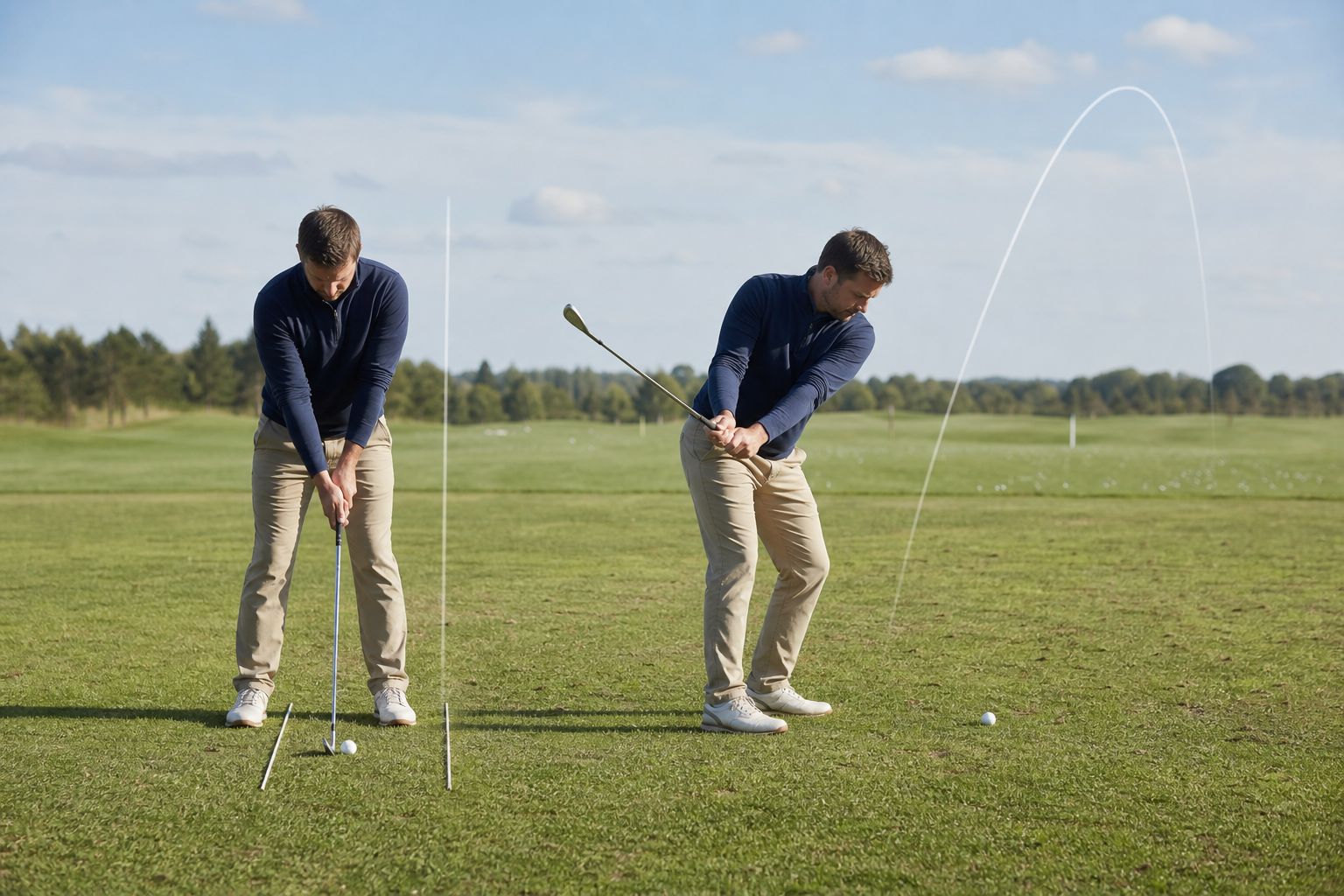
Built for: Golfers choosing between inexpensive practice aids for alignment, movement, rhythm, or speed awareness.
When a shot starts left of the flag, a new gadget can feel like a solution. First decide whether you need a visible reference for where you are aimed or a repeatable cue for how the club is moving. Alignment sticks and swing tempo trainers answer different questions, so the better buy is the one that makes your actual practice problem easier to observe.
The quick verdict
Buy alignment sticks when your practice question is about aim, ball position, stance, or a club-path reference. Choose a swing tempo trainer when your useful question is whether your motion feels rushed, uneven, or hard to repeat from swing to swing.
Best for Alignment sticks suit golfers who can point to a setup or start-line concern. A tempo trainer suits golfers who already have a clear target and want a simple physical cue during rehearsals and swings.
Skip it if Skip both if you cannot name one observable problem to work on. More feedback is not better when it distracts from a specific practice goal.
Start with the shot or motion you can describe
A player on the range may watch three drives begin left of the intended target, then reach for a tempo aid because the swing felt quick. That may be the wrong feedback. A left start can be observed against a target line; a hurried feel is a separate observation. Purposeful practice connects the activity to a specific goal, according to the PGA of America. Write the problem before selecting the aid, because the written problem tells you what feedback is useful.
Guild recommendation: If you can describe where the ball starts or where your body and club are set, begin with alignment sticks. If your clearest observation is an inconsistent cadence or a rushed change of direction, consider a tempo trainer.
Alignment sticks provide external reference points
Alignment sticks are most useful when the golfer needs to see a relationship: feet relative to a target line, ball position relative to stance, or a safe on-ground boundary for a rehearsal. Their value is not that they explain why a ball missed. Their value is that they make one setup or directional reference difficult to ignore. For example, a golfer who repeatedly aims at the center of a green but sees shots start well right can use a stick as a consistent target-line reference before changing anything else.
Guild recommendation: Choose sticks if you practice on a range or mat where you can place a ground reference safely and repeatedly. Skip them as a first purchase if your setup already looks consistent but your main complaint is that every swing has a different pace.
A tempo trainer supplies a movement cue, not an aim line
A swing tempo trainer is for the golfer whose problem is less about where they stand and more about how the motion is organized. It can give a tangible cue during slower rehearsals, which is useful when a player says, “I snatch the club back,” or, “I rush from the top,” and can recognize that difference from one swing to the next. It does not show whether the player is aligned at the target, and it does not replace a target-line check. A golfer who swings smoothly but is aimed poorly has bought feedback for the wrong problem.
Guild recommendation: Choose a tempo trainer when you have enough room for controlled rehearsals and want one repeatable feel. Skip it if you want direct evidence of aim, ball position, or start direction; alignment sticks make those observations more accessible.
Do not turn two simple aids into one crowded drill
The inexpensive choice is often the aid that narrows your attention, not the one with the most possible uses. A player preparing for a tee shot can use sticks to establish a reference, remove the visual clutter, and then make normal swings. Another player can use a tempo trainer for a few rehearsals, put it aside, and hit shots to a target. Combining several positions, cadence thoughts, and ball-flight goals in one swing makes it harder to tell what the session was meant to reveal.
Guild recommendation: Use one aid for one set of shots. Record a simple outcome that matches the aid: start direction for alignment work, or a consistent self-described rhythm for tempo work.
Keep practice aids in their proper setting
Practice aids are tools for practice, not assumptions about what is permitted during play. The USGA Equipment Rules state that equipment and its use during a stipulated round are governed by the applicable rules. Before taking any training item onto the course during a round, check the rules and the competition conditions that apply to you.
Guild recommendation: Set up training aids in a designated practice setting. For play, rely on the equipment and procedures permitted under the applicable rules.
Try this · 20 minutes.
The One-Problem Practice Test
Use a level practice area, a target, six balls, and either alignment sticks or a swing tempo trainer. Before starting, write one observable problem in plain language, such as “my shots start left of the target” or “my transition feels rushed.” Do not try to solve both problems in the same set.
- For a start-line or setup problem, place one alignment stick on the ground parallel to your intended ball-to-target line and far enough from the ball that it cannot interfere with the swing. Make three slow rehearsals, checking only your chosen reference, then hit six shots while noting whether each starts left, near, or right of the target.
- For a rhythm or movement-awareness problem, make three controlled rehearsals with the tempo trainer, using the same unhurried cadence each time. Then make six swings with the same single intention, noting after each whether the motion felt rushed, even, or interrupted.
- Keep the club, target, and one practice intention the same for all six shots. Do not add a second aid or chase shot shape during the set.
- Review the notes after the set. If the aid made your chosen issue easier to notice and your notes became more consistent, keep it in the next session. If it supplied feedback unrelated to the problem you wrote down, it is not the first aid to buy.
What progress looks like: The success signal is a clearer, more repeatable record of one chosen observation, such as more shots starting near the target line or more swings described as even, rather than a promise about a swing diagnosis.
Put the guide to work
These searches are a starting point—not a substitute for the fit and comparison criteria above.
Simple alignment stick set
Compare straight, plainly visible sticks that can create an easy ground reference without adding unnecessary features.
Swing tempo trainer
Compare trainers by whether the length, weight, and format let you make controlled rehearsals safely in your available practice space.
If you buy through these links, Guild of Golf may earn a commission at no extra cost to you.
The practical takeaway
- Choose alignment sticks for an observable reference involving aim, stance, ball position, or a ground-based swing boundary.
- Choose a tempo trainer for a single, repeatable cue about rhythm or movement awareness.
- A ball starting away from the target and a swing that feels rushed are different practice problems, even when they happen on the same shot.
- Use one aid and one measured observation per practice set so you can tell whether the feedback helped.
- Check applicable rules before using any training aid during a stipulated round.
Frequently asked questions
Are alignment sticks better than a swing tempo trainer?
Neither is universally better. Alignment sticks are the stronger first choice when your problem is visible setup or directional reference. A tempo trainer is the better match when the useful feedback is a repeatable rhythm or movement cue.
Can alignment sticks fix a slice or pull?
They can provide a consistent reference for aim, stance, ball position, or a rehearsal boundary, but they do not identify the cause of a shot pattern. Use them to observe one setup or directional variable rather than treating them as a complete answer to a miss.
Should I practice with both aids at once?
Usually, no. Start with one aid and one stated goal. Separate sets make it easier to see whether you were working on start-line reference or rhythm awareness.
Can I use a tempo trainer during a round?
Equipment and its use during a stipulated round are governed by applicable rules. Check the relevant rules and any competition conditions before using a training aid during play.
Sources used for this draft
- PGA of America: Practice With Purpose — The principle that purposeful practice should connect an activity to a specific goal.
- USGA Equipment Rules — The reminder that equipment and its use during a stipulated round are governed by applicable rules.
Guild of Golf may earn a commission from qualifying purchases made through shopping links, at no additional cost to the reader.