
comparison
Putting Mirror vs. Putting Mat: Choose for the Problem You Can Observe
A purposeful way to choose a home putting mirror or putting mat by matching the aid to an observable setup or ball-roll problem.
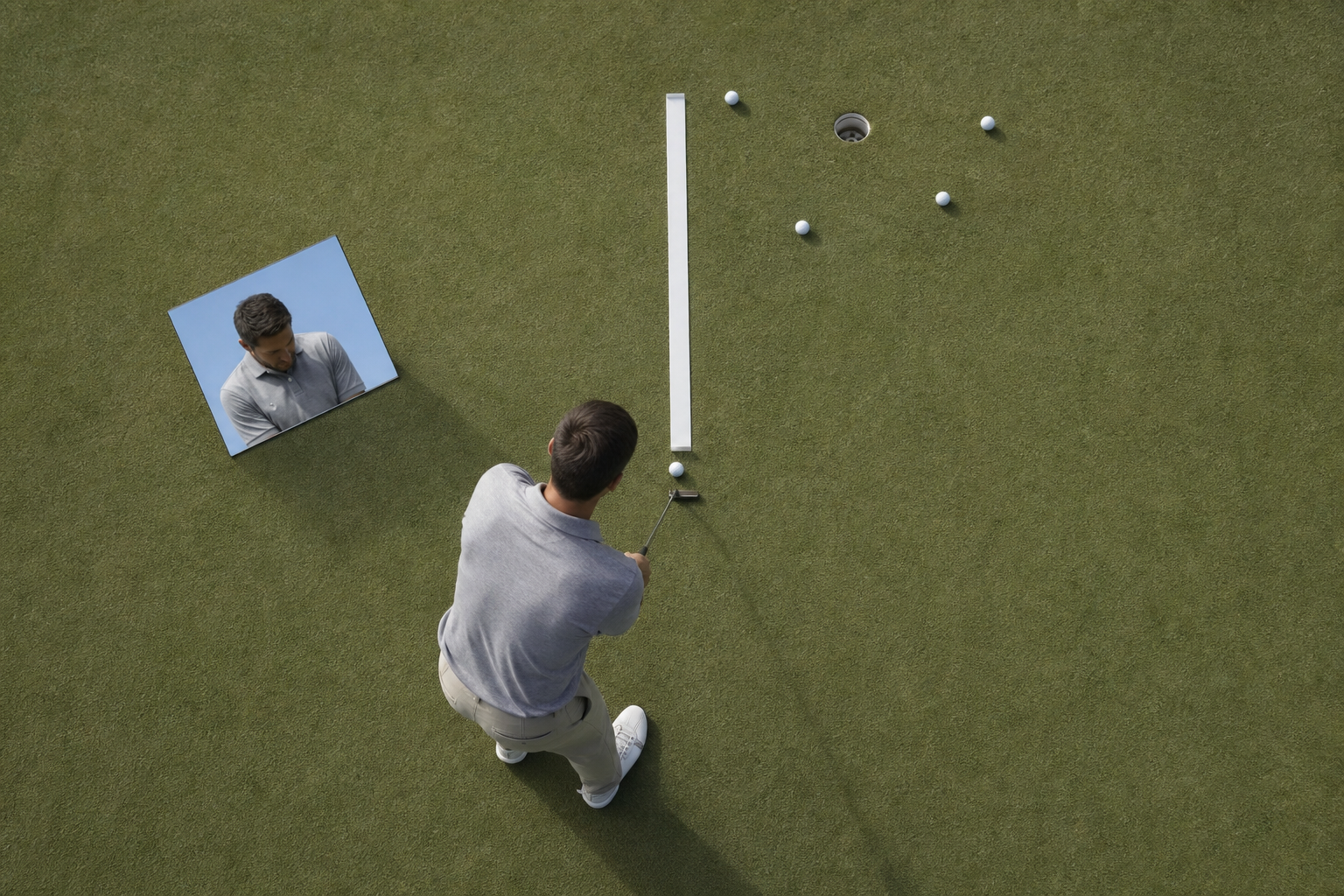
Built for: Golfers choosing one practice aid and deciding whether they need setup feedback or ball-roll feedback.
When short putts miss, the tempting response is to buy more practice equipment. Start smaller: identify whether the problem appears before the stroke or after the ball leaves the face, then choose the single feature that lets you observe it at home.
The quick verdict
Choose a putting mirror when your recurring uncertainty is visible at address; choose a putting mat when you need a repeatable target and a clear record of where short putts finish. If you cannot name the observable problem, use a simple target drill first and delay the purchase.
Best for A mirror is best for golfers who repeatedly rebuild their stance, aim, or eye position over the ball. A mat is best for golfers who want a ready-made indoor lane for start-line and distance-control practice.
Skip it if Skip a mirror if looking at setup details makes you freeze over the ball. Skip a mat if your only plan is to roll putts without a target, a distance, or a way to record the result.
Start with the miss, not the gadget
A four-footer can create two very different frustrations. One golfer stands over the ball and cannot tell whether the setup looks the same from putt to putt. Another feels comfortable at address but watches balls finish short, long, or away from the intended line. Those are different observable problems, so they deserve different home-practice tools.
Purposeful practice needs a defined task and a structure for observing the outcome, as the PGA of America emphasizes in its guidance on practice with purpose: https://www.pga.com/story/practice-with-purpose-to-improve-your-game. Before shopping, roll a short set toward one target and write down what happens. Do not label the cause. Simply distinguish what you can see before the stroke from what you can see after it.
Guild recommendation: Buy only after you can complete this sentence: “My repeated problem is __, and I need to see __.”
Choose a mirror when the uncertainty happens before impact
A putting mirror is an address-feedback tool. It gives a golfer a visual reference while setting the putter behind the ball, which can be useful for the player who keeps shuffling feet, moving the ball position, or doubting aim on short putts. Its value is not in making a claim about why a putt missed. Its value is letting the golfer build a repeatable pre-stroke picture.
Consider the golfer who misses a few short putts, then changes posture, ball position, and aim on the next one. That player has no stable starting point from which to learn. A mirror can impose a brief, repeatable address check. Once the player is set, the focus should return to the target rather than become an extended inspection of reflection details.
A mirror is a poor first choice for a golfer whose address already feels repeatable and whose main question is whether the ball reached the target with the intended pace. It also loses value if it turns every putt into a search for visual perfection.
Guild recommendation: Choose a mirror if your practice notes repeatedly identify inconsistent address positions before you begin the stroke.
Choose a mat when the evidence appears after the strike
A putting mat creates a consistent indoor place to roll balls toward a target. That makes it the more direct choice for a golfer who needs to observe start direction, finishing distance, and how often a short putt reaches a chosen target. The constraint is space: a mat must fit the room and be easy enough to leave out or deploy often. A long mat that stays in a closet is less useful than a compact lane used several times a week.
Imagine a golfer who starts a five-putt set with three balls that stop noticeably short, then tries to compensate by hitting the next two too firmly. A mat and a fixed target make that pattern visible. The golfer can set a distance, record outcomes, and make the next set comparable. This is not a substitute for the varied slopes and speeds of a course green, but it can give indoor practice a repeatable task.
A mat is less compelling when the golfer cannot settle into a consistent setup. In that case, rolling more balls may produce a large pile of results without clarifying what changed before each stroke.
Guild recommendation: Choose a mat if your notes show a recurring ball-roll pattern and you have enough clear floor space to use it consistently.
Do not confuse a target with a diagnosis
Both tools can help a golfer observe, but neither can diagnose a putting stroke from a handful of indoor rolls. A mirror shows what you elect to check at address. A mat shows where the ball finishes in that particular indoor setting. Keep the practice question narrow: Can I reproduce the setup I selected? Can I start the ball toward this target? Can I send it a chosen distance?
That restraint matters because putting on the course includes the conditions of the putting green and the line of play. Rule 13 provides the rules context for putting greens and lines of play: https://www.usga.org/rules/rules-and-clarifications/rules-of-golf/rule-13.html. A home station can support a repeatable routine, but it does not recreate every on-course read or condition.
Guild recommendation: Use one measurement per set, such as starts on the intended path or balls finishing within a chosen zone, rather than trying to fix several ideas at once.
A practical one-aid decision
If you have one purchase to make, choose the aid that removes the largest uncertainty. The golfer who says, “I never know whether I am set up the same way,” should favor the mirror. The golfer who says, “I need a simple place to practice making the ball finish at a target,” should favor the mat.
There is a middle case: the golfer whose setup and result both vary. Do not automatically buy both. Run the Before-or-After 20-Putt Check twice on different days. If the same category dominates both sessions, that is the feature worth paying for. If neither category repeats, the more valuable change may be a shorter, more structured practice session rather than another aid.
Guild recommendation: Make the decision from two brief practice records, not from the number of features shown on a product listing.
Try this · 10 minutes.
The Before-or-After 20-Putt Check
On a level indoor surface, place a small cup, coaster, or other safe flat target 4 to 6 feet away. Use a ball that can roll safely on the surface. If you own a mirror, position it under the ball; if you own a mat, use its target or mark a target at the far end.
- Roll five putts with no rehearsal. After each putt, record only one result: started on the intended path, finished short, finished long, or missed to either side.
- For the next five putts, pause at address for two seconds. If using a mirror, observe whether you can settle into the same ball position and intended alignment before each stroke. Do not alter your stroke during the set.
- Roll another five putts toward the same target, using the same address routine. Record the same results.
- Finish with five putts at a second distance, either 2 feet closer or farther away. Compare the first and second sets rather than chasing a perfect stroke.
What progress looks like: You have a useful purchase signal when the notes show a repeated pre-stroke issue, such as inconsistent address, or a repeated post-stroke issue, such as an inconsistent finish distance or start direction. A mirror serves the first pattern; a mat serves the second.
Put the guide to work
These searches are a starting point—not a substitute for the fit and comparison criteria above.
Compare putting mirrors
After confirming that your problem occurs at address, compare whether the reflective layout gives you a simple, non-distracting view of the ball and your setup.
Compare putting mats
After confirming that you need ball-roll feedback, compare the usable putting length, the target presentation, and whether the surface fits the room where you will actually practice.
Compare compact putting stations
Consider a combined station only if you have shown that you will use both setup feedback and a repeatable target in the same routine.
If you buy through these links, Guild of Golf may earn a commission at no extra cost to you.
The practical takeaway
- A putting mirror addresses a visible pre-stroke setup question; a putting mat addresses an observable ball-roll and target question.
- The first aid should remove one repeated uncertainty, not attempt to solve every putting problem.
- A compact practice space and a defined target matter more than a long, unstructured session.
- Record simple outcomes across two sessions before deciding whether setup feedback or ball-roll feedback is the priority.
Frequently asked questions
Can a putting mirror improve distance control?
A mirror can help you make your chosen address routine more repeatable, but it does not itself provide a target distance or show how far the ball finishes. For an observable distance-control task, a mat or a marked indoor target is the more direct tool.
Can I practice on a putting mat without a mirror?
Yes. Set one target and one distance, roll a defined number of putts, and record starts and finish positions. The structure gives the session a purpose even without setup feedback.
Should a beginner buy a mirror or a mat first?
A beginner should first identify the easier problem to observe. Pick a mirror if the address position changes constantly; pick a mat if a consistent target and repeatable roll are missing from home practice.
How often should I change the practice target?
Keep the target unchanged for one short set so the results are comparable. Change distance only after recording the first set, then compare the outcomes rather than mixing targets on every putt.
Sources used for this draft
- PGA of America: Practice With Purpose — The recommendation to use a defined purpose and structure for practice.
- USGA Rule 13: Putting Greens — The rules context for putting greens and lines of play.
Guild of Golf may earn a commission from qualifying purchases made through affiliate links.