
evergreen guide
Choose a Home Launch Monitor by the Ball Flight Problem You Can See
A practical framework for choosing a personal launch monitor around one observable ball-flight problem, the practice space, and the feedback needed to measure progress.
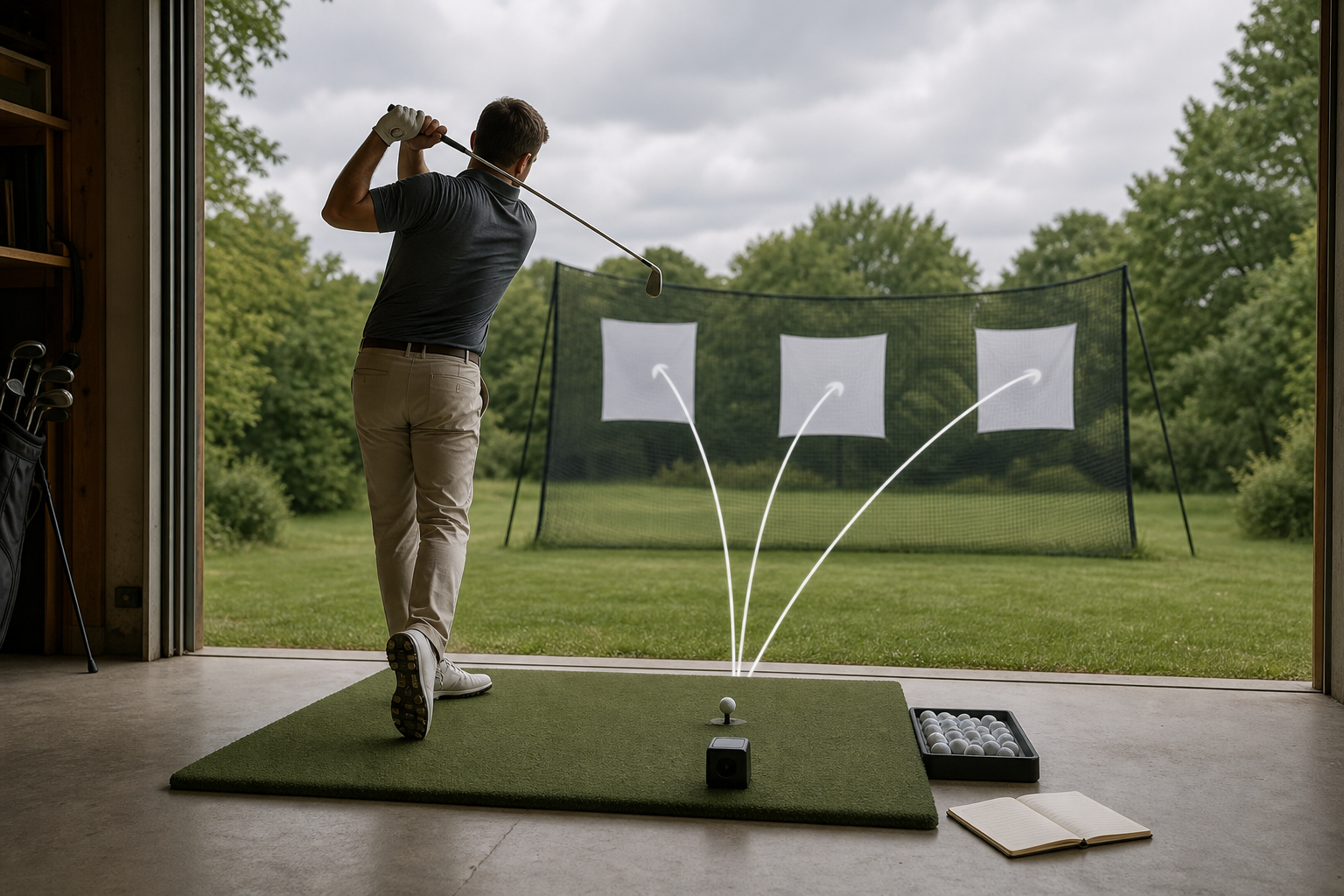
Built for: Golfers deciding whether a personal launch monitor provides the measurements and setup their practice actually needs.
The frustrating home-practice trap is collecting numbers after every shot without knowing what any of them should change. Start with the shot pattern you can observe, then buy only the feedback that helps you run a repeatable practice experiment.
The quick verdict
A useful home launch monitor is not the one with the longest metric list; it is the one that reliably supports a defined question, such as whether a chosen setup or swing-feel produces a more repeatable starting direction, trajectory, carry result, or strike pattern in your available space.
Best for Golfers who can name one recurring on-course pattern, have a safe and repeatable place to hit balls, and will record a small set of results over several sessions.
Skip it if Skip or delay the purchase if you do not have sufficient safe hitting space, cannot use the setup consistently, or mainly want a device to tell you what is wrong with your swing.
Begin with the shot that costs you strokes
A launch monitor earns its place at home when it turns a familiar on-course problem into a countable practice question. “My 7-iron finishes short of the green” is observable. So is “my tee shot repeatedly begins away from my intended starting line” or “my flight looks noticeably too low for the target I am trying to carry.” “I need better numbers” is not yet a useful buying reason. Practice is more productive when it has a defined purpose and measurable structure, so name the pattern before comparing feature lists.
Guild recommendation: Write one sentence describing the ball-flight result you want to make more repeatable, using words you could verify after a shot.
Match the measurement to the question, not the brochure
For a distance-control question, compare monitors according to whether their displayed feedback lets you group shots by the carry result you intend to practice. For a trajectory question, prioritize feedback that lets you compare the height or launch result you are trying to change. For a left-right pattern, look for feedback that helps you judge starting direction or lateral outcome relative to a clearly defined target line. Some golfers will want several measurements, but additional data is useful only when each number informs a decision you will actually make between shot sets. More readings can turn a focused session into number watching.
Guild recommendation: Make a two-column list: “observable problem” on the left and “one result I will record” on the right. Reject any feature that does not earn a place on that list.
Treat the room as part of the purchase
A monitor can be useful only when you can reproduce its setup safely and consistently. Measure the usable hitting area, identify where the ball, target, net, and device would go, and confirm that your normal practice club can be swung safely. Just as important, ask whether you can leave clear reference points or mark placement so the station returns to the same arrangement next week. A golfer with a compact indoor station may value a straightforward repeatable setup more than a broad menu of feedback that is cumbersome to use there. A golfer who can practice outdoors may have different constraints, but still needs a consistent target and device position to compare sessions fairly.
Guild recommendation: Draw your station before shopping, including ball position, intended target line, device location, and safe clearance around the swing.
Decide how much evidence you will trust
A personal monitor should support comparison, not create certainty from a single shot. Use repeated shots under the same conditions, keep the ball and club constant for a session, and look for patterns across sets. When reading manufacturer claims about measurements or performance, look for a clear explanation of what is claimed, under what conditions, and how the claim is supported. Objective product claims should have a reasonable basis. That principle is especially useful when a purchase decision depends on a particular measurement or home-use setup.
Guild recommendation: Before buying, list the claims that are essential to your decision and seek clear support for those specific claims rather than relying on a general impression.
Choose a feedback routine you will still use in November
The best home setup removes friction between arriving at the ball and beginning a purposeful set. Picture two golfers. One has fifteen minutes after work and needs a ready station, one club, one target, and one recorded outcome. The other has a larger space and enjoys reviewing several shot groups after a longer session. Neither golfer needs the same interface or volume of data. The first should favor a fast, repeatable routine. The second may value a system that makes it easy to review and compare saved sessions. In both cases, the outcome is better practice, not a larger spreadsheet.
Guild recommendation: Choose the monitor and workflow that let you complete a five-shot baseline and two five-shot comparisons without changing your station or losing your practice question.
Try this · 25 minutes.
The One-Question Shot Pattern Session
Use a safe hitting area and the same club, ball type, target line, and launch-monitor position for the whole session. Before hitting, write one observable question, such as, “Can I produce a more repeatable starting direction with this club?” Choose one displayed result that answers that question and, if useful, one secondary result; do not change the device position during the session.
- Hit five comfortable baseline shots without making a mechanical change. Record the chosen result for each shot and note only the broad pattern you observe, such as left, right, short, long, high, or low.
- Choose one simple intention for the next five shots, such as setting the club behind the ball with the same target picture each time. This is an experiment, not a diagnosis of your swing.
- Record the same result for all five shots. Do not add a second intention because one shot was poor.
- Repeat one more five-shot set with the same intention. Compare the two sets with the baseline by looking for a tighter or more repeatable pattern rather than chasing one exceptional reading.
- Finish with five shots using your normal routine. Record whether the pattern remains more repeatable when the experiment is removed.
What progress looks like: The session succeeds when you have a written baseline and two comparable sets that show whether one clearly defined intention made the selected result more repeatable; a single best shot does not count as proof.
Put the guide to work
These searches are a starting point—not a substitute for the fit and comparison criteria above.
Launch monitors for basic home ball-flight practice
Use this search after deciding that repeatable distance or trajectory feedback is the one result you will track.
Launch monitors for directional practice setups
Use this search if your visible problem is a recurring left-right start pattern and you need feedback that fits that practice question.
Home golf launch monitor practice net setup
Use this search to compare the monitor with the space, net, mat, and placement routine required for your home station.
If you buy through these links, Guild of Golf may earn a commission at no extra cost to you.
The practical takeaway
- Buy for one observable ball-flight problem first, not for the longest metric list.
- The useful feature is the one that supplies feedback you can record and compare in a repeated shot set.
- A safe, repeatable home station is a requirement, not an accessory.
- Judge progress by patterns across comparable shots rather than one standout reading.
- Examine essential product claims for clear, reasonably supported evidence before making a decision.
Frequently asked questions
What is the first question to answer before buying a home launch monitor?
Ask which visible result you want to make more repeatable, such as a distance outcome, a trajectory outcome, or a left-right starting pattern. Then identify the single measurement or displayed result you would record during practice.
Do I need every available measurement for home practice?
No. A measurement is useful when it answers your selected practice question and helps you compare repeated shots. Extra readings can be unnecessary if they do not change what you practice or how you evaluate a set.
How should I evaluate a launch monitor claim?
Identify the exact claim that matters to your home setup or practice question, then look for a clear explanation and reasonable support for that objective claim. Avoid treating an isolated result or a broad claim as proof that the monitor will solve your own ball-flight pattern.
Can a launch monitor diagnose my swing?
A monitor can provide feedback for a defined practice experiment, but it should not be treated as a diagnosis. Use its results to observe patterns in comparable shots, and keep conclusions limited to the outcome you measured.
Sources used for this draft
- PGA of America: Practice With Purpose — The recommendation to give practice a defined purpose and measurable structure.
- FTC Advertising and Marketing Basics — The guidance to look for a reasonable basis behind objective product claims.
Guild of Golf may earn a commission from qualifying purchases made through shopping links, at no additional cost to the reader.