
comparison
Alignment Sticks or a Tempo Trainer? Buy for the Feedback You Need.
Choose a practice aid by the mistake you can observe: target setup and swing-path reference call for alignment sticks, while uneven motion and rushed transitions call for a tempo trainer.
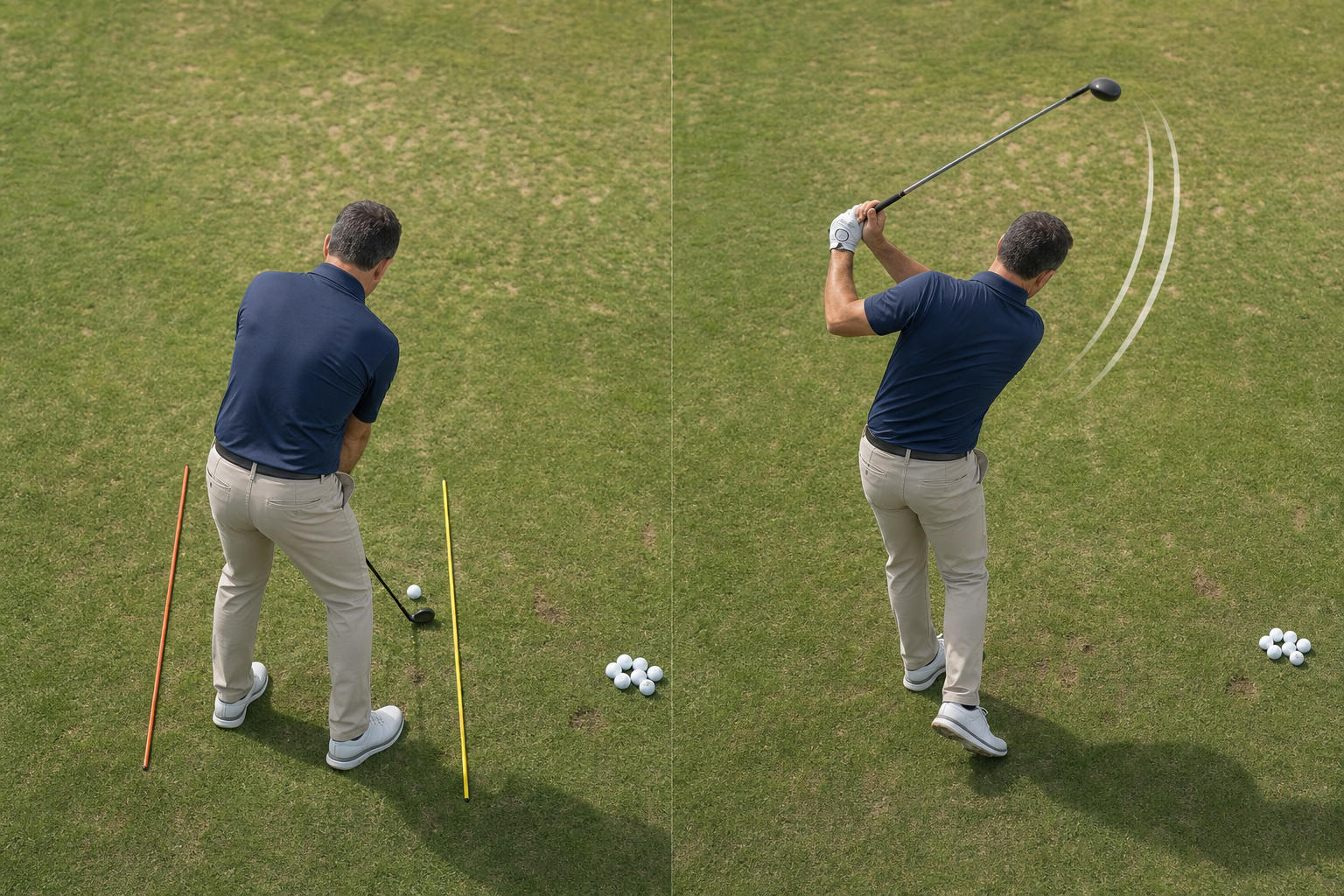
Built for: Golfers choosing between inexpensive practice aids for alignment, movement, rhythm, or speed awareness.
A poor shot can tempt you to buy a tool that promises a better swing. Start smaller: identify whether you can see a setup-direction problem or feel an inconsistent motion cadence, then buy only the aid that makes that one problem easier to notice.
The quick verdict
Choose alignment sticks when your useful question is, “Where am I aimed or moving relative to a line?” Choose a swing tempo trainer when the question is, “Can I make this motion with a repeatable cadence?” The better purchase is the one that produces feedback you can observe on the next few practice swings.
Best for Alignment sticks suit golfers who need a visible reference for target line, ball position, stance organization, or a club-travel corridor. A tempo trainer suits golfers whose practice swings vary noticeably from hurried to smooth and who want one repeatable motion cue.
Skip it if Skip both for now if you cannot name the problem you want to monitor. A practice aid without a defined task can add another sensation or visual without making practice more purposeful.
Begin with the shot pattern you can actually see.
Picture a tee shot that starts far right even though you felt as if you made a normal swing. Before assigning blame to tempo, check the evidence available at address: where your feet, clubface, and intended target line appear to be organized. Now picture a different range session: one rehearsal is quick and snatched, the next is languid, and neither feels like the swing you want to take to the ball. That is a motion-cadence problem to monitor. These are different jobs, so they deserve different feedback.
Guild recommendation: Write down one observation from a recent shot or rehearsal before shopping. If it is about a line or position, favor sticks; if it is about changing cadence from swing to swing, consider a tempo trainer.
Alignment sticks answer location questions.
Alignment sticks are external references. Their value is not a promise to fix a swing; it is their ability to make a chosen line or position visible during practice. A golfer who repeatedly discovers that the stance is aimed somewhere other than intended can use a ground reference to make that mismatch obvious. The same approach can help organize a repeatable practice station for ball position or a clear corridor, provided the sticks remain safely away from the club’s path.
Guild recommendation: Buy alignment sticks if you want to check a reference you can point to before the swing. Skip them as your first choice if your setup already looks consistent and the uncertainty is the pace of the motion.
A tempo trainer answers cadence questions.
A swing tempo trainer gives the golfer a dedicated cue for rehearsing one motion rhythm. It is most useful when the problem is variability: the backswing suddenly gets rushed, the transition feels abrupt, or practice swings have no stable cadence. Its limitation is equally important. A rhythm cue cannot show whether you are aimed at the intended target, and it does not replace a visible setup check. Use it to make one repeatable rehearsal, not to chase a particular speed or to make broad mechanical changes all at once.
Guild recommendation: Choose a tempo trainer if you can recognize an inconsistent cadence in your own rehearsals and will use it for controlled practice swings. Skip it if the key issue is a visibly inconsistent target-line setup.
Use a narrow practice goal, not a larger toolbox.
Purposeful practice connects the activity to a specific goal, according to the PGA of America. That principle turns this purchase from a gadget decision into a feedback decision. For example, a golfer preparing for a tight driving hole may work only on beginning each practice swing from a clearly organized target reference. Another golfer who rushes after a poor shot may rehearse only a comfortable, even cadence before returning to the ball. Neither needs to solve alignment and rhythm in the same five-ball block.
Guild recommendation: Give the aid a single job for one session. If you cannot state the job in a short sentence, delay the purchase and identify the observable problem first.
Keep practice aids in practice unless the rules allow otherwise.
Equipment and its use during a stipulated round are governed by the applicable rules, as the USGA notes. That makes the range, practice area, or home rehearsal space the natural place for either tool. If you are considering an aid during a round or in a competition setting, consult the applicable rules and conditions rather than assuming a practice use carries over to play.
Guild recommendation: Build your routine around pre-round or practice-session feedback, and verify rules before using any training aid during a stipulated round.
Try this · 15 minutes.
The One-Variable Feedback Check.
Use two alignment sticks or two straight, safe ground references on a level practice area. Place one on the ground along an intended target line and the second parallel to it outside the ball position, leaving ample room for the club to move safely. Start with slow, ball-free rehearsal swings.
- State one observable goal before beginning, such as keeping your feet parallel to the target reference or making each rehearsal swing at the same unhurried cadence.
- Make five slow rehearsal swings while using the ground references only to check your starting organization. Do not place a stick where it could be struck by the club.
- Remove one reference or step away from the setup and make five more rehearsal swings with the same stated goal.
- If your main difficulty is not directional setup but an uneven cadence, repeat five ball-free swings with a tempo trainer or a similar safe motion cue, keeping the motion comfortable rather than forcing speed.
- Finish by writing one simple result: whether your last five rehearsals looked more consistent than your first five under the single goal.
What progress looks like: Success is being able to describe one repeatable change you could see or feel—such as a more consistently parallel setup or a steadier cadence—without adding a second correction.
Put the guide to work
These searches are a starting point—not a substitute for the fit and comparison criteria above.
Compare alignment-stick sets.
After deciding that a visible ground reference is your need, compare portability, visibility, and whether the set works safely for the simple ground-based setup you plan to use.
Compare swing tempo trainers.
After deciding that cadence is the issue, compare the trainer’s form factor and whether it lets you rehearse a comfortable, repeatable motion rather than encouraging forced effort.
If you buy through these links, Guild of Golf may earn a commission at no extra cost to you.
The practical takeaway
- A line, stance, or position question points toward alignment sticks because the feedback is visual and external.
- A changing cadence from rehearsal to rehearsal points toward a tempo trainer because the feedback is about repeating a motion cue.
- One observable goal per session is more useful than trying to correct setup and rhythm simultaneously.
- Practice aids belong in a purposeful practice plan, and their use during a stipulated round is subject to applicable rules.
Frequently asked questions
Should a beginner buy alignment sticks or a tempo trainer first?
Choose the one tied to the clearest observable issue. If the beginner needs a simple target-line and setup reference, start with alignment sticks. If the setup is not the question but every rehearsal has a different pace, start with a tempo trainer.
Can alignment sticks and a tempo trainer be used together?
Yes, but not as competing corrections in the same drill. Use sticks for a setup-reference block and the tempo trainer for a separate cadence-rehearsal block, each with one stated goal.
Will a tempo trainer fix a slice or hook?
It is better treated as a cadence-feedback tool than as a cure for a particular ball flight. If the observable concern is aim or a directional reference, alignment sticks provide more directly relevant feedback.
May I use these aids during a round?
Equipment and use during a stipulated round are governed by applicable rules. Check the relevant rules and competition conditions before using a practice aid during play.
Sources used for this draft
- PGA of America: Practice With Purpose — The value of connecting practice activity to a specific goal.
- USGA Equipment Rules — The reminder that equipment and its use during a stipulated round are governed by applicable rules.
Guild of Golf may earn a commission from qualifying purchases made through shopping links, at no extra cost to you.