
evergreen guide
Choose a More Playable Driver by Your Strike Pattern and Miss
A practical driver-selection process that starts with where you strike the face, where your misses finish, and which shot outcomes make a hole playable.
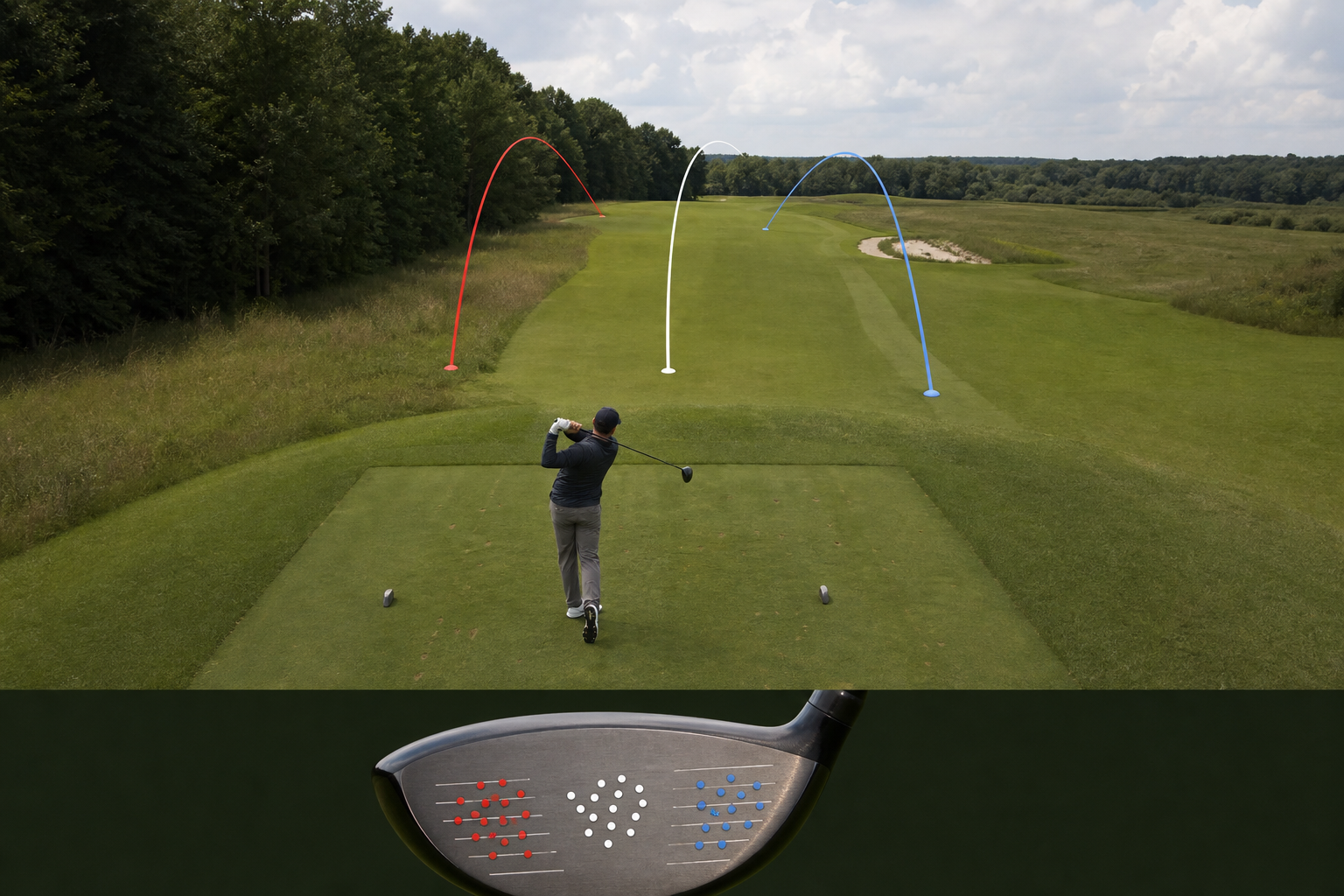
Built for: Golfers seeking a more playable driver who want to evaluate strike consistency, dispersion, launch, and confidence without relying on a vague game-improvement label.
The tee shot that ruins a hole is rarely solved by a broad category on a hang tag. Identify the repeated ball-flight problem first, then compare only the driver traits and fitting results that can make that miss less costly.
The quick verdict
Choose a driver for the miss you can observe repeatedly, not for a “game-improvement” label. A promising option is one that improves your usable tee-shot pattern—strike location, starting direction, curve, launch, and finishing area—without creating a new miss you cannot play.
Best for Golfers who can describe a recurring result, such as a low-face strike that launches too low, a ball that starts right and stays right, or a solid strike pattern that still finishes too far from the intended fairway.
Skip it if Skip a blind driver purchase if your strike pattern and miss change from swing to swing. Begin with a small on-range sample or a fitting session that compares measured results instead.
Start with the shot that makes the next shot difficult
A tee ball can find short grass and still be a poor fit for your game if it launches too low to carry a hazard, leaves an awkward distance, or repeatedly reaches the wrong side of the hole. Conversely, a ball that finishes in the first cut with a clear route forward may be a far more playable miss than one that drifts into trees or penalty trouble. Before looking at a driver, name the result that costs you most often. “My usual miss starts right and stays right” is useful. “I need more forgiveness” is not yet a buying instruction.
Guild recommendation: Define the problem by its observable consequence: lost balls, blocked approaches, missed carry, or a dispersion pattern that exceeds the fairway you normally face.
Separate strike pattern from shot pattern
Strike pattern is where contact tends to occur on the face. Shot pattern is what the ball does: its start direction, curvature, height, and finishing area. They often appear together, but they are not interchangeable. A golfer who marks repeated heel contact has a specific consistency question to bring to a fitter. A golfer whose contact is broadly centered but whose shots scatter may need to compare how different setups produce a more controllable overall pattern. In either case, avoid drawing a conclusion from one unusually good drive or one poor swing.
Guild recommendation: Collect a modest group of normal swings. A repeated pattern across that group is more useful than a single “best” launch or longest shot.
Choose the feature category that addresses the evidence
Once the miss is clear, limit the comparison to features that address that miss. If launch is consistently too low for the carries you face, compare setups that produce a more usable launch window in measured shots. If the chief problem is a start line that repeatedly brings one side of the course into play, compare configurations that make the resulting pattern more manageable. If off-center contact is routine, compare heads and shafts by the dispersion and distance retention you actually see across imperfect strikes, not merely by the promise implied by a category name. An adjustable driver can be valuable when its settings are checked against results; it is not automatically the answer to every inconsistency.
Guild recommendation: Ask one question per comparison: “Does this reduce the specific shot outcome that makes this hole unplayable?” Keep the option only if the answer is visible in the results.
Use confidence as a performance check, not a substitute for evidence
Confidence matters when a narrow landing area asks you to make a committed swing. Yet a driver that feels reassuring only because it produced one spectacular ball is not necessarily more playable. Look for confidence that survives ordinary contact: you can aim at a realistic target, make a normal swing, and expect a reasonable next shot when the strike is not perfect. That is a more useful standard than chasing the one shot that reaches the farthest part of the range.
Guild recommendation: During any comparison, alternate candidates and retain the same target, tee height, and routine. A change in the club should be the variable, not a change in intent.
Finish with fitting and conformity checks
A driver comparison is strongest when it is based on fit and measured results. The PGA of America advises golfers to consider club fitting and measured outcomes when comparing options. Use that process to compare your strike pattern, launch, dispersion, and playable finishing area under similar conditions. Also confirm that the club you intend to play conforms with the applicable equipment rules; conforming-club requirements apply regardless of how a product is marketed.
Guild recommendation: Bring your 10-ball notes to a qualified fitting conversation and ask for side-by-side results that answer your stated problem rather than a generic category recommendation.
Try this · 20 minutes.
Ten-Ball Tee-Shot Pattern Check
Use a driving range with clear targets, one driver, normal tees, and a notebook or phone note. Pick a target line and a practical fairway-width corridor rather than trying to hit every ball at a single flag.
- Hit two relaxed shots to establish a comfortable tempo; do not record them.
- Hit 10 normal driver shots, using the same target and routine for each ball.
- After each shot, record only three observations: the general strike area on the face if visible, the ball’s starting direction, and where it would finish relative to your chosen corridor.
- Group the results after the tenth ball. Look for the most common combination, such as heel contact with right-starting shots, low-face contact with low launch, or broadly centered contact with a wide left-to-right finish pattern.
- Take the notes to a fitting comparison and ask to test options against that one repeated outcome, while keeping the same target and making normal swings.
What progress looks like: The session succeeds when you can state one repeatable pattern in plain language and identify whether its consequence is a lost ball, a blocked route to the green, or simply a shorter playable tee shot.
Put the guide to work
These searches are a starting point—not a substitute for the fit and comparison criteria above.
Adjustable driver heads
Compare adjustment options only after you know whether your repeated pattern is primarily a launch, start-line, or curvature problem, then verify the resulting shot pattern with measured shots.
Driver fitting tools
Use fitting-oriented tools or sessions to record comparable strike and ball-flight outcomes rather than choosing from a marketing category alone.
Driver impact tape
Face-contact evidence can help distinguish a repeatable strike-location pattern from a ball-flight pattern that needs further fitting comparison.
If you buy through these links, Guild of Golf may earn a commission at no extra cost to you.
The practical takeaway
- A “game-improvement” label does not identify your particular tee-shot problem.
- Track both face-contact tendency and ball-flight tendency, because each supplies different evidence.
- The best playable miss is the one that leaves a realistic next shot on the courses you play.
- Compare one variable at a time and judge normal swings rather than isolated highlights.
- Measured fitting results are the sensible final check before committing to a driver.
Frequently asked questions
What is a playable miss with a driver?
A playable miss is a result that may not be ideal but still leaves a reasonable next shot. Its definition depends on the hole: a ball in the rough with a route to the green can be more playable than a similar-distance ball behind trees or in a penalty area.
Should I buy a driver labeled game-improvement?
Treat the label as a starting point for a comparison, not a conclusion. Buy only when measured shots show that the driver improves the recurring outcome you are trying to solve, such as usable launch, a tighter finishing pattern, or more manageable results from your typical imperfect contact.
How many swings should I use when comparing drivers?
Use enough normal swings to reveal a pattern rather than judging a single standout shot. Keep the target, tee height, and routine consistent, and compare the collection of strike and ball-flight results.
Can a fitting help if I do not know my swing speed?
Yes. The useful starting point is your observable tee-shot pattern and the outcome you want to improve. A fitting comparison can then use measured results to assess options rather than requiring you to arrive with a technical diagnosis.
Do I need an adjustable driver?
Not necessarily. Adjustment is useful only when a setting change produces a more playable pattern in your measured shots. A simpler option that consistently gives you a usable result can be the better choice.
Sources used for this draft
- USGA Equipment Rules — The reminder that conforming club requirements apply regardless of marketing category.
- PGA of America: Club Fitting — The recommendation to use club fitting and measured results when comparing driver options.
Guild of Golf may earn a commission from qualifying purchases made through Amazon links, at no additional cost to the reader.