
evergreen guide
Choose Driver Loft From Your Actual Launch, Strike, and Ball Flight
A repeatable, observation-first process for narrowing driver loft choices before confirming the result in an individual fitting.
Built for: Golfers comparing driver lofts who want a repeatable decision process instead of a universal loft recommendation.
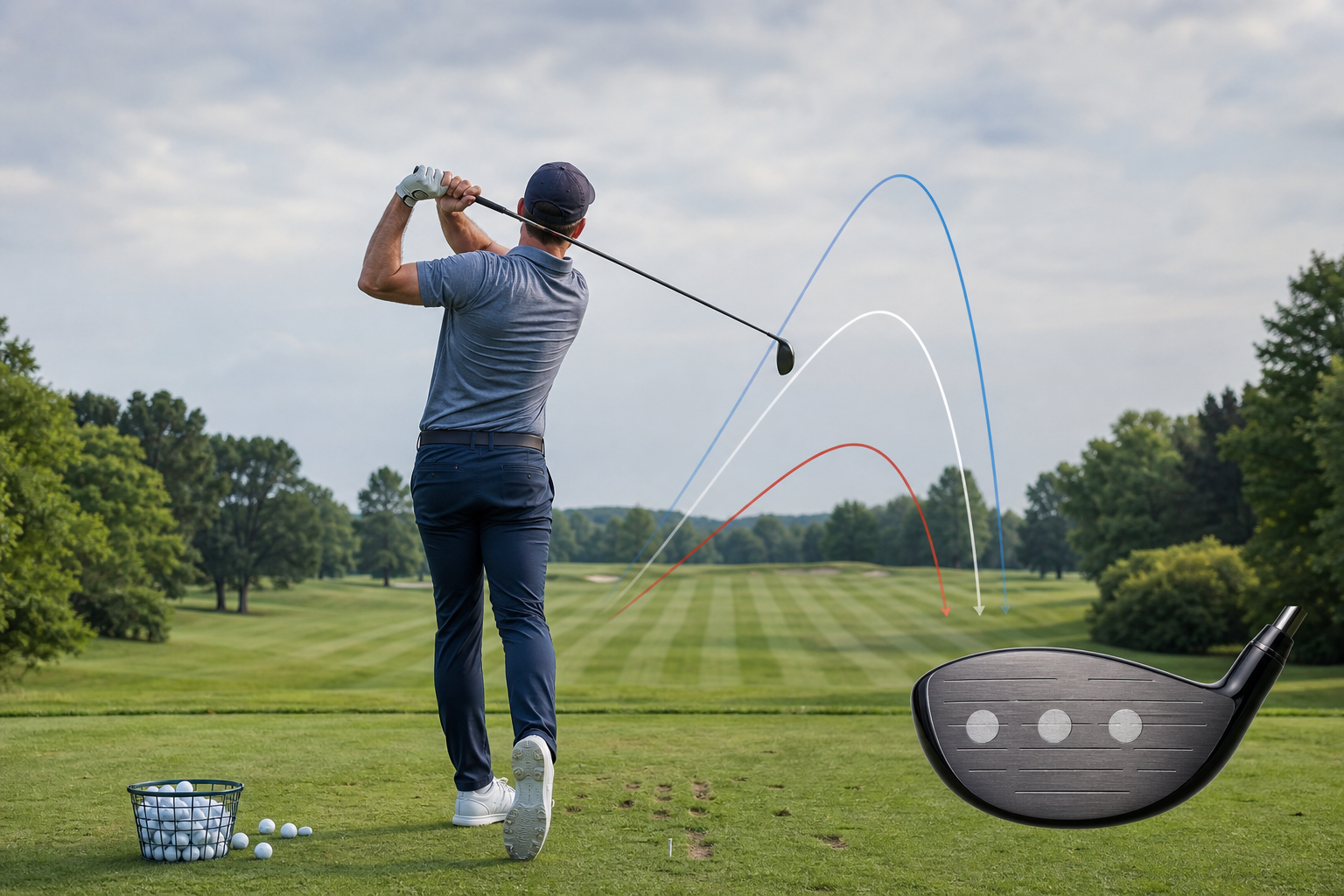
When one drive climbs, another falls out of the sky, and a third misses the fairway, a single loft number cannot explain the problem. Start with the shot you can observe, change only the feature you are evaluating, and use a fitting to confirm the driver that serves your own pattern.
The quick verdict
Choose driver loft as a response to a repeatable launch-and-flight pattern, not as a badge of swing speed or ability. Keep the ball, target, tee height, and swing intention consistent while comparing settings, then confirm the best candidate through an individual fitting.
Best for Golfers whose usual driver shot has a recognizable height, curvature, strike pattern, or carry-versus-roll outcome they can describe over several swings.
Skip it if Skip a loft decision based on one unusually good or poor drive, or if your setup and strike location vary so much that no repeatable ball-flight pattern is visible.
Begin with the tee-shot problem, not the loft number.
The decision usually arrives after a familiar hole: you catch one drive that appears to hang in the wind, then respond by reaching for a lower stated loft; or you see a flatter shot run out and assume more loft must be the answer. Neither conclusion is secure until you know whether those shots came from a repeatable strike and launch pattern. Write the problem in observable terms: “My normal drive launches below the tree line,” “my useful drives rise to a playable height but curve too much,” or “my contact is scattered across the face.” Those statements give you something to compare. “I need 10.5 degrees” does not.
Guild recommendation: Describe the usual shot with four notes: starting direction, height, curvature, and where the ball contacted the face when you can see it.
Separate launch, strike, and curvature before changing a setting.
A driver shot gives several pieces of feedback at once, and they should not be folded into one diagnosis. Launch is the initial window: low, medium, or high relative to your normal view. Strike is the contact pattern: concentrated in one area or spread across the face. Ball flight includes the starting line, the amount of curve, and where the shot finishes. If the strike pattern is widely scattered, a loft comparison may simply reflect different contact rather than a useful setting difference. If strike is reasonably repeatable but the launch window changes from setting to setting, you have a cleaner equipment question to take to a fitting.
Guild recommendation: Do not use a curvature problem alone as proof that a particular loft is required. First establish whether the same general strike and launch window produce that curve repeatedly.
Compare two candidates with everything else held still.
The useful question is not whether a higher- or lower-numbered loft is universally better. It is whether one setting gives you a more repeatable usable shot than another when the other conditions stay constant. Keep one ball model, tee height, target, and intended shot shape. Alternate only after completing a small group at each setting so that a single poor swing does not dominate the choice. On the course, a playable result might mean a flight that clears the trouble you actually face, starts in a manageable corridor, and finishes where you can find it. For another golfer, it may mean removing a flight that is routinely too low or too high for the holes they play.
Guild recommendation: Judge each option by the middle of its shot group, not by its best drive. A setting that produces five usable shots is more informative than one spectacular result surrounded by misses.
Let the fitting answer the individual question.
Club fitting is the point at which an initial range of settings becomes an individual equipment decision. The PGA of America advises that equipment choices should be evaluated for the individual golfer through fitting. Take the notes from your practice comparison: the settings tested, the repeated flight pattern, visible strike locations, and the outcome you prefer. That gives the fitter a clear starting question rather than a request for a universal loft recommendation. If you intend to use the driver in competition, ensure that the club conforms to the applicable equipment rules.
Guild recommendation: Ask for an evaluation of your repeatable pattern, and verify competition conformity when that matters to your play.
What to compare before you shop.
After you know the observable problem, inspect only the features that let you test the answer. If you are comparing loft settings, confirm that the driver offers a clear way to identify and return to each setting. If strike location is the uncertain variable, prioritize a simple method of recording face contact before spending time on a loft decision. If you use a launch monitor, decide in advance which observations you will pair with its readings: the flight you saw, the target you chose, and the strike pattern. The goal is not more equipment data. It is a cleaner comparison.
Guild recommendation: Choose tools that help you hold the test conditions steady and preserve your observations for a fitter.
Try this · Twenty minutes.
The One-Variable Driver Loft Check
Use one driver with adjustable loft if available, one model of ball, a consistent tee height, and a target with enough room to observe starting direction, peak height, curvature, and finishing distance. Mark the face with an appropriate impact-location spray or transfer marker if you use one, and choose two loft settings to compare.
- Hit five shots at the first setting with the same target and normal on-course intention. Record each shot as low, medium, or high; note its starting direction and curve; and mark where the ball contacted the face when visible.
- Hit five shots at the second setting without changing ball, tee height, target, or intended shot shape. Record the same observations.
- Set aside obvious mishits that do not resemble your normal strike. Compare the remaining groups rather than selecting the single longest shot.
- Choose the setting that gives the more repeatable usable window for your course: a flight and direction you would willingly play from a tee box. Bring those notes to a club fitting rather than treating the result as a final prescription.
What progress looks like: You finish with two small groups of observations and can state which setting produced the more repeatable launch window and strike pattern under the same conditions.
Put the guide to work
These searches are a starting point—not a substitute for the fit and comparison criteria above.
Search adjustable-loft drivers after you have identified the two settings you’ll
Compare whether the loft sleeve provides the settings you want to evaluate, then confirm how the club performs for you in a fitting.
Search face-impact marking tools if strike location is unclear.
A temporary face mark can make contact location easier to record during the one-variable check.
Search launch monitors only if you will use the readings consistently.
Use a monitor as a recordkeeping aid for repeated comparisons, not as a substitute for observing strike and ball flight.
If you buy through these links, Guild of Golf may earn a commission at no extra cost to you.
The practical takeaway
- There is no universal driver loft recommendation in an observation-first decision process.
- Name the repeatable performance problem in terms of launch, strike, starting direction, curvature, and finishing result.
- Change one variable at a time and compare groups of shots under the same conditions.
- Treat visible strike variation as a reason to gather better evidence before drawing a loft conclusion.
- Use your notes to support an individual fitting, and verify club conformity for competition use when applicable.
Frequently asked questions
Should I choose driver loft from my swing speed?
This process starts with the ball flight and strike pattern you can repeat, then uses an individual fitting to evaluate equipment for you. A swing-speed label alone does not describe your launch window, contact pattern, or playable result.
How many shots should I hit before comparing loft settings?
Use a small group at each setting and look for the pattern across the group rather than the best individual shot. The practice plan uses five shots per setting as a manageable starting point.
What if my contact moves around the face?
Record the pattern and avoid treating one flight as a definitive loft result. A scattered strike pattern makes it harder to tell whether the setting or the contact produced the outcome you saw.
Can I use an adjustable driver in competition?
Equipment used in competition must conform to the applicable club rules. Confirm the club’s conformity and follow the applicable rules for the competition you are entering.
Sources used for this draft
- PGA of America: Club Fitting — The recommendation to evaluate equipment choices through an individual fitting.
- USGA Equipment Rules — The note that equipment used in competition must conform to applicable club rules.
Guild of Golf may earn a commission from qualifying purchases made through shopping links, at no additional cost to you.