
comparison
Putting Mirror vs. Mat: Match the Aid to the Result You Can See
Choose a putting mirror for an observable setup question or a putting mat for an observable ball-roll question, then practice one measurable task at home.
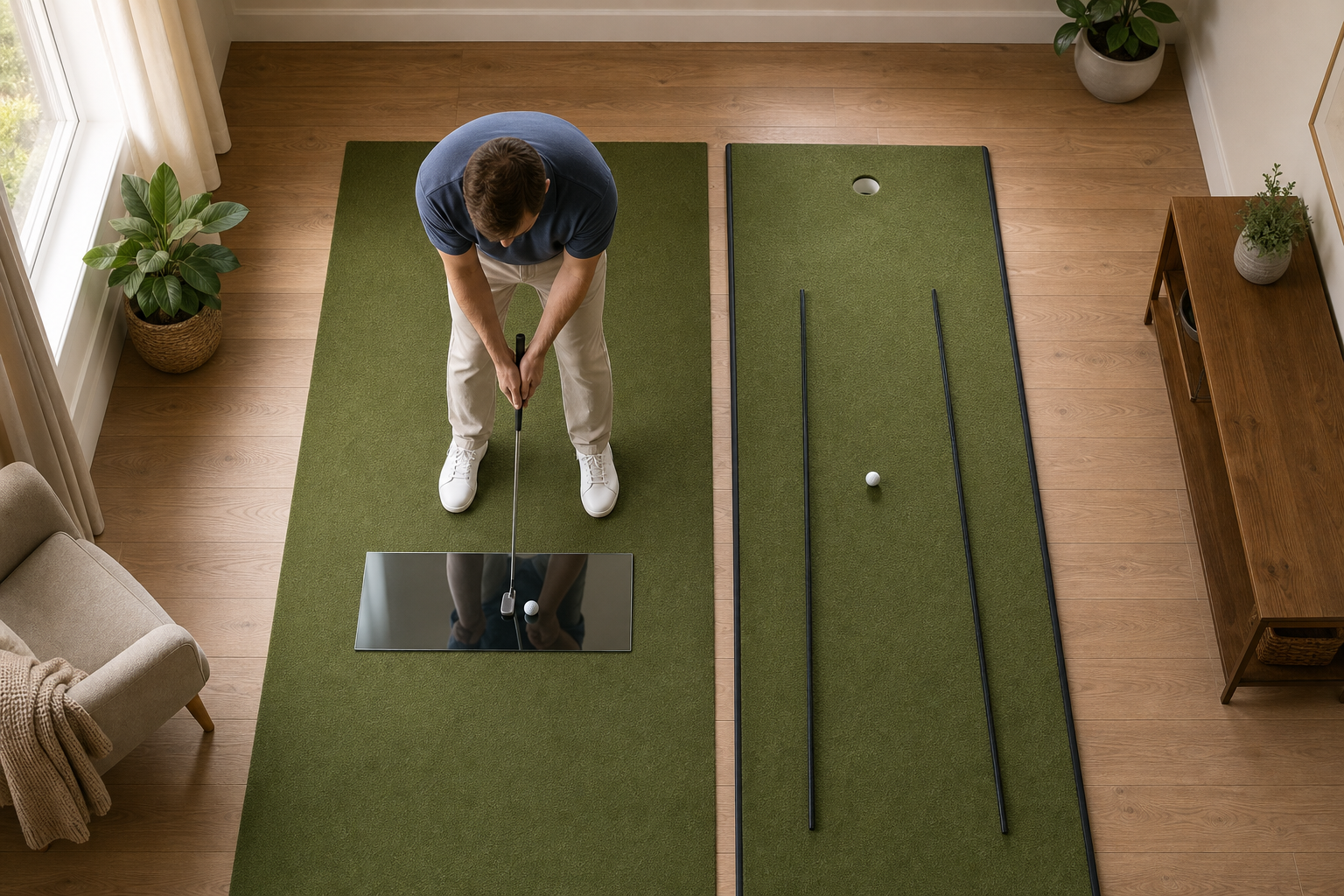
Built for: Golfers choosing one practice aid and deciding whether they need setup feedback or ball-roll feedback.
A home practice aid earns its space only when it answers a visible question. If your uncertainty happens while you are standing over the ball, start with a mirror. If it happens after the ball leaves the face, start with a mat.
The quick verdict
Choose a putting mirror when your visible problem is an inconsistent or uncertain address position. Choose a putting mat when you are comfortable at address but need a repeatable way to observe start line or pace on the same home putt.
Best for A mirror suits golfers who repeatedly adjust their feet, eyes, shoulders, or putter aim before starting the stroke. A mat suits golfers who want to roll a series of putts to one target and record a simple result.
Skip it if Skip a mirror if you already have an address picture you can repeat and will not use a visual checkpoint. Skip a mat if your available space does not allow a useful straight roll or if extra targets will distract from one defined task.
Begin with the moment the problem appears
The familiar home-practice mistake is buying an impressive-looking aid before identifying what is actually going wrong. One golfer may stand over a short putt, shuffle the feet, re-aim the putter, and still feel unsure about the address position. Another may feel settled, make the stroke, and watch repeated putts start outside the intended line or finish with inconsistent pace. Those are different observable problems. A mirror helps with the first question, while a mat gives the second golfer a repeatable ball-roll task. The PGA of America emphasizes that practice is more useful when it has a defined purpose and structure.
Guild recommendation: Before buying, state the problem in one sentence that begins with either “Before I stroke the putt” or “After the ball starts rolling.”
A mirror is for uncertainty before the ball moves
A putting mirror is the better first choice when the unresolved question is your address picture. Consider the golfer who takes several looks at the target, changes shoulder alignment, then changes it again because there is no reliable reference. A reflective surface provides a visual checkpoint that can help make one chosen setup reference easier to revisit. That is useful when the outcome you want is fewer unnecessary resets before a putt. Its tradeoff is straightforward: the mirror does not, by itself, create a series of ball-roll outcomes to compare. If your address already feels repeatable and your real question is where the ball starts, a mirror can become an extra ritual rather than a useful practice tool.
Guild recommendation: Choose a mirror with a reflection area and alignment references you can see comfortably from your normal address, rather than selecting extra features with no role in your practice task.
A mat is for an answer after impact
A putting mat is the better first choice when you need repeated evidence from the ball’s journey. It gives the golfer who wants to roll ten putts to one target a consistent home setting for observing whether the ball begins where intended and reaches a chosen finish. For example, if a golfer is comfortable at address but repeatedly starts a short indoor putt outside a simple target area, a mat makes the result easy to count across several attempts. The tradeoff is that a mat is not a setup reference. It will show a pattern in the rolls, but it will not show whether your chosen address picture was the same before each stroke. Rule 13 provides the rules context for putting greens and lines of play, a useful reminder that a home station should support a specific practice task rather than attempt to represent every on-course situation.
Guild recommendation: Choose a mat that fits a useful straight putt in your real practice space and has a target you can use repeatedly without changing the task.
Compare the feature that supports your measurement
Feature lists can make this decision more complicated than it needs to be. When comparing mirrors, ask whether you can establish one clear visual reference without crowding your normal stance. When comparing mats, ask whether the surface can lie flat, provides enough roll length for your intended practice distance, and offers a target that lets you evaluate the same outcome repeatedly. More markings, slopes, targets, or return features are not automatically more useful. They matter only when they support the problem you identified. A golfer trying to reduce address uncertainty does not need a busier target. A golfer tracking start line does not need more setup references than they will genuinely use.
Guild recommendation: Finish this sentence before purchasing: “I will use this feature to measure whether I can do this one thing more consistently.”
Buy one aid before building a station
A mirror and a mat can work together, but buying both at once can blur the reason for practicing. Start with the aid that answers the earlier question in your routine. If uncertainty appears while you are standing over the ball, begin with a mirror and measure whether you can recreate one address reference. If the uncertainty appears after impact, begin with a mat and count balls that start through a small target area or reach a selected finishing area. Add the other type of aid only when it addresses a separate, visible problem.
Guild recommendation: For your first home putting aid, choose the option that turns your most common visible frustration into a countable result.
Try this · 12 minutes.
Ten Putts, One Question
Use a flat, clear floor or a flat section of a putting mat. Create a target about four feet away with a cup-sized target or two coins set slightly wider than a ball. If using a mirror, place it where you can take a brief look at your normal address before each stroke. Use the same ball and target for all ten putts.
- Choose one question before beginning: “Can I reproduce my address picture?” for mirror work, or “Can I start the ball through the target with controlled pace?” for mat work.
- Hit five putts without changing targets or adding another drill. With a mirror, take one short look at your chosen address reference before each stroke. With a mat, watch whether the ball begins through the target area.
- Hit five more putts with the same target and the same pace intention. Avoid moving the target after a miss.
- Record one outcome only: the number of addresses that matched your chosen visual reference, or the number of balls that started through the target area.
- Use that one number to select the same task or a simpler version for the next session.
What progress looks like: The session is useful when it produces one repeatable number, such as eight of ten addresses matching your visual reference or seven of ten balls starting through the target area.
Put the guide to work
These searches are a starting point—not a substitute for the fit and comparison criteria above.
Compare mirrors after identifying a setup question.
Compare the usable reflective area and whether the reference lines are clear from your normal address position. Buy one only if you have a specific address picture you intend to revisit.
Compare mats after identifying a ball-roll question.
Compare the available roll length, how well the surface fits flat in your room, and whether the target supports repeated start-line or pace practice.
If you buy through these links, Guild of Golf may earn a commission at no extra cost to you.
The practical takeaway
- A putting mirror is best for an observable setup problem that occurs before the stroke.
- A putting mat is best for an observable ball-roll problem that occurs after impact.
- Purposeful home practice uses one target, one task, and one recorded outcome.
- Compare mirrors for readable setup references and mats for flatness, usable roll length, and a repeatable target.
Frequently asked questions
Should a beginner buy a putting mirror or a putting mat first?
Choose a mirror when the beginner repeatedly changes position at address and cannot identify a consistent setup reference. Choose a mat when the beginner needs a simple place to roll repeated putts toward one target and record the result.
Can a putting mat replace putting practice on a green?
No. A mat can support a repeatable home task, but it does not replace practice on a putting green or every on-course line of play.
Do I need a putting mirror with many markings?
No. Additional markings are useful only when they help you reproduce one chosen address reference. A simpler mirror is often the better choice if extra markings cause repeated adjustments.
What should I measure during home putting practice?
Measure one result that matches the aid. With a mirror, count addresses that match your chosen reference. With a mat, count balls that begin through a target area or reach a chosen finishing area.
Sources used for this draft
- PGA of America: Practice With Purpose — The recommendation to give each practice session a defined purpose and structure.
- USGA Rule 13: Putting Greens — Rules context for putting greens and lines of play.
Guild of Golf may earn a commission from qualifying purchases made through its shopping links, at no extra cost to you.