
evergreen guide
Choose Driver Loft by the Shot You See, Not a Universal Number
A practical driver-loft decision process that begins with the ball flight and strike pattern you can observe, then narrows the fitting conversation to the feature most likely to matter.
Built for: Golfers comparing driver lofts who want a repeatable decision process instead of a universal loft recommendation.
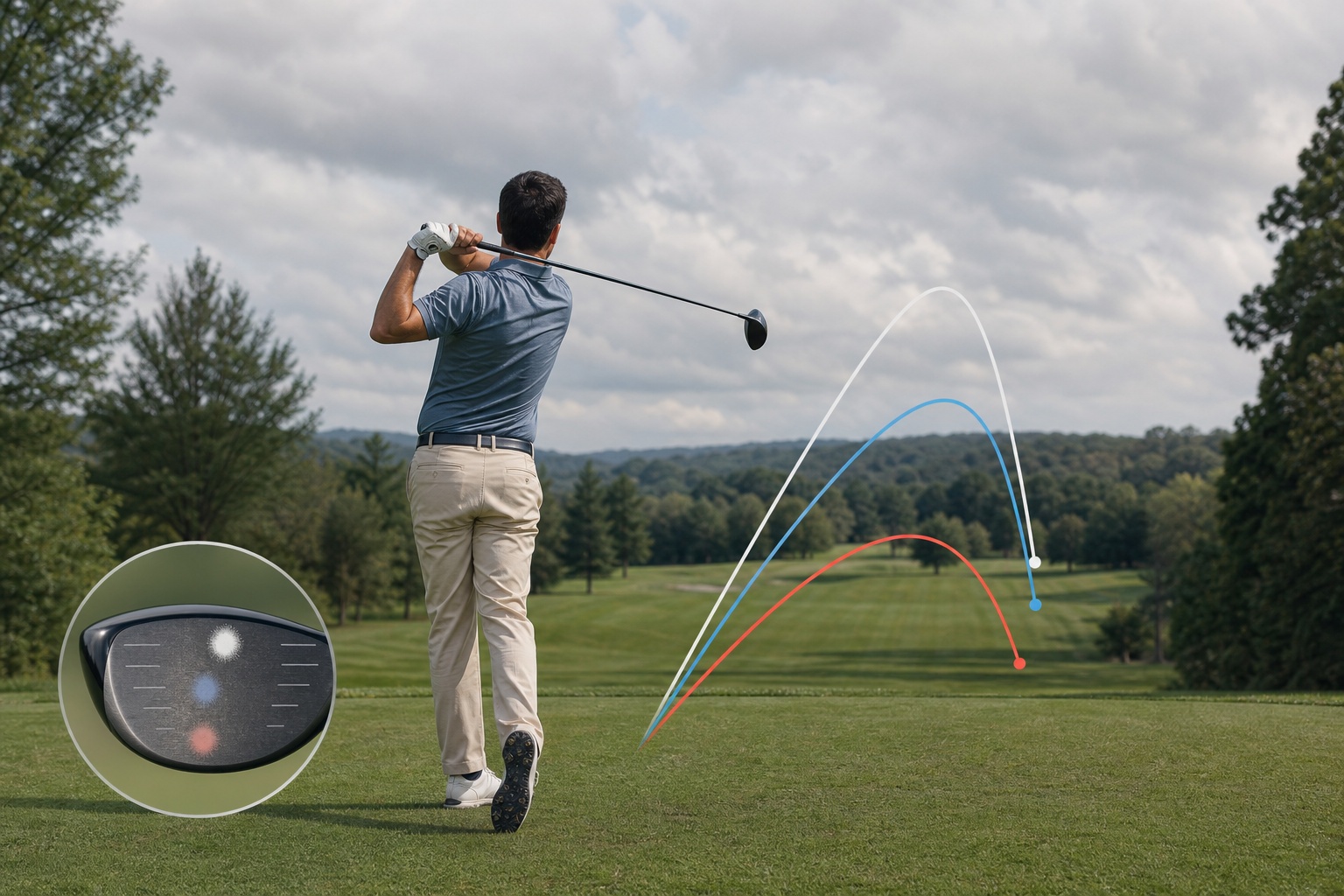
When one tee shot climbs, another falls flat, and both finish short of expectation, the answer is not automatically more or less loft. Start with the observable problem—launch, face contact, and usable ball flight—then use a fitting to test a focused change rather than chasing a number on the sole.
The quick verdict
Choose driver loft as a response to a repeatable, observable ball-flight problem, then verify the choice in an individual fitting rather than adopting another golfer’s preferred loft.
Best for Golfers who can describe their usual tee-shot height, strike location, starting line, and curve over several swings.
Skip it if Skip a loft change as the first move when your contact and ball flight vary wildly from shot to shot; first collect a clearer pattern, then take that pattern to a fitter.
The first question is not “What loft should I buy?”
Picture the golfer who sees a high drive that appears to hang in the air but does not produce the result expected, then responds by shopping for less loft. Or the golfer whose drives come out low and weak, who orders more loft after one poor range session. Both may be reacting to a real problem, but neither has identified it precisely enough to make a productive equipment decision.
Begin with three observations from several normal swings: the height at which the ball launches, the area of the face where contact tends to occur, and the shot’s start direction and curve. Those observations separate a repeatable performance pattern from a one-off miss. Loft can be a fitting variable, but it is not a universal correction for every flight problem.
Guild recommendation: Write down the pattern you see over at least nine shots before comparing lofts or head settings.
Treat launch, strike, and shape as separate clues
Launch is the visible height and initial rise of the ball. It is a useful clue, but a low flight alone does not tell you why it happened. A drive can launch low after low-face contact; another can launch low despite centered contact. Those are different observations and deserve different questions in a fitting.
Strike is the evidence closest to the clubface. A golfer who repeatedly finds contact in one area has a more actionable fitting conversation than a golfer who only says the driver feels inconsistent. Use face marks when available, or simply record what you can reliably tell from feel and flight. Do not turn one centered strike into proof that the club is perfectly matched.
Ball flight adds the on-course consequence. Record whether the ball starts left, at the target, or right, and whether it curves left, stays relatively straight, or curves right. A tee shot that starts right and continues farther right presents a different playing problem from one that starts right and curves back to the fairway. Loft should not be chosen as a substitute for identifying that distinction.
Guild recommendation: Describe the issue in one sentence: “My typical drive launches low, contacts low on the face, and starts near target,” for example. That is a useful fitting brief.
Choose the feature that matches the problem you can observe
If your repeated pattern is a flight you judge too low, the fitting question is whether a different loft setting produces a more useful launch while preserving a repeatable strike and a playable shape. The outcome to watch is not simply a higher-looking shot; it is a flight you can repeat and use on the holes you play.
If the flight is already usable but your contact wanders from high to low or heel to toe, resist assuming loft is the primary answer. Your first task is to establish whether the strike pattern is stable enough to compare settings fairly. A loft change evaluated through scattered contact can create more noise than clarity.
If the visible problem is primarily starting line and curve, name that before assigning responsibility to loft. Test any loft setting by watching whether your starting line, curve, and contact remain manageable across multiple balls. A setting that produces one ideal tracer but worsens the typical miss is not automatically the better course choice.
This approach deliberately narrows the decision. You are not searching for the “best driver loft.” You are testing the single feature most connected to the pattern you can actually describe.
Guild recommendation: Change one fitting variable at a time and compare several ordinary shots, not only your best swing.
Use on-course demands to define “better”
A broad, soft fairway may allow you to prioritize a repeatable launch window. A narrow hole bordered by trouble may make your typical starting line and curve the more important outcome. On a hole where a low flight runs into a slope or under a wind, your preferred result may differ again. The correct loft decision is therefore tied to the shot you need to play, not just the height that looks most impressive on a range.
Bring a recent course example to the fitting: “On the fourth hole, my normal drive starts at the right edge and stays there,” or “On the tenth, my usual flight comes out too low to carry the trouble I face.” These are concrete constraints. They let the fitter evaluate loft alongside the rest of the club setup for you as an individual golfer.
Guild recommendation: Define success before testing: a repeatable starting line, a usable trajectory for your regular course, and contact you can reproduce.
Why a fitting is the final check
PGA of America guidance recommends evaluating equipment choices through fitting for the individual golfer. That matters because the same printed loft can be a different answer for golfers who present different strike patterns and produce different ball flights. Your notes focus the session; they do not replace it.
Ask the fitter to compare your current club against a limited set of loft options while keeping your decision criteria visible. Watch for the pattern that improves the problem you brought in without creating a new one you cannot accept. If you play competitive golf, also make sure any club you use conforms to the applicable equipment rules; the USGA states that equipment used in competition must conform to those rules.
Guild recommendation: Book a fitting when you have a repeatable observation to test, and bring your current driver plus notes from the nine-ball check.
Try this · 20–25 minutes
Nine-Ball Driver Pattern Check
Use a driving range with a clear target line. Bring your current driver, nine balls, and a way to note results. Pick one target that is far enough away to make start direction and curve easy to see. If the range allows it, use the same tee height for every ball.
- Hit three balls with the sole purpose of observing launch height: label each low, medium, or high relative to the other two, without judging whether it was good.
- Hit three more balls and record where each one starts relative to the target: left, at the target, or right. Also note its curve: left, straight, or right.
- Hit the final three balls with attention on contact feedback. Note the strike as centered, high on the face, low on the face, toward the heel, or toward the toe, using impact marks if you have a safe way to see them.
- Review the nine shots for the most repeated pairing, such as low launch with low-face contact or a playable medium launch with mostly centered contact. Take that concise pattern, rather than one exceptional shot, into a fitting discussion.
What progress looks like: You finish with a written description of your most common launch, strike area, and starting-line/curve pattern, plus a clear statement of the one feature you want to investigate first.
Put the guide to work
These searches are a starting point—not a substitute for the fit and comparison criteria above.
Adjustable-loft driver
Compare the available loft settings and confirm that the adjustment range gives a fitter a practical way to test a focused loft change against your current flight.
Driver impact tape
Compare sheets that fit a driver face and leave readable strike marks, because a repeatable strike pattern is more useful than guessing where contact occurs.
Golf launch monitor
Compare which ball-flight measurements are displayed and how easily results can be reviewed, so the device supports a consistent comparison rather than adding unexplained numbers.
If you buy through these links, Guild of Golf may earn a commission at no extra cost to you.
The practical takeaway
- There is no universal driver loft recommendation because equipment choices should be evaluated for the individual golfer through fitting.
- A useful starting point is the repeated pattern of launch height, strike location, and starting line with curve.
- Do not use loft as a catch-all answer when the more visible issue is inconsistent contact or an undefined directional miss.
- Judge a change by a repeatable, playable result on the course, not by a single standout drive.
- For competition, use equipment that conforms to the applicable club rules.
Frequently asked questions
Should I choose more loft because my drives fly low?
Not from that observation alone. First note whether low flight occurs with centered contact or with a repeated low-face strike, and note the ball’s starting line and curve. Then use a fitting to test whether a loft change improves the flight without harming your typical result.
Can strike location matter when I am comparing driver lofts?
Yes, because strike location is part of the evidence you should collect. If contact moves around the face from swing to swing, it is harder to tell whether a different loft setting produced a meaningful change or whether you simply struck the ball differently.
What should I tell a club fitter?
Give a concise description of your common pattern and your on-course constraint. For example: “My usual tee shot launches low, tends to strike low on the face, and I need a more playable flight on a carry-heavy opening hole.”
Is the highest launch automatically the best driver setup?
No. A better result is one that you can repeat with a strike pattern and shot shape you can use on the course. Compare several ordinary shots rather than choosing from one especially high or long-looking ball.
Do driver settings affect whether a club is legal for competition?
Equipment used in competition must conform to the applicable club rules. If competition is part of your plan, verify that the club and its configuration meet those requirements.
Sources used for this draft
- PGA of America: Club Fitting — The recommendation to evaluate equipment choices through individual fitting.
- USGA Equipment Rules — The note that equipment used in competition must conform to applicable club rules.
Guild of Golf may earn a commission from qualifying purchases made through shopping links, at no additional cost to the buyer.