
comparison
Alignment Sticks vs. Tempo Trainers: Buy for the Miss You Can Observe
A practical decision guide for choosing an alignment stick or swing tempo trainer by starting with an observable practice problem, then selecting the simplest feedback that fits it.
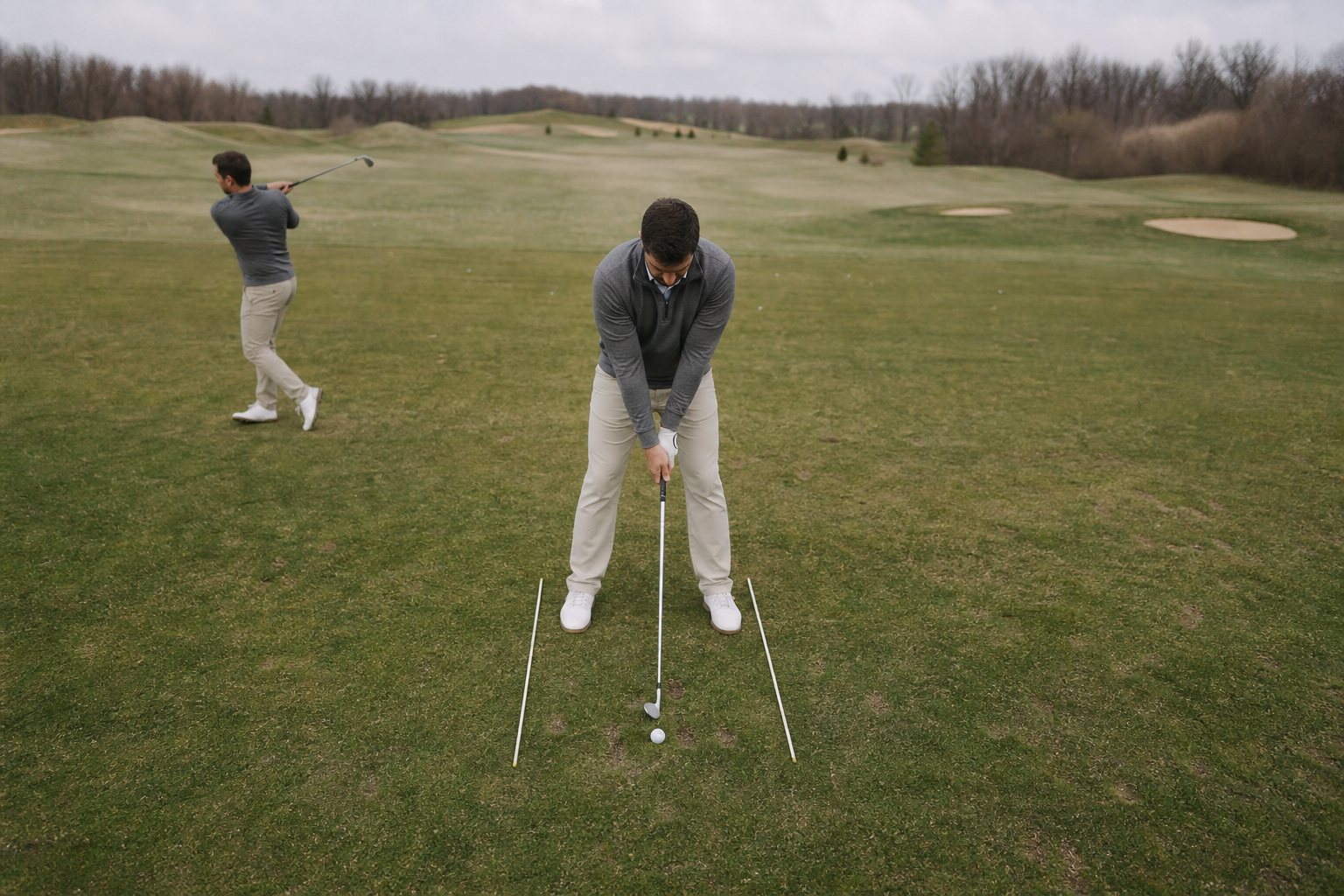
Built for: Golfers choosing between inexpensive practice aids for alignment, movement, rhythm, or speed awareness.
When a practice session feels busy but the same tee shot keeps starting left, or contact changes as soon as the swing gets quicker, another gadget is not the answer. Choose the aid that makes one visible problem easier to notice and repeat.
The quick verdict
Choose alignment sticks when you need a fixed visual reference for setup, target line, ball position, or the space around your movement. Choose a tempo trainer when your useful observation is about rhythm or how your motion changes as you swing at different speeds.
Best for Alignment sticks are best for golfers who can point to a setup or directional reference they want to rehearse. A tempo trainer is best for golfers whose performance changes when their motion feels rushed, uneven, or difficult to repeat from swing to swing.
Skip it if Skip both for now if you cannot name the observation you want to improve; purposeful practice begins with a specific goal, not a purchase.
Begin with the miss you can describe
A golfer who says, “I need to fix my swing,” has not yet created a useful buying decision. A golfer who says, “My shots often begin away from the target when I feel aimed correctly,” has. The first statement invites a collection of aids; the second identifies an observable practice problem. Purposeful practice connects an activity to a specific goal, so make the goal small enough to watch on every repetition. That might be whether your feet and clubface look consistently related to the target, whether the ball sits in a repeatable place, or whether your rehearsal and shot feel similarly paced.
Guild recommendation: Write one observation you can check after every swing before deciding which category of aid belongs in your bag.
Choose alignment sticks for spatial feedback
Alignment sticks make the most sense when the question is where something is: where you aim, where the ball sits, where your feet are set, or whether you are preserving a chosen corridor around the ball. Their strength is not a promise to solve a swing; it is the fixed reference they can provide while you rehearse a repeatable setup. Consider the player who stripes several range balls, then notices the next few begin in unexpected directions. If that player cannot confidently tell whether the target line and setup were consistent, a pair of simple ground references provides more useful feedback than a rhythm cue.
Guild recommendation: Choose sticks if a line, position, or space is the feature you need to make visible, and use them with one stated target rather than a crowded drill.
Choose a tempo trainer for timing feedback
A tempo trainer is the more sensible choice when your key observation is not a line on the ground but the character of the motion: whether the swing becomes hurried, whether the rehearsal and the strike feel disconnected, or whether adding effort changes your sense of rhythm. Picture the golfer who makes calm practice swings but immediately lunges at the ball when trying to hit a fuller shot. That golfer may learn more from a repeatable rhythm cue than from another target-line reference. The constraint is important: a tempo-focused aid can make pace easier to notice, but it cannot tell you where you are aimed.
Guild recommendation: Choose a tempo trainer if your practice goal is to recognize and repeat a comfortable rhythm, especially when the issue appears as effort or speed increases.
Do not buy feedback you already have
The cheapest, most useful aid is often the one that reveals something your current practice cannot. If you already use a club on the ground to establish a reliable visual reference, dedicated alignment sticks may duplicate feedback you can create yourself. If you can make a consistent rehearsal and clearly recognize when you rush, a dedicated tempo aid may also be redundant. Conversely, buy the tool that removes friction from a practice routine you will actually perform. A compact, easy-to-set-up reference is valuable when it gets you from vague range-ball hitting to a clear observation before the bucket ends.
Guild recommendation: Before shopping, run the practice plan with ordinary ground references and a repeated rehearsal; buy only the category that supplies feedback you cannot reliably create now.
Keep practice aids off the scorecard decision
A practice aid belongs in practice only when its feedback helps you pursue a defined goal. During a stipulated round, equipment and its use are governed by the applicable Rules, so do not assume that an aid used freely in practice can be used in competition. Keep the purchase decision separate from the on-course decision: first establish whether the feedback helps your practice, then check the applicable Rules before using any equipment during a stipulated round.
Guild recommendation: Use either category to structure practice, and consult the applicable Rules before bringing a training aid into a stipulated round.
Try this · 20 minutes.
One-Variable Feedback Session
Choose a safe practice area and one short club. Place two plain ground-reference rods parallel to the intended target line, far enough from the ball and your feet that they do not interfere with the club. Pick a target and use the same ball position for each shot.
- Write one observable goal before hitting a ball, such as starting each shot on the intended line or maintaining the same unhurried rehearsal-to-swing rhythm.
- Hit five easy shots with the rods in place. After each shot, note only whether your chosen observation matched the goal; do not add a second swing thought.
- Remove the rods and hit five more easy shots while keeping the same single goal. Compare the clarity of your observation, not the quality of any one shot.
- If rhythm is your chosen goal, make one unhurried rehearsal before each of the final five shots and observe whether the motion feels similarly paced. Do not force a prescribed tempo or change your mechanics.
- Finish by recording which feedback was easier to see or feel consistently: the fixed ground reference or the repeated rhythm cue.
What progress looks like: The session succeeds when you can state, in one sentence, which feedback helped you observe your selected goal more consistently across the two groups of shots.
Put the guide to work
These searches are a starting point—not a substitute for the fit and comparison criteria above.
Compare simple alignment sticks
Compare portability, visibility, and whether the design gives you a simple ground reference without adding unnecessary parts.
Compare swing tempo trainers
Compare the type of feedback offered and whether it lets you rehearse rhythm comfortably without distracting from your one practice goal.
If you buy through these links, Guild of Golf may earn a commission at no extra cost to you.
The practical takeaway
- Start with one observable performance problem, not a general desire to improve your swing.
- Alignment sticks suit spatial questions about line, position, and available space around the ball.
- Tempo trainers suit timing questions about rhythm and changes in motion as effort rises.
- A purchase is worthwhile only if it supplies feedback you cannot already create simply and safely.
- Training-aid use during a stipulated round is subject to the applicable Rules.
Frequently asked questions
Should a beginner buy alignment sticks or a tempo trainer first?
Choose the one that addresses the first observation the beginner can state clearly. If setup and target reference are unclear, begin with alignment sticks; if the useful observation is a rushed or inconsistent rhythm, begin with a tempo trainer.
Can one aid replace the other?
Not completely. Ground references answer spatial questions, while a tempo-focused aid addresses the feel and repeatability of rhythm. They overlap only when a golfer has not yet defined the problem being practiced.
Can I use these aids during a competitive round?
Equipment and its use during a stipulated round are governed by the applicable Rules. Check those Rules before using a training aid in that setting.
Sources used for this draft
- PGA of America: Practice With Purpose — The principle that purposeful practice connects an activity to a specific goal.
- USGA Equipment Rules — The note that equipment and its use during a stipulated round are governed by applicable rules.
Guild of Golf may earn a commission from qualifying purchases made through shopping links, at no additional cost to you.