
comparison
Putting Mirror vs. Mat: Match the Aid to the Result You Can Measure
A putting mirror and a putting mat answer different home-practice questions. Choose the one that gives feedback on the observable problem slowing your putting improvement, rather than buying features you cannot use in a short session.
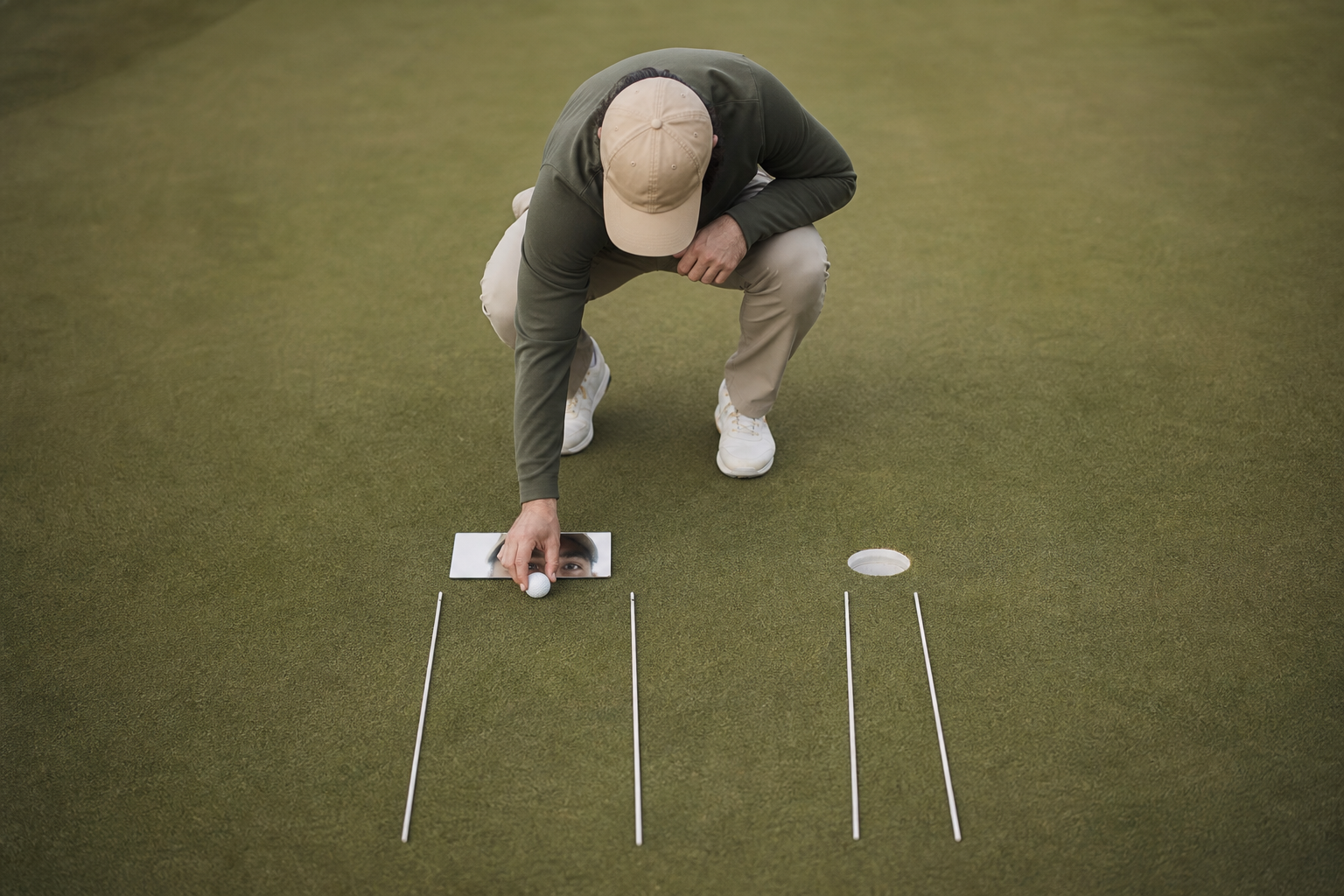
Built for: Golfers choosing one practice aid and deciding whether they need setup feedback or ball-roll feedback.
When a six-foot putt starts somewhere other than intended, a mirror can make your address routine visible. When your setup feels repeatable but you need a repeatable target and a record of makes, a mat can make the roll visible. Start with the result you can observe.
The quick verdict
Buy a putting mirror when you cannot confidently repeat your ball position, eye position, or putter aim at address. Buy a putting mat when you need a defined start point, target, and repeated ball-roll outcome. Neither aid identifies a swing fault; each simply makes one part of practice easier to observe.
Best for A mirror is best for golfers whose pre-putt picture changes from ball to ball. A mat is best for golfers who need a convenient place to rehearse distance, start line, and a simple make-or-miss routine.
Skip it if Skip the mirror if you will not pause to look at setup before each stroke. Skip the mat if you have no room to make a full, unhurried stroke or if a target-based routine will turn into mindless ball-raking.
Begin with the putt you can describe
The familiar home-practice trap is buying a tool for a vague goal such as “better putting.” Make the decision from a recent, observable result instead. Perhaps you stand over a short putt and the ball seems too far forward one time and too far back the next. Perhaps your address feels settled, yet you have nowhere at home to roll 10 putts toward the same target. Those are different problems, and they call for different feedback. Purposeful practice needs a defined purpose and structure, not merely more repetitions, as the PGA of America emphasizes in its guidance on practicing with purpose.
Guild recommendation: Write down one observable sentence before shopping: “My setup picture varies,” or “I need a repeatable roll-to-target task.” Choose the aid that answers that sentence.
Choose a mirror when the question is set before the stroke
A putting mirror is an address-reference tool. It is the stronger first purchase when your uncertainty arrives before the putter moves: where the ball sits, where your eyes appear relative to it, or whether the putter looks aimed as you intend. Imagine a golfer who makes a few putts on the living-room rug but changes posture and ball position every time the ball is replaced. A mirror gives that golfer a consistent visual checkpoint before the stroke. The tradeoff is that reflection does not show whether a ball reached a target with the pace you intended. It can make the starting picture clearer, but it does not turn a putt into a scored roll.
Guild recommendation: Favor a mirror if you will use it for a brief address check, then look away from the reflection and make a normal stroke. Skip elaborate guide features if a simple, repeatable visual reference is all you need.
Choose a mat when the question is answered by the ball
A putting mat is a ball-roll and target tool. It is the stronger first purchase when you can form a dependable address position but lack a reliable lane for repeated putts. Consider the golfer who has only 10 quiet minutes after work: placing balls at the same start point and rolling them toward the same target produces an immediate outcome to record. Did the ball begin on the intended lane, and did it finish at the target? The tradeoff is equally important. A mat can show a repeated outcome, but it cannot by itself explain why that outcome happened. If the golfer is changing setup from stroke to stroke, counting makes may hide the question that needs attention first.
Guild recommendation: Favor a mat if your practice needs a defined lane and target more than another setup reference. Skip mats with extra visual clutter if it distracts you from one simple start-point-and-target task.
Do not ask one aid to answer both questions
The useful distinction is timing. A mirror supplies feedback before the ball is struck; a mat supplies feedback after the ball has rolled. That timing keeps practice honest. If five putts begin left of a target, do not assume the result names a mechanical cause. First decide whether the next session needs a more repeatable address check or another set of rolls to a clear target. On the course, putting is played under the rules and conditions that govern putting greens and lines of play; home practice is best used to simplify one controllable question at a time, not to recreate every on-course condition. See USGA Rule 13 for the rules context on putting greens.
Guild recommendation: If you eventually own both, use the mirror for a short setup check first and the mat for the remaining rolls. If you are buying only one, buy the feedback you currently lack.
Try this · 12 minutes.
The 12-Ball Outcome Check
Create a straight practice lane in a clear indoor space with a start point and a small target about six feet away. Use 12 balls, a putter, and either the aid you own or a plain target. If using a mirror, place it at the start point; if using a mat, use its start point and target without adding extra drills.
- Roll six balls one at a time with the sole purpose of starting each ball toward the target. Record only whether each ball starts on the intended lane or clearly leaves it early.
- If you have a mirror, use the next three balls to pause at address and check that your chosen ball position and putter aim look the same before you putt. Then hit the three balls without changing your objective.
- Finish with three balls using the same routine but without looking for a technical explanation. Notice whether the setup picture or the ball’s initial direction is easier for you to judge.
- Write one sentence after the session: either “I need a clearer address reference” or “I need a clearer roll-and-target reference.” Use that sentence to guide the purchase.
What progress looks like: The useful signal is not a perfect score; it is being able to state, after 12 balls, whether your uncertainty occurs before the stroke at address or after the stroke in the ball’s initial roll.
Put the guide to work
These searches are a starting point—not a substitute for the fit and comparison criteria above.
Compare putting mirrors
Compare a reflection area that lets you see your eyes, ball position, and putter at address without crowding the space where you stand.
Compare indoor putting mats
Compare a length that fits your available lane, a target you can use repeatedly, and a surface that lies flat enough to keep the start point and target clear.
If you buy through these links, Guild of Golf may earn a commission at no extra cost to you.
The practical takeaway
- A putting mirror is most useful when the inconsistency is visible at address before the stroke.
- A putting mat is most useful when you need repeated ball rolls to a defined target.
- A make or miss is an outcome, not a diagnosis of why the ball rolled that way.
- A short session with one purpose is more valuable than a long session with several competing cues.
Frequently asked questions
Should a beginner buy a putting mirror or a putting mat first?
A beginner should choose the aid that answers the clearest current question. Pick a mirror when address position changes noticeably from putt to putt. Pick a mat when the bigger need is a dependable lane and target for repeated rolls.
Can a putting mat improve alignment?
A mat can give you a target and reveal whether a ball begins toward it. That is useful outcome feedback, but it does not necessarily show what changed in your address or stroke.
Can a putting mirror help with pace?
A mirror can help you repeat an address reference before the stroke. It does not provide a ball-roll target or a direct pace result, so it is not the stronger single tool for pace-focused practice.
What should I compare before buying either aid?
For a mirror, compare whether the reflective area gives you a clean, usable address view in your available space. For a mat, compare whether its length, flatness, start point, and target suit the lane you can actually use. In both cases, choose the simplest version that supports one repeatable routine.
Sources used for this draft
- PGA of America: Practice With Purpose — The value of giving practice a defined purpose and structure.
- USGA Rule 13: Putting Greens — Rules context for putting greens and lines of play.
Guild of Golf may earn a commission from qualifying purchases made through shopping links, at no added cost to the buyer.